Reduce hot-water demand and losses
by Fred Braxton

When we planned the renovation of our cottage we wanted to make it comfortable, healthy and as energy-efficient as we could on our budget. Research tells us that around a third of all energy used in the average New Zealand home goes in heating water. Another third goes in room heating.
In our home the rooms are mainly heated free from the sun so the water-heating fraction of the total energy use is a lot more than a third. Most water-heating systems aren’t well tuned. Improving their efficiency usually brings significant cost savings, a welcome relief in the current economic climate. Often it’s easy and costs little to do.
What we found
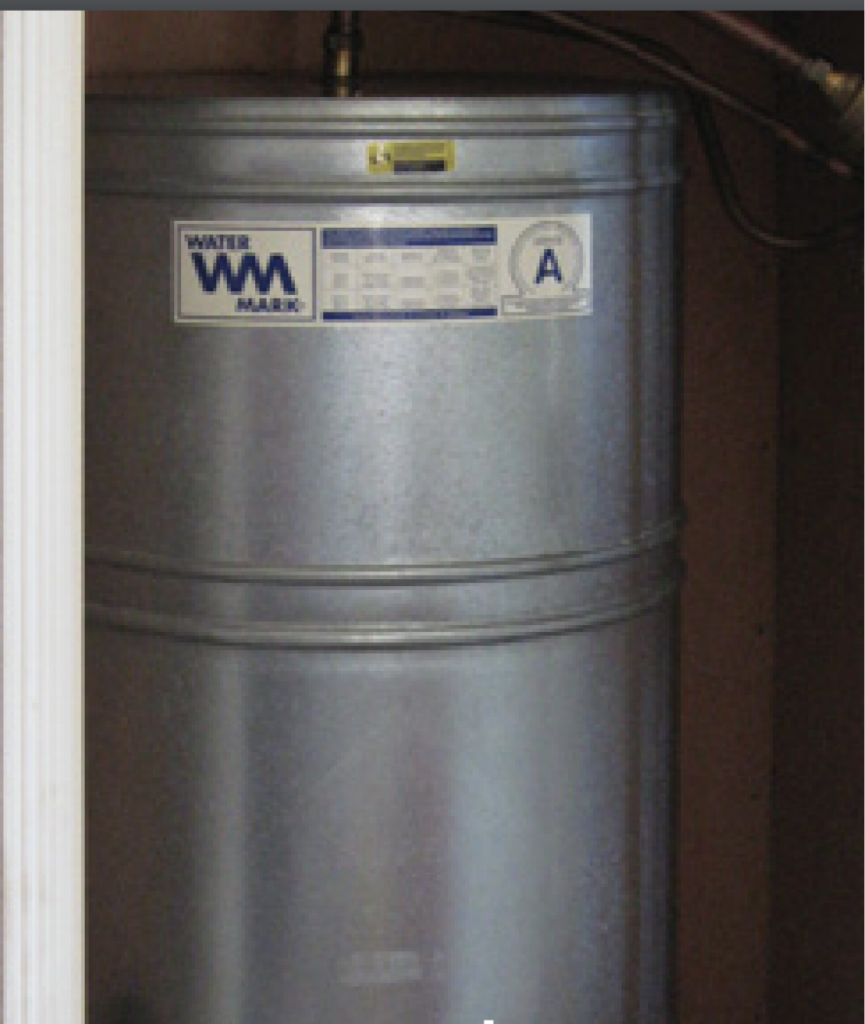
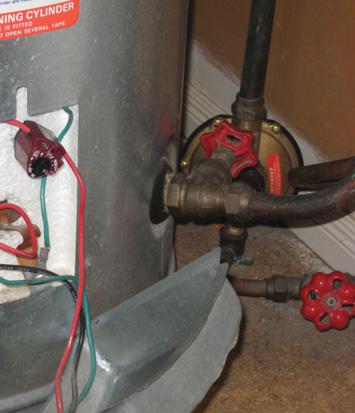
Our electric, low-pressure hot-water cylinder is 25 years old and poorly insulated by today’s standards. It leaked a lot of heat into the airing cupboard. Copper is a great conductor of heat, so the uninsulated copper pipework was happily carrying heat to the outside world.
The thermostat was set high so the whole system was unnecessarily hot. There was no tempering valve to moderate the temperature at the taps. The openair vent pipe was too short, so when the element came on, expansion water ran onto the roof.
The pressure-reducing valve had been adjusted to its lowest setting to reduce this, which meant the shower didn’t work properly.
A good feature: the pipe runs are quite short, and the longest pipe run, to the kitchen sink, is in 10 mm pipe rather than the usual 15 mm. This significantly reduces the plug of “dead” cold water in the pipe and speeds up the delivery of hot water—reducing both energy and water wastage.
Action plan
We decided to keep the system and tune it to be more efficient.
Hot-water cylinders should last for 20 years, low-pressure ones longer. I saw one that still worked after 50 years. This one’s probably good for another five years at least. Copper pipe is very durable. The whole system would cost only a couple of hundred dollars to significantly improve, with instant benefits and quick payback. Technology for heating water is developing fast so when the cylinder dies we can look again at our options in light of new technology and energy prices.
Tune-up
The best efficiency rules are simply
1. Reduce demand; and
2. Reduce losses.
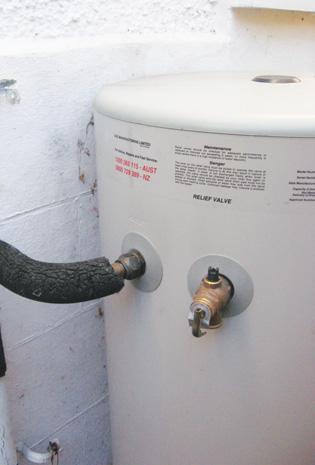
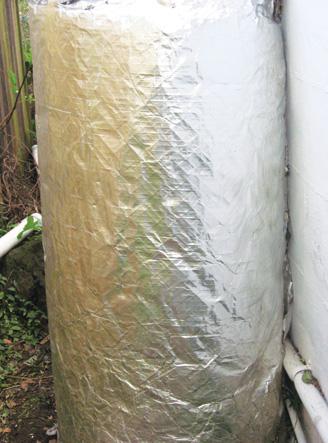
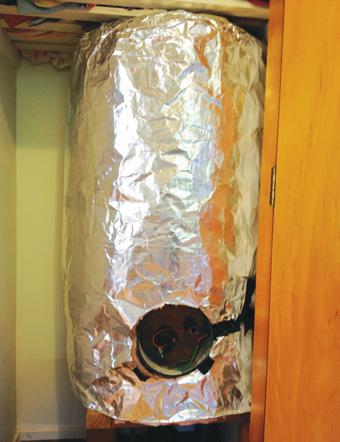
A cylinder insulating wrap cost about $100 and took an hour to install. This reduced the 24/7 heat loss from the cylinder but still left the hot-water cupboard warm enough to keep the linen dry. Insulating all the pipework took a few lengths of pipe insulation ($90) and a couple of hours work. This included insulating the copper vent pipe above the roof, to 300 mm above the waterline. Most of the houses I visit have uninsulated hot-water pipes.
Temperatures
The water at the tap nearest the cylinder was 73 °C—dangerously hot, and wasteful of energy.
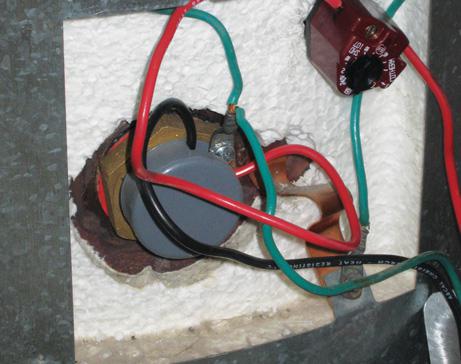
To prevent scalding, water at the tap should be no more than 55 °C (50 °C for young children or the elderly). Obviously the cylinder thermostat was set too high and the thermostat needed adjusting. Some cylinders have a thermostat that’s adjustable without removing a cover, but ours has the more common type that needs the external cover to be removed for access. This poses an electrical hazard because sometimes there are exposed live terminals inside.
Not wanting to risk electrocution, I got the electrician to adjust the thermostat while he was there for another job. Stored hot water needs to be kept at 60 °C (to kill legionella). If you have it higher than this you’re wasting energy, about one percent for every extra degree.
Once the electrician had the cover off I could see the thermostat was pointing at 70 °C. Yet the water at the tap was 75 °C so the true temperature in the cylinder must have been well above 70 ˚C, allowing for some losses in the pipework.
Thermostats, particularly older ones, are often inaccurate and the indicator markings not very clear. I always measure the actual temperature at the tap, using a probe-type thermometer. These cost less than $40 from electrical retailers. You could easily save that much in a few months if your water temperature is too high. They’re useful for home brewing or cooking too. I got the electrician to turn the thermostat down by about 15 °C. Next day I checked the tap temperature: it was 55 °C.
Airing cupboard
Hot water cylinders aren’t designed to dry clothes—a cupboard heater would be more energy-efficient. However even a fully-insulated cylinder and its surrounding pipework does give off some heat and will keep things dry. If you need to put your linen in the cylinder cupboard to keep it dry, your house may have a moisture problem. Address this first.
Efficient
Our cottage hot-water system works efficiently. The shower works well, the taps deliver hot water quickly, and power bills are low. The average monthly energy bill for a three-person family is $135 (about a third of the average for a household of this size) most of which is hot water since electric space heating is minimal. Lighting, fridges, appliances, cookers etc don’t usually account for more than a third of energy use.
Hot-water systems
The cottage system is a simple one: low-pressure, with an open vent pipe through the roof that allows for expansion, over-pressure and over-temperature.
Nowadays mains-pressure systems are most common. These are more complex, with several more valves. They usually deliver higher flows to showers and taps than low-pressure systems. I still prefer low-pressure systems because they’re simpler. There’s less to go wrong. If they’re properly designed and installed they can be more energy-efficient than mains-pressure systems.
Most people who convert from low to mains-pressure systems report higher energy bills. The usual criticism of low-pressure systems is that the shower temperature fluctuates when a tap somewhere else in the house turns on or off. But this simply is a sign of poor design or installation and can often be rectified.
The cottage system doesn’t have this problem. One drawback of all systems that store hot water is loss of heat from the cylinder. This can be minimised by good design and installation and high levels of well-installed insulation. Controllers can be fitted that both minimise the time the water is kept hot and maintain legionella control. Such controllers are made in New Zealand and exported around the world.
A good addition to our system would be a tempering valve. This is a thermostatic valve, now standard in new installs, that mixes enough cold water with the hot from the cylinder to maintain the tap temperature at the desired 50–55 °C regardless of cylinder temperature.
They can be adjusted without the need to adjust the cylinder thermostat—just make sure the cylinder isn’t set too cold or too hot. Some low-pressure systems give insufficient hot-water flow at the shower. Hence plumbers often turn up the temperature in the cylinder to compensate.
This can have the negative effect of making tap temperatures dangerously high. The solution can often be as simple as cleaning the filters in the shower mixer or insulating the pipes. Sometimes a better shower mixer and head might be the answer.

Other heat sources
NZ has an unusually high number of electric storage hot-water systems, a legacy of plentiful cheap hydro power in days gone by.
In the early days before town water supplies, the hot-water cylinder was often relied on as a backup supply of water when the rain tank ran out. Hot-water systems can also be powered by LPG, natural gas, solar, heat pump, wetback, geothermal or a combination of these. Most of the tips above for making them efficient still apply.
New home
If you’re designing a new home or a new hot-water system, remember Rules 1 and 2: minimise the demand and the losses.
Investing in efficient showers, taps, washing machines and dishwashers will always have the best payoff. When buying, look for the WELS blue-star water rating (as well as the red energy stars on appliances) and go for the highest number of stars.
The type of system you choose for a new home depends on your preferences, budget, cheapest source of energy, family size, house layout, climate zone etc. Reduce demand, minimise losses, choose the right source of heat for you, and encourage shorter showers because in most households this is where at least half the hot water goes.
Manifold
Large homes might need more than one system because of the inevitable heat losses in long pipe runs, even well-insulated ones.
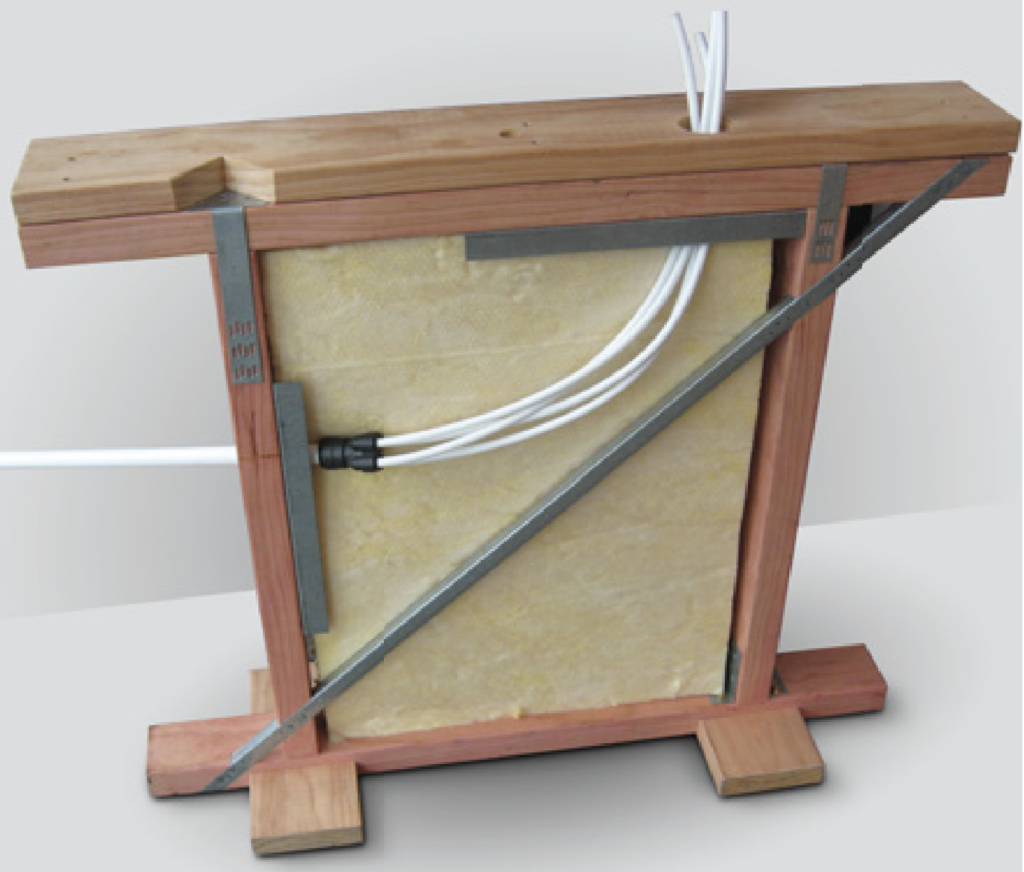
One excellent method is small-bore plastic piping. It can be installed like cable and connects via push-fittings, so is fast. Fittings are minimised and flows maximised by having a separate line to each use point from a central manifold near the supply. The plug of dead water is smaller because of the small diameter and the pipe has a moderate insulation value.