
Creative duet

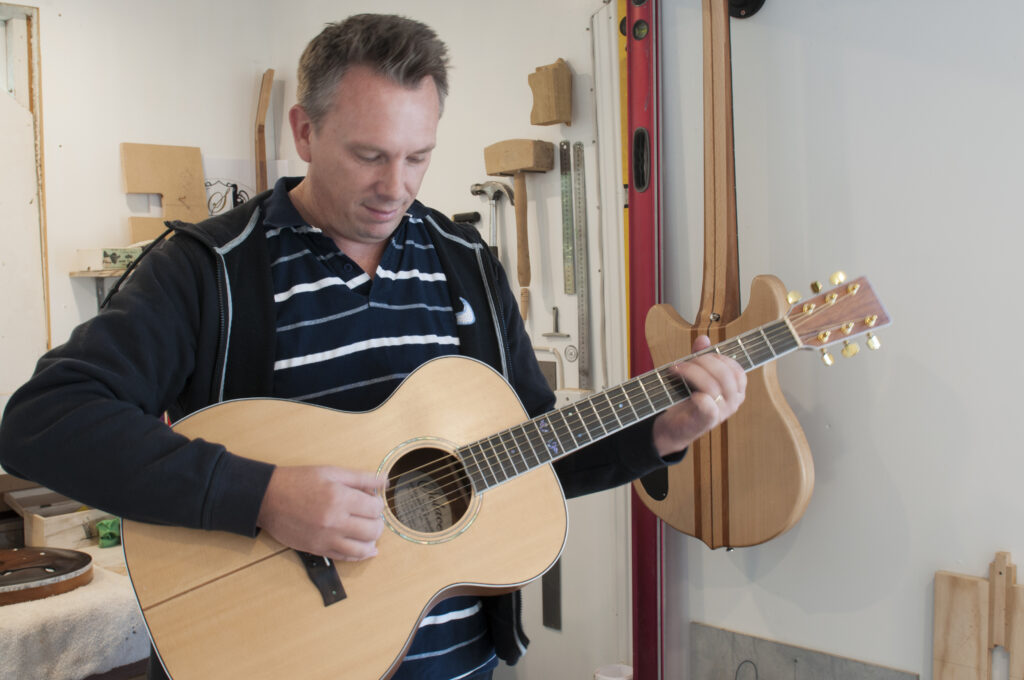
For Dave Pauling, making guitars is the natural fusion of two passions – music and wood. Dave, who has been playing the guitar since he was 13, also knew the pleasure of pottering in sheds from a young age. His father is a “sheddie” from way back who, among other things, still spends many hours restoring vintage vehicles. “I grew up helping him with his Model Ts, making bows and arrows, or working on a model railway we had in the loft,” he says. While Dave himself has spent a fair few hours restoring a 1965 Mustang imported from San Francisco, he prefers working with wood. There’s something about the malleability and smell of wood, as well as its provenance, he says. Wood, especially the recycled timber he uses to construct his guitars, has had a previous life. “Every guitar I make comes with a pre-history.”

A sheddie’s love of music and wood fuse in the creation of bespoke guitars from recycled timber
By Sue Allison
Photographs: Juliet Nicholls

For Dave Pauling, making guitars is the natural fusion of two passions – music and wood.
Dave, who has been playing the guitar since he was 13, also knew the pleasure of pottering in sheds from a young age. His father is a “sheddie” from way back who, among other things, still spends many hours restoring vintage vehicles. 
“I grew up helping him with his Model Ts, making bows and arrows, or working on a model railway we had in the loft,” he says.
While Dave himself has spent a fair few hours restoring a 1965 Mustang imported from San Francisco, he prefers working with wood. There’s something about the malleability and smell of wood, as well as its provenance, he says. Wood, especially the recycled timber he uses to construct his guitars, has had a previous life. “Every guitar I make comes with a pre-history.”

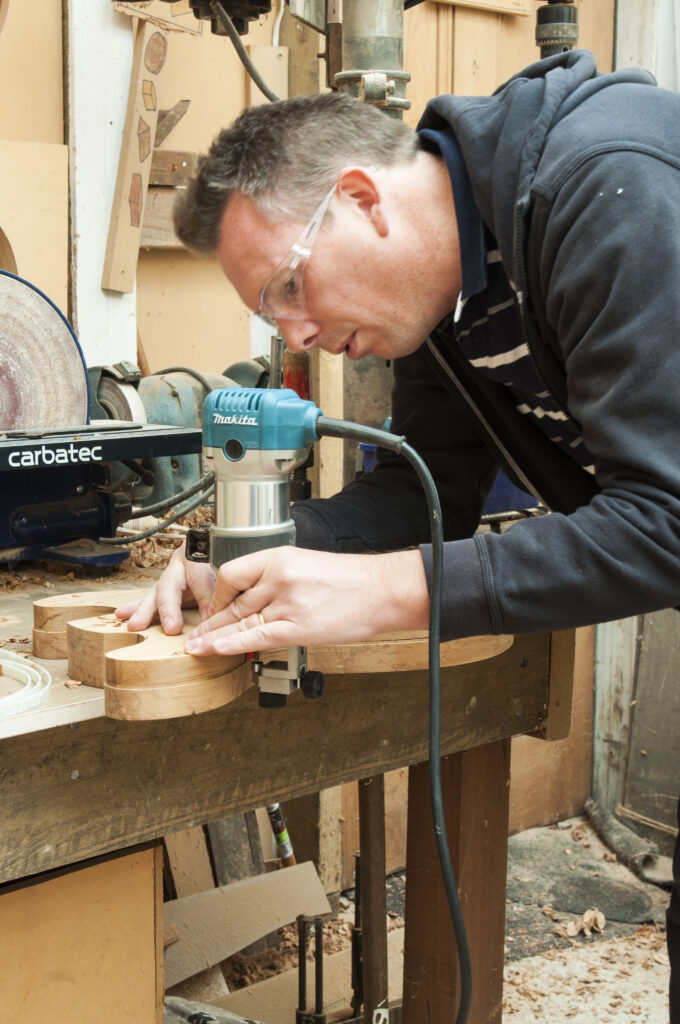
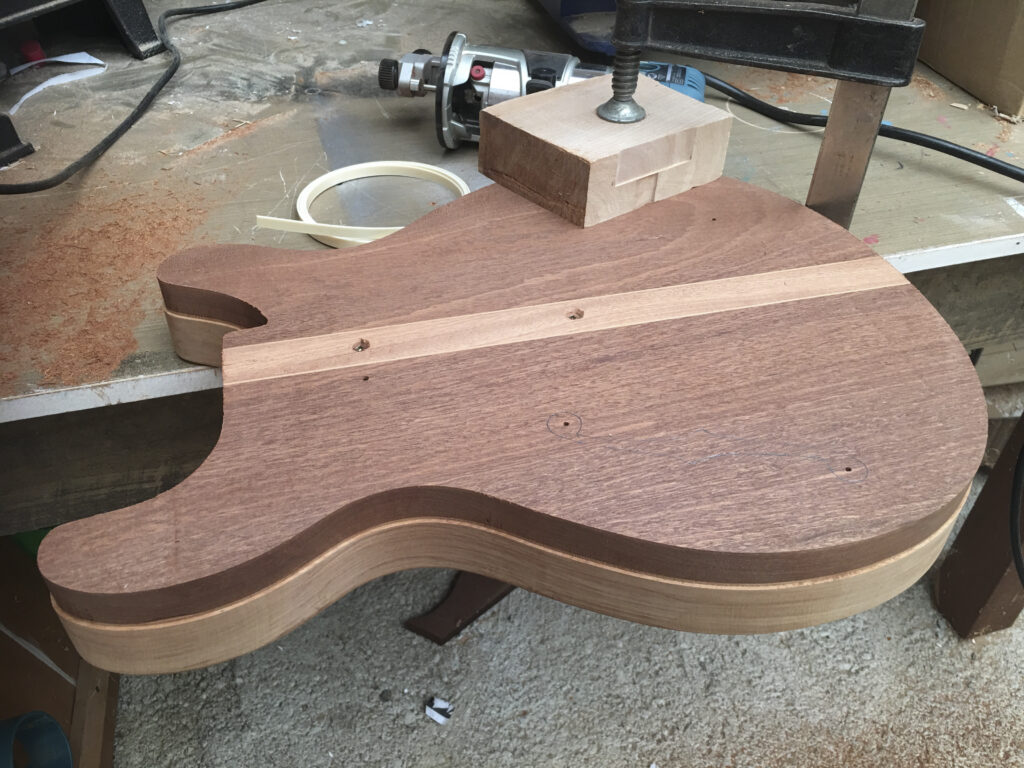
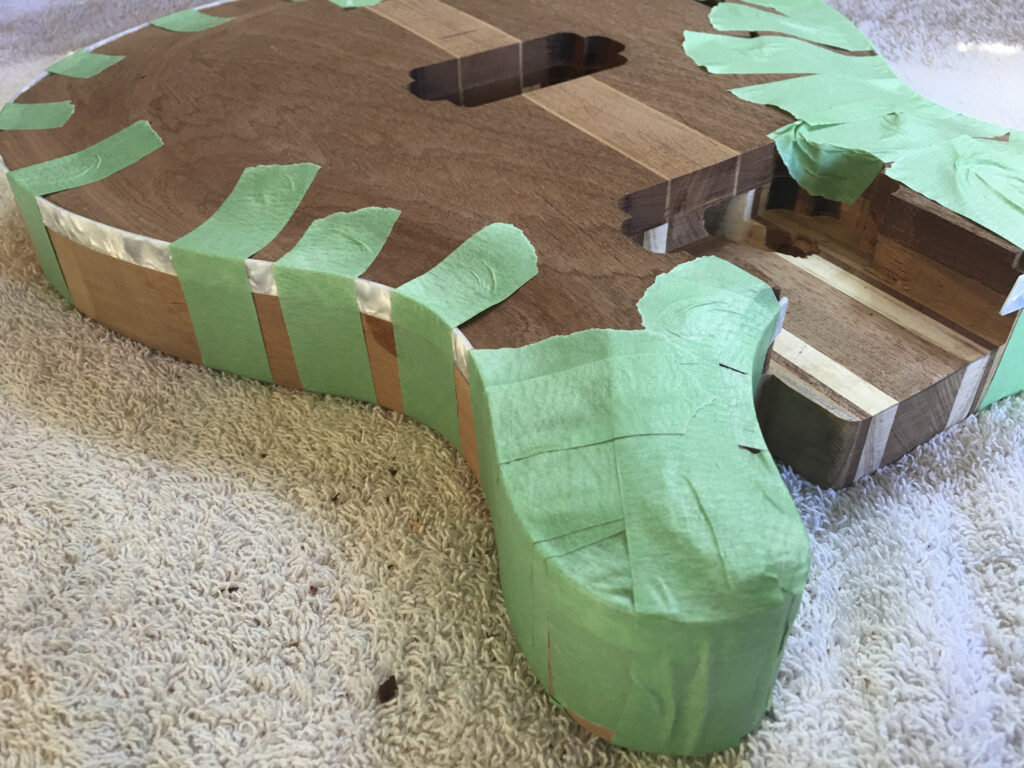
Routing the channel for the binding with a finishing router and a wheel attachment

Inspiration from a catalogue
Dave built his first guitar in a woodwork class as a 15-year-old schoolboy, but it wasn’t until another 15 years passed that the Blenheim-based school principal started making musical instruments in earnest. “My inspiration came from a Stewart MacDonald parts catalogue that was in a pile of guitar magazines a friend gave me in 2009,” he says. “It looked doable so I thought I’d give it a go.” 
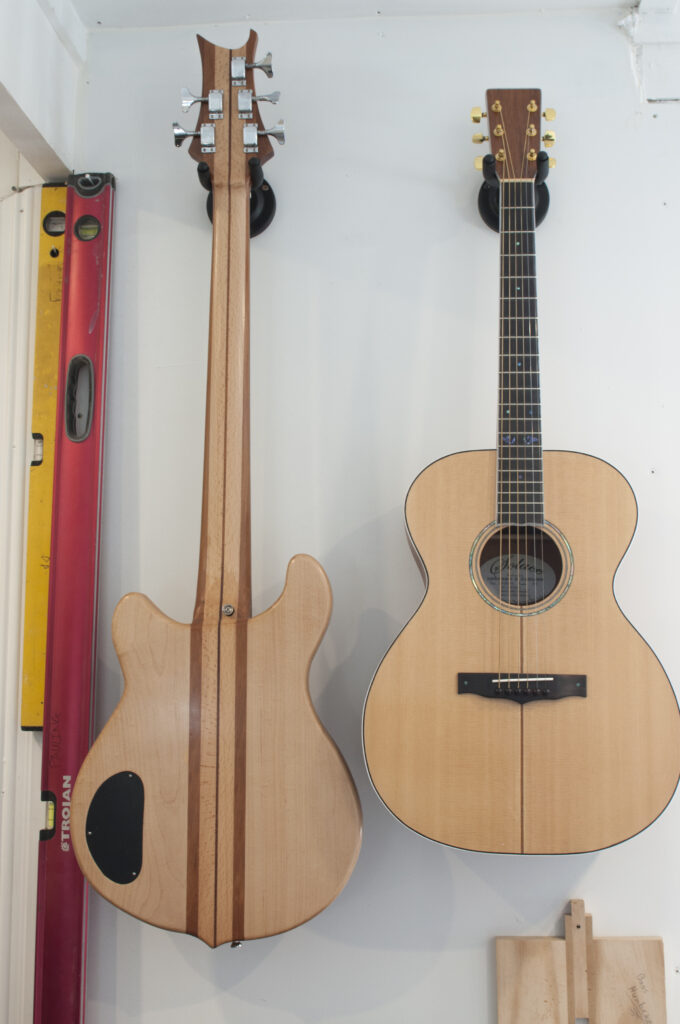
He started with acoustic guitars and flat-top, telecaster-style instruments before moving into carved-top electric guitars, and now he makes semi-hollow, carved-top guitars and basses. 
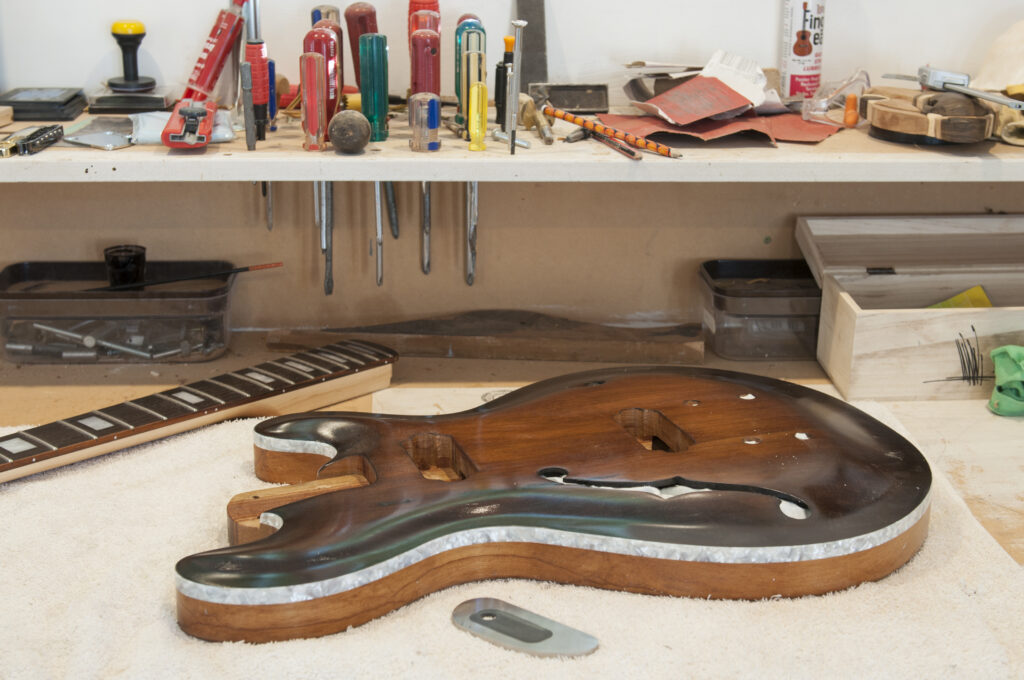
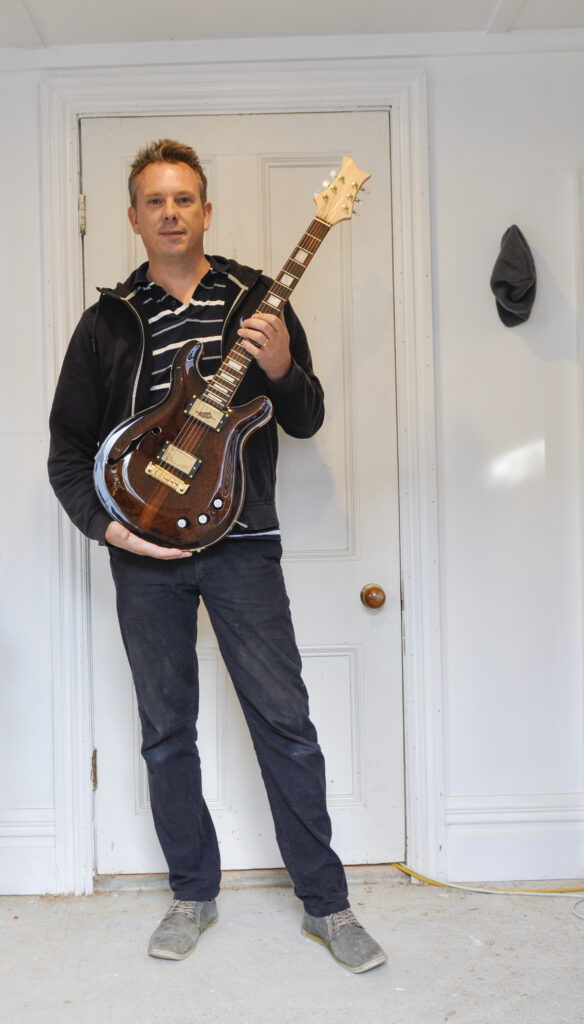
Dave has built more than 25 guitars over the past 10 years, mostly for friends and family, under his brand-name ‘Solace’. Each one is given a name and goes to its owner with a small book telling the story of its construction. The guitars are given evocative names like the syrupy ‘Brown Sugar’, or ‘Taonga’ with its pounamu-effect finish. “I also have my own shape called the ‘Marlbarian’, acknowledging the fact that the body is made entirely from Marlborough timber,” he says.

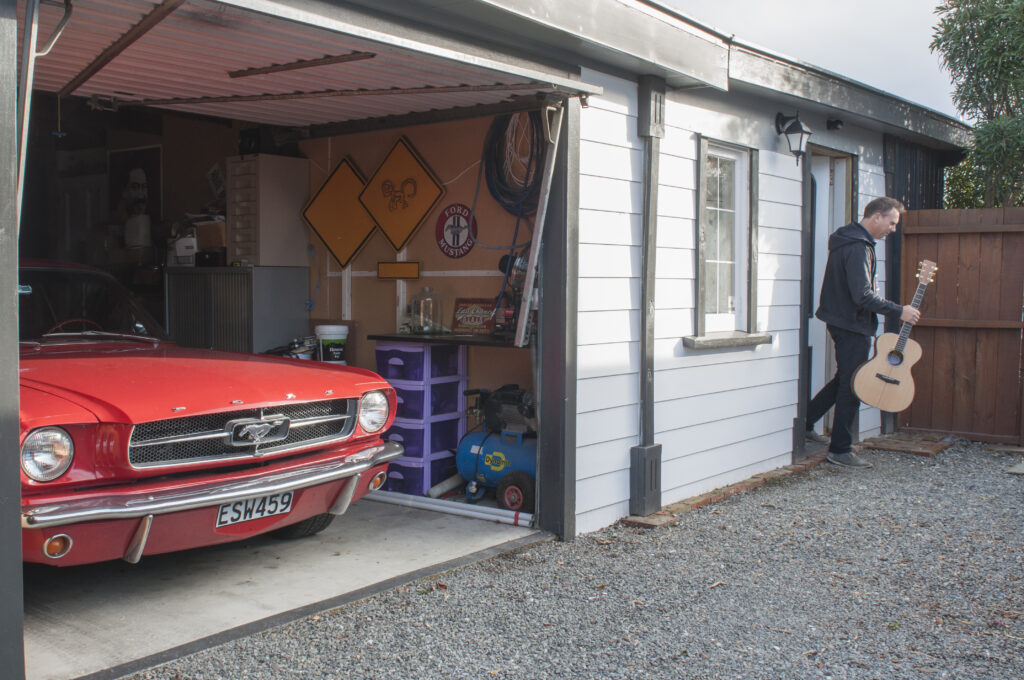
A 1965 Mustang sleeps on one side of the guitar-building shack

Time to go home
After 25 years in Auckland, Dave was drawn “home” to Marlborough eight years ago. Part of the lure was a much-loved beach house in Queen Charlotte Sound’s Sunshine Bay which had been in the family since the 1930s. He wanted his own three children and wife Danielle to enjoy it as much as he had as a child. A year or two after the family’s arrival in Blenheim, Dave was appointed principal of Richmond View Primary School, where he has since founded a music academy.
Dave, who never counts his hours, says making guitars involves a lot of thought as well as trial and error. “There’s a lot of hand-sanding and feeling with your hands to get it right.” It’s a relaxing and tactile process, much like playing the finished products.

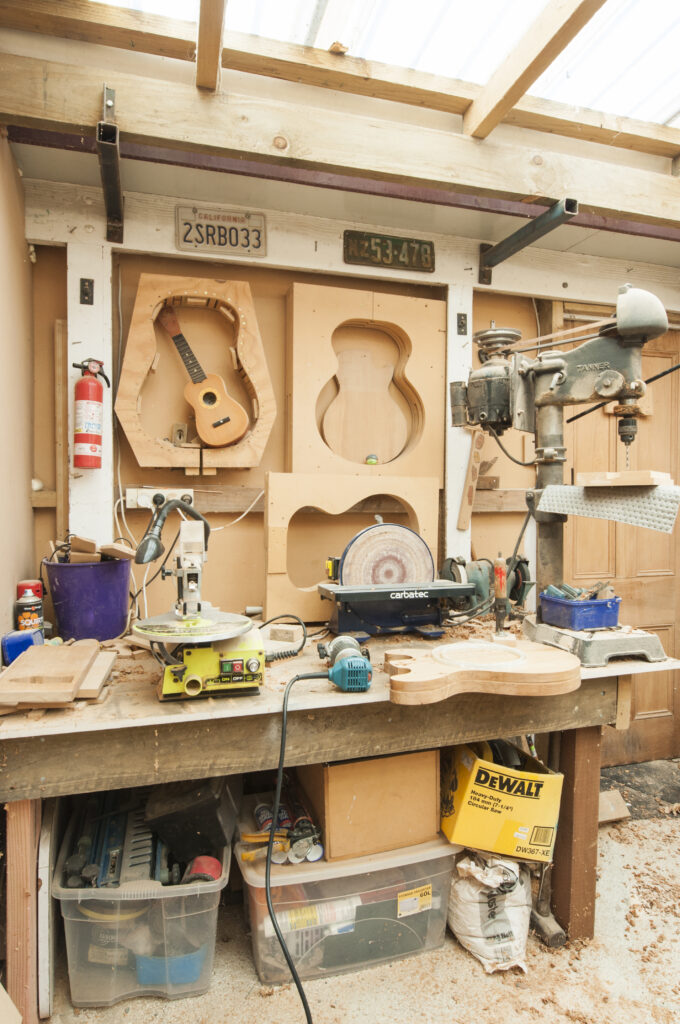
Acoustic guitar jigs on the wall of the “messy” part of the shed
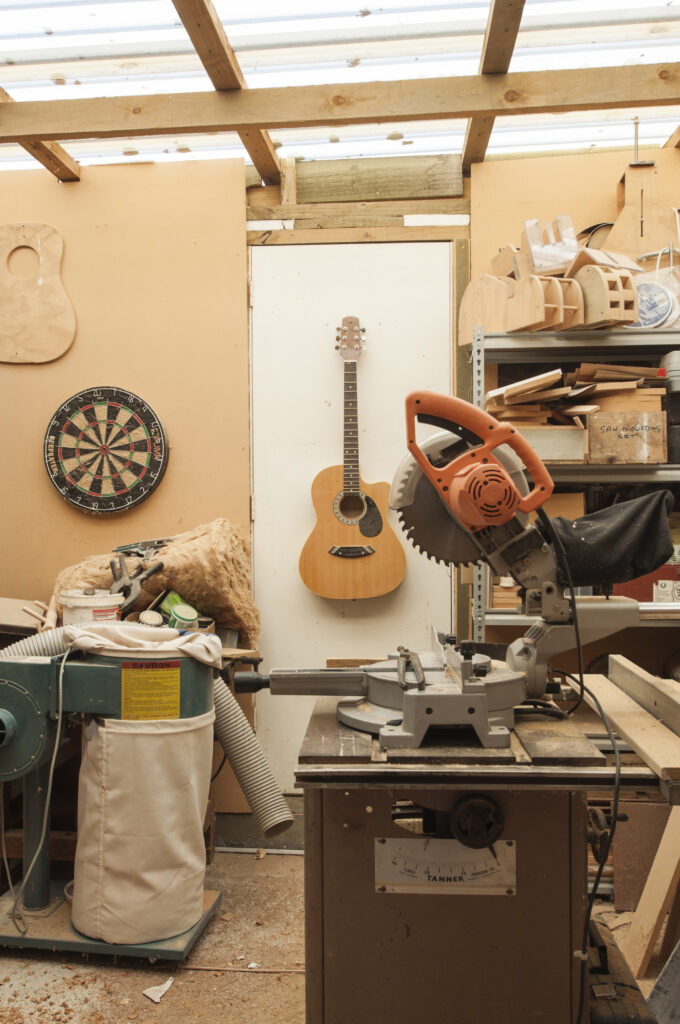
Dust extractor, sawbench, etc., again on the “messy” side of the shed

Dave’s shed
Dave adapted an existing shack behind the house into a two-room workshop, which he describes as a “one-man-and-two-boy” shed, as he shares the space with his sons, Olly, 11, and Toby, 9. “I put a proper floor in and insulated it as it was freezing in winter,” he says. 
The back room houses heavier-duty machinery as well as jigs for different-shaped guitars. Dave has installed a vacuum system to keep the air clean, although he says he has “probably inhaled a four-by-two beam over my life”.
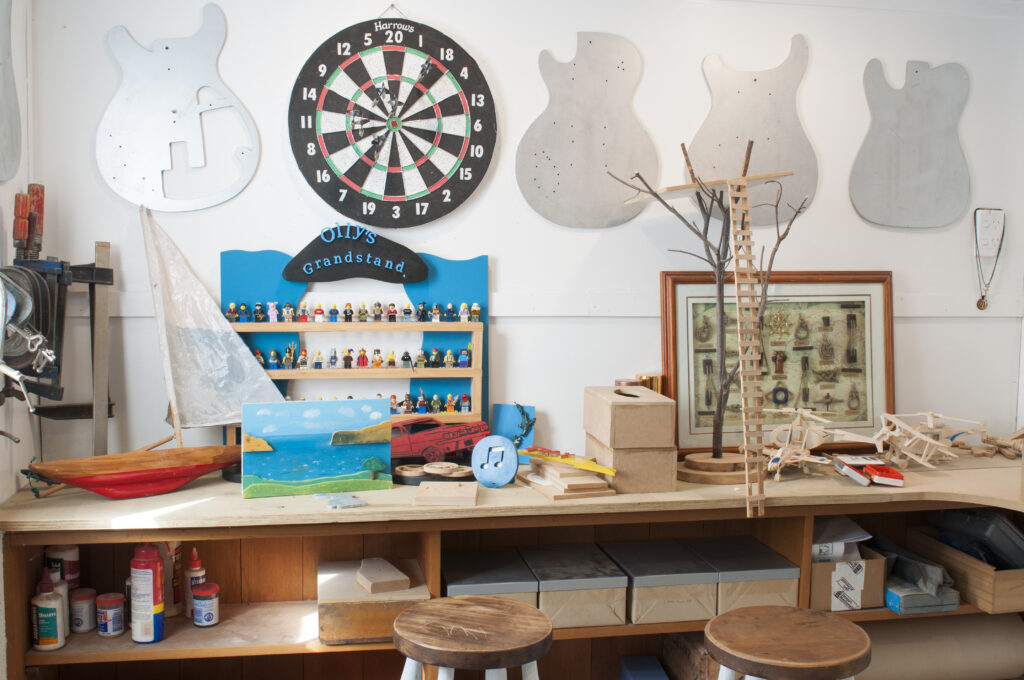
The front workshop is a clean space for finer work, with shelves containing labelled project boxes for each guitar. Pin-prick holes in the wall and ceiling are not borer, he explains, indicating a dartboard that is the focus of some serious, if not always accurate, father-son tournaments between projects. 

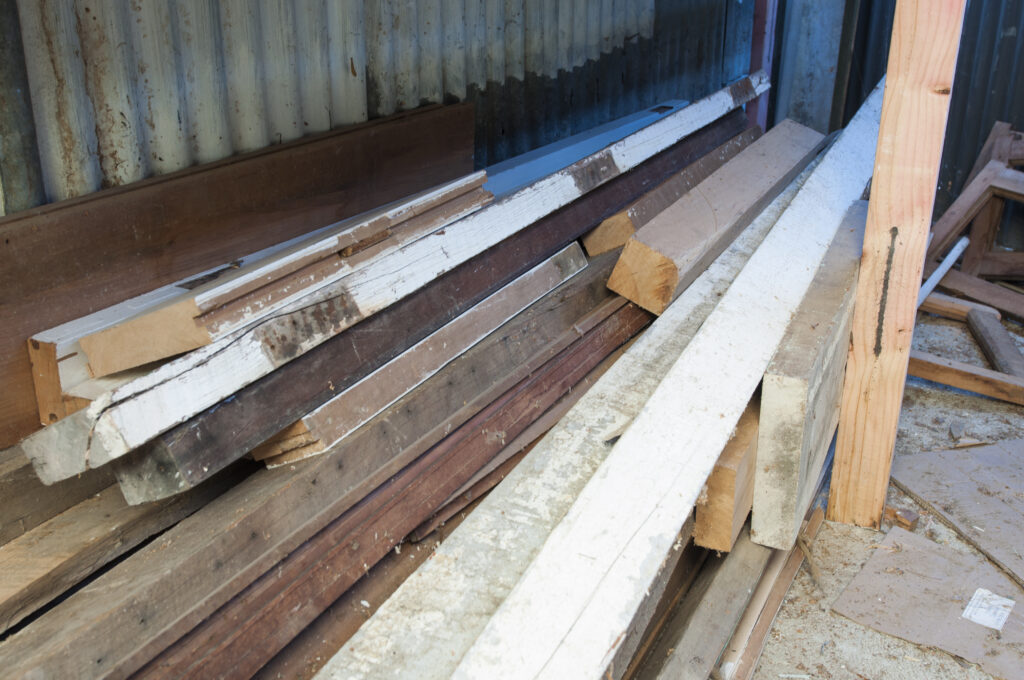
A mixture of mainly native timbers ready for repurposing

Locally grown, recycled timber
Behind Dave’s shed is a stack of old timber waiting to be repurposed as fine musical instruments. He mainly uses locally grown recycled woods like rimu, matai and rewarewa. “Most of it has come out of buildings. Timber that has sat inside as a beam or door is very dry and stable.” 
The rimu back of a walnut-topped guitar on his workbench spent the first 100 years of its milled life as a door in the family’s villa, which Dave is slowly renovating. “The door was in the house for a hundred years so the wood must be three or four hundred years old.”
When the front window of the family bach was replaced with a sliding door, Dave used the old rimu to make three guitars for family members, including his teenage daughter, Caitlin. “You can still see the latch mark on one,” he says. 
Marlborough Sounds rimu is a bit darker than other varieties. “It’s lovely alongside matai and walnut,” says Dave. Walnut, while beautiful, tends to be a little heavy for guitar construction, but Tasmanian blackwood is a highly regarded timber for making both violins and acoustic guitars, and Dave was lucky enough to get a supply from an old tree at the Koromiko cheese factory. 
He has also made two guitars made from the struts from an old water tower in the area. “It was heavy, sappy stuff but made for a beautiful sounding guitar.” Mahogany makes for attractive decorative strips, and Dave is still slicing his way through a neighbour’s discarded bedside table.
He uses North American spruce for the guitar tops. “You really wouldn’t want to go with anything else. Because it grows slowly in freezing temperatures, it’s a very tight-grained wood but light. The closest thing we have to it in New Zealand is cedar, but the grain pattern is too far apart, making it weak.”

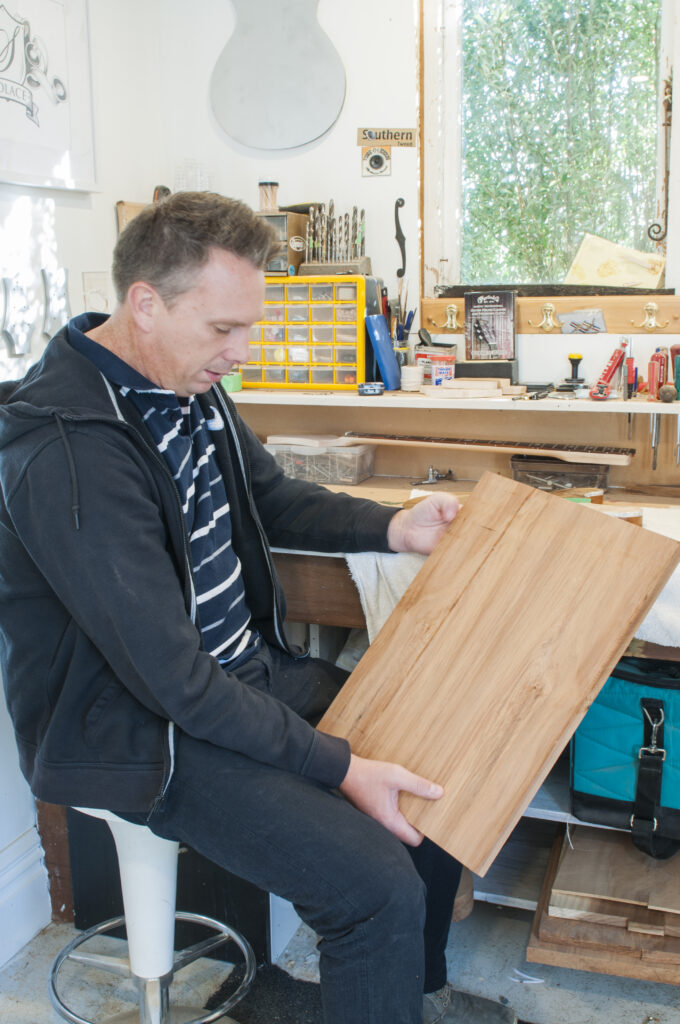
Inspecting a piece of Marlborough rimu for a carved-top electric guitar
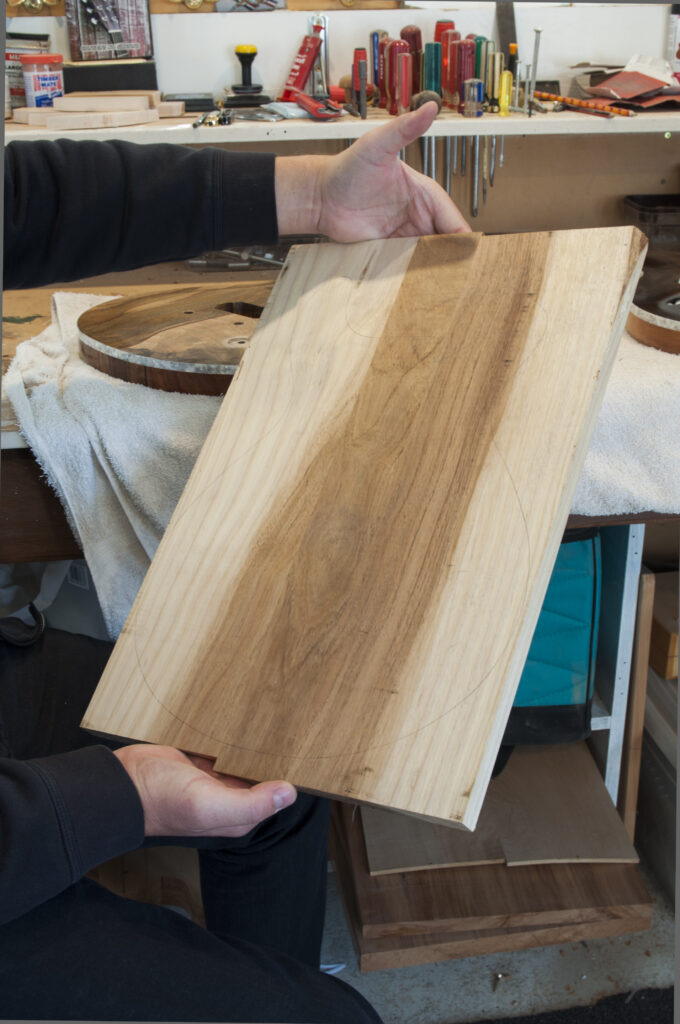
A piece of locally grown Tasmanian blackwood ready to become a carved top

Solid start
Dave recommends novices start out building telecaster-style instruments with their solid bodies and bolt-on necks. “Making acoustic and electric guitars are very different processes,” he says. “Electric ones are relatively quick to make, while building an acoustic guitar is more akin to boat-building with all the braces and steaming to bend the sides. They can take up to six months to make. I could fill a small novel describing how to make one of those.”

A four-string Marlbarian bass on the bench awaiting final assembly
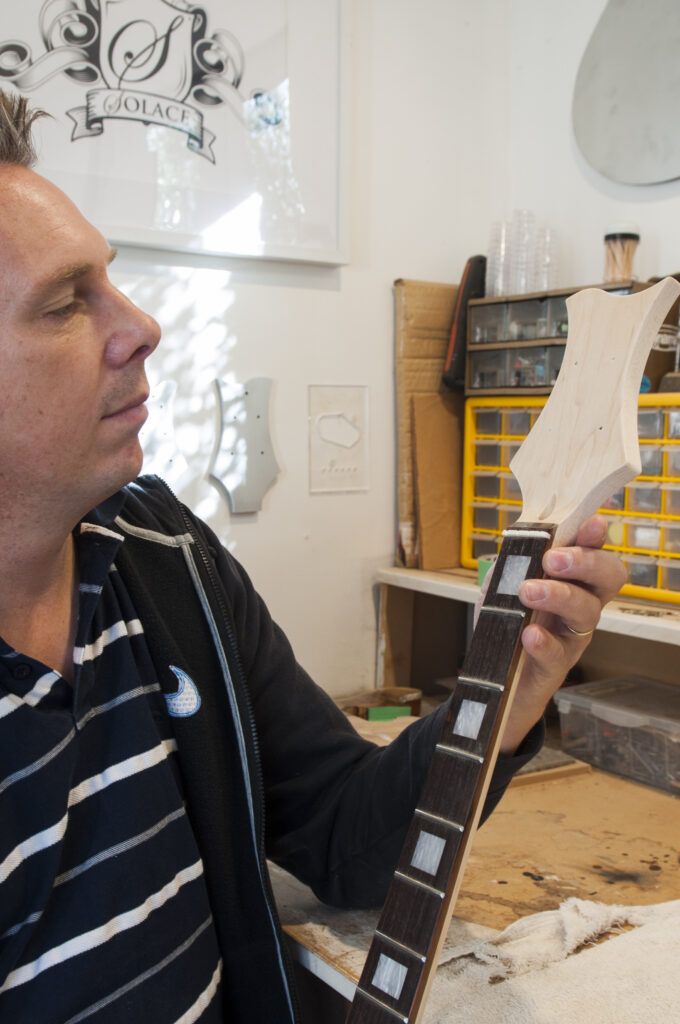
Inspecting the Solace headstock-shape cut-out
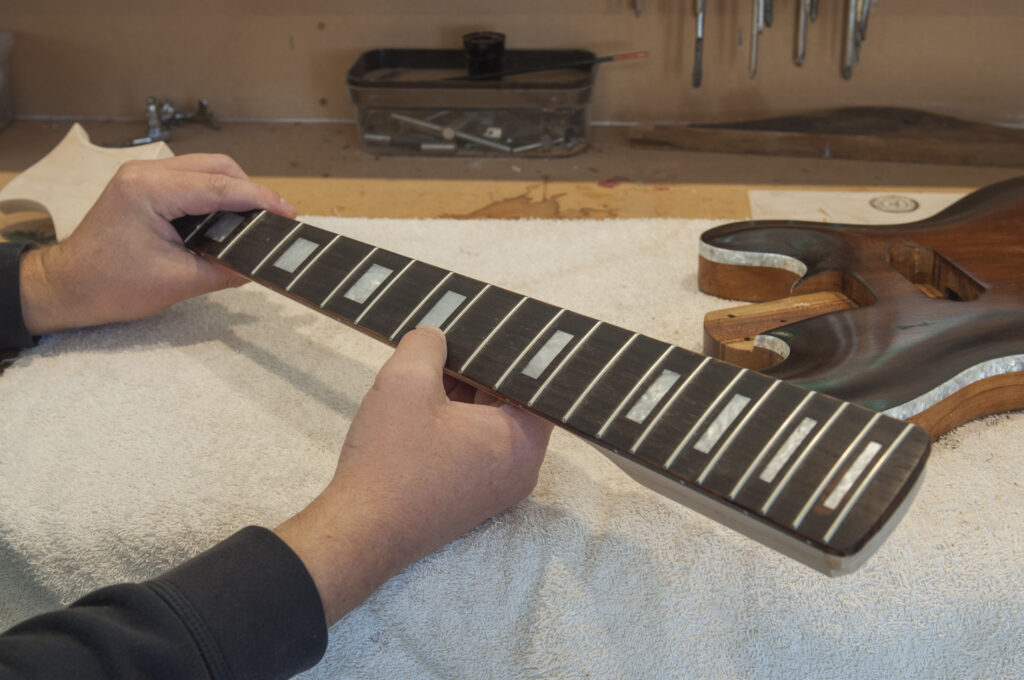
Four-string bass neck with pearloid inlay
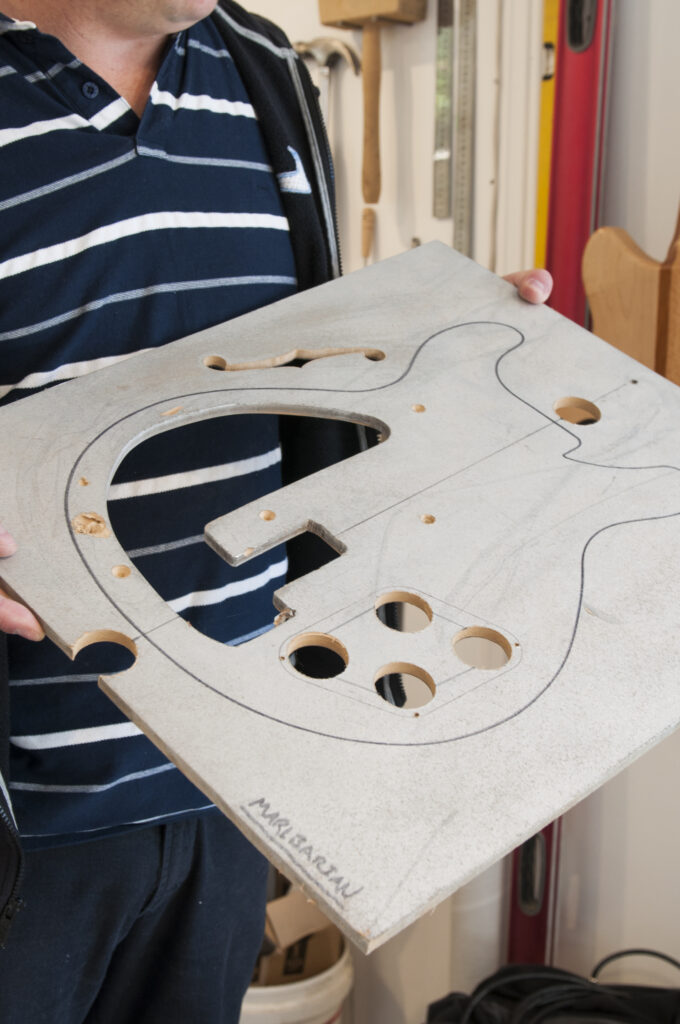
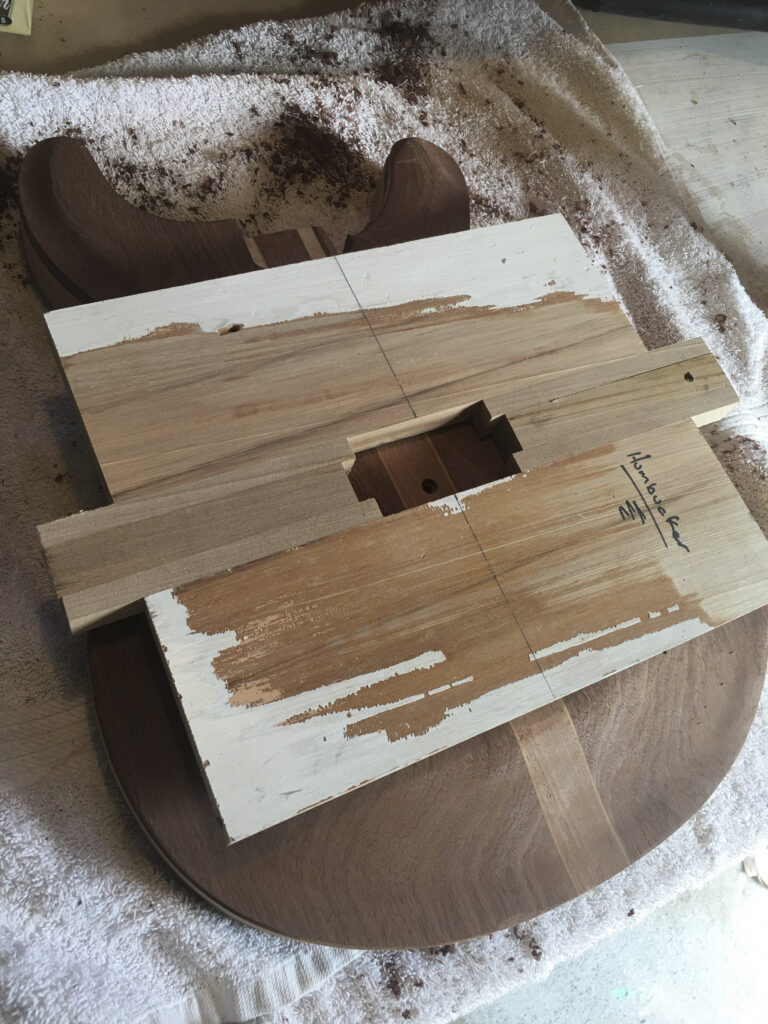
The MDF routing jig for the Marlbarian semi-hollow guitar.

Simple solutions (pic using scraper)
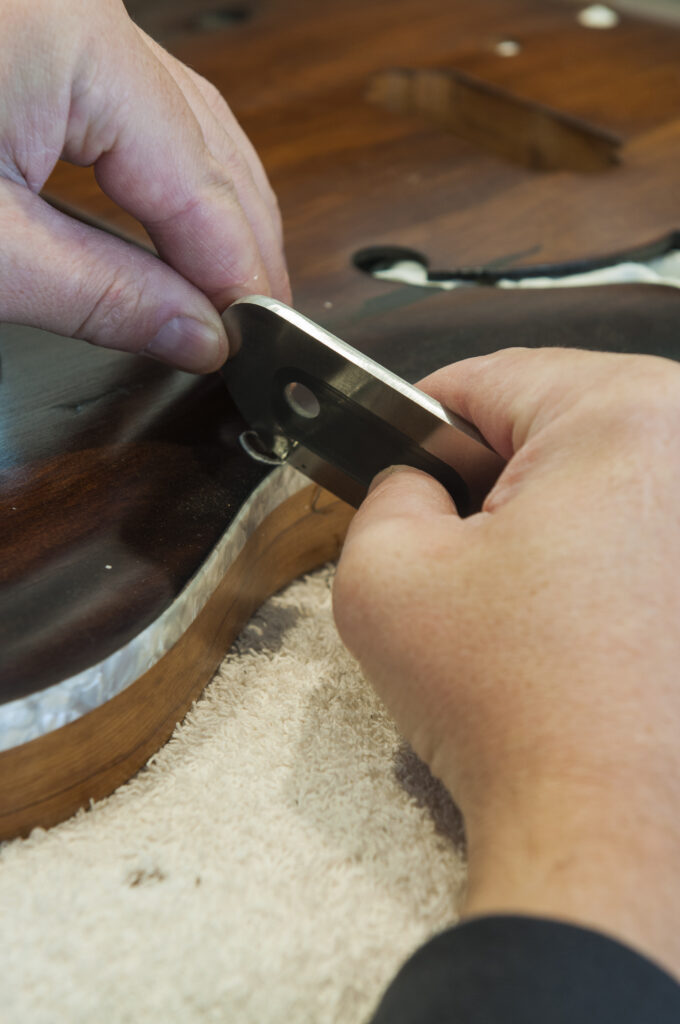
“Not making mistakes is all about having the right tools,” says Dave. Some of the best are the simplest. “One of my favourite tools is a little oval scraper I use to finish off the edges.” Sharpened with a burr, it efficiently shaves off any of the sealer coat that has leached into the sides. But his router gets the most use. “As well as speeding up the carving process, you can do a lot with a good router.”

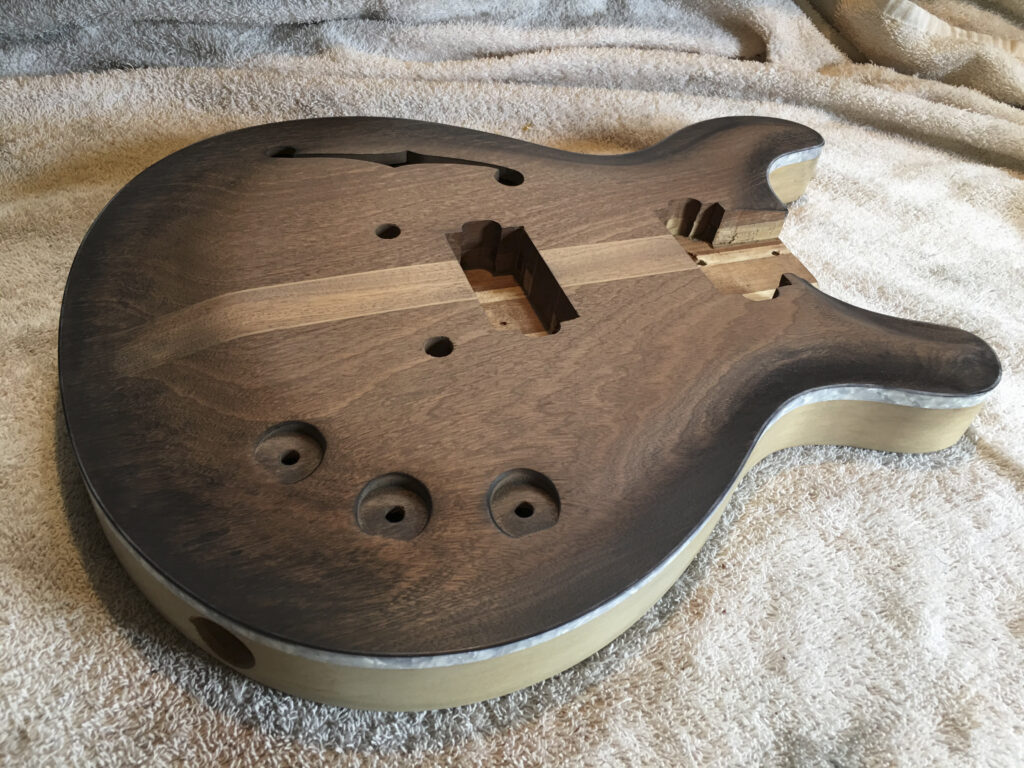
Scraping the binding to take off stain before final glossing

The Italian connection 
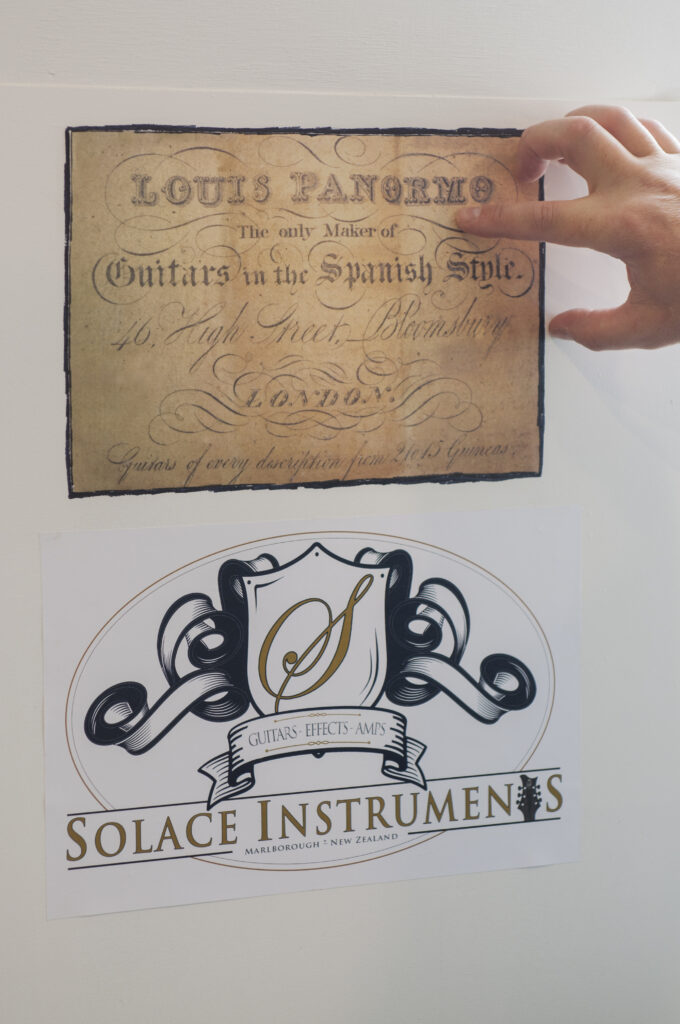
Dave had been building guitars for eight years when he discovered that crafting musical instruments was in his DNA. He learned from his aunt that his forebear was Louis Palermo, a guitar-maker in the Spanish style who had a shop in London’s Soho before following his children to New Zealand in the late 19th century. “His father was quite a famous Italian violin maker who had emigrated to England from Sicily,” says Dave.

Louis Panormo’s guitar logo above the Solace Instruments logo

Pure sound (with photo of retro amps)
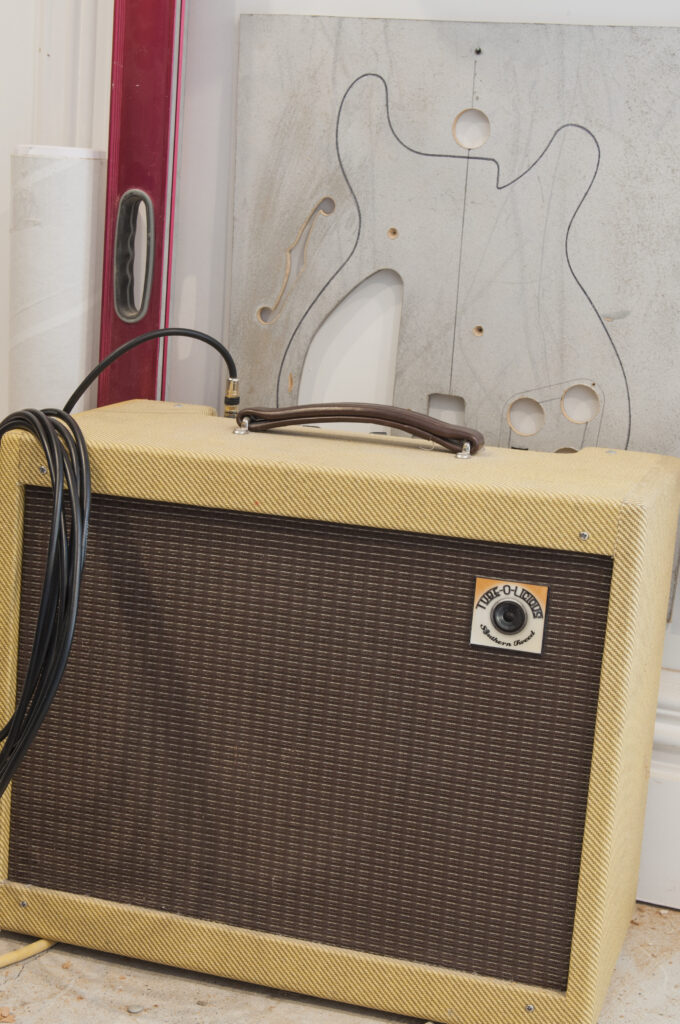
Dave is a purist when it comes to music. “I love the sound of tubes and valves and anything analogue,” he says. He also makes stomp boxes, basses and retrospective amps which he fits out with seven-valve electronics and “old-school wiring”. His ‘Tube-O-Licious’ has the wiring of a 1964 Fender Princeton reverb built into a 1959-style Fender Deluxe box which he built from scratch, complete with dovetail joints, out of South Island pine. 

The handmade Tube-O-Licious all-valve guitar amp

Perfect harmony
Since returning to Blenheim, Dave has enjoyed the camaraderie of provincial life. His guitars have input from all over the community, from the friends and local businesses who give him wood, to the spray painter who does the glossing, and the badge-maker who made his ‘Solace’ logo stamp. Inlaid paua on his guitars was caught by a friend, and a guitar pick was crafted by a local bone carver, Peter Mitchell, who also made one for Pink Floyd’s David Gilmour.

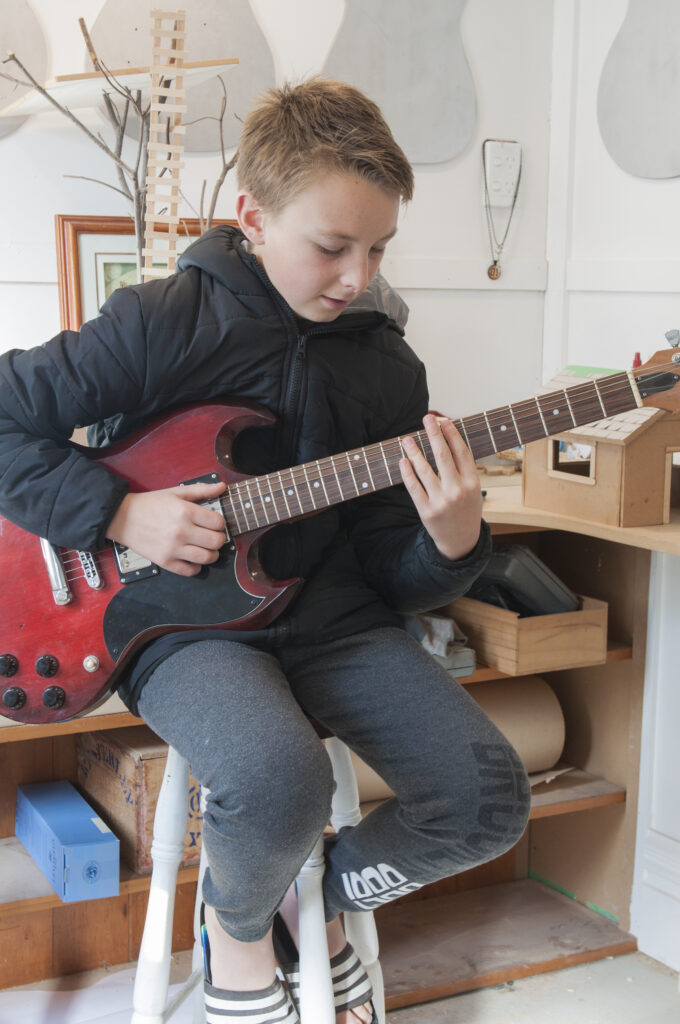
Olly plays his ‘SG’ made from recycled rimu

Chips off the block (with photos of boys in workshop)
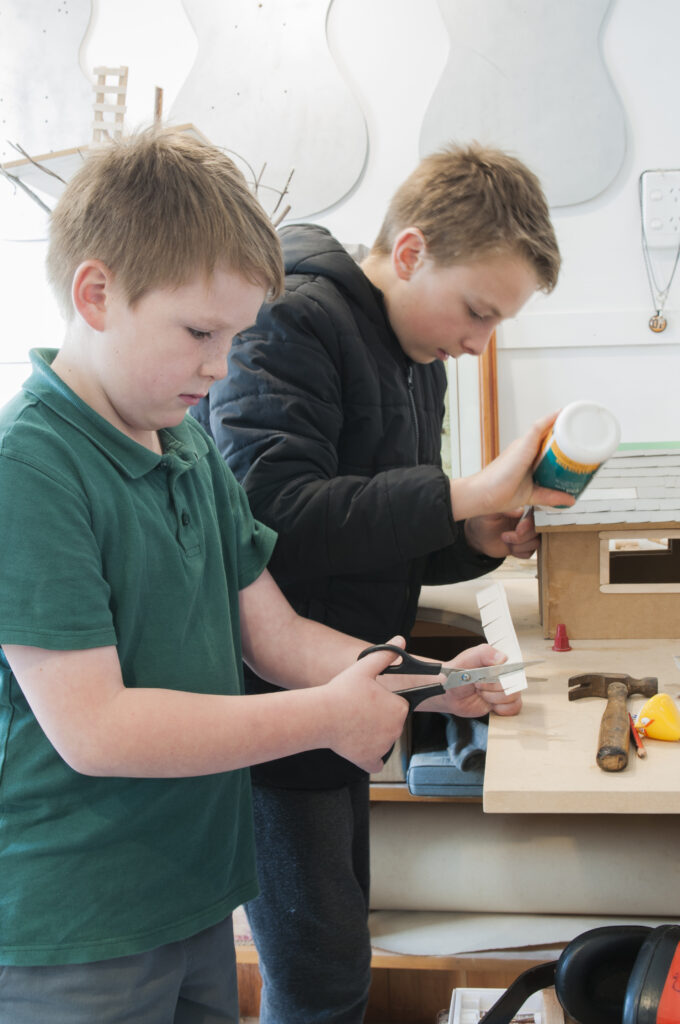
Dave’s sons, Olly and Toby, spend as much time as they can in the workshop when school is out. “It’s good to have the shed gene passed on,” says Dave. “They build some cool stuff. They’re pushing for a 3D printer, and I may well oblige one day.” Both list the scroll saw as their favourite machine, closely followed by Dremel tools. They are busy modifying cricket bats and building models, while their latest project has been constructing a miniature tree house complete with panelled door and furniture. 
Olly plays an electric SG guitar made for him by his father, while Toby, whose guitar is still under construction, plays the ukulele.

Toby and Olly work on a model tree house project for school
A line-up of some of Olly and Toby’s finished projects below a range of electric-guitar shapes, some Dave’s own and some well-known brands

Building a semi-hollow body

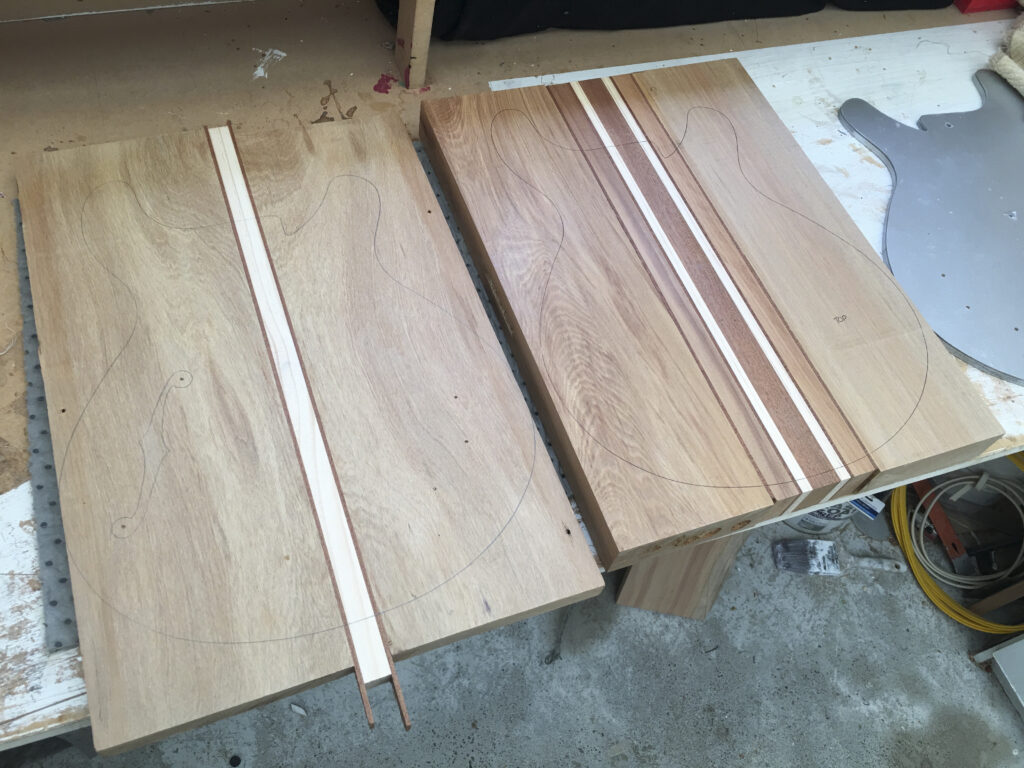
Dave makes up the body blank from laminated recycled timber. “I find rimu is safe from a tone and weight point of view. I also use matai and mahogany, and other thin strips for colour,” he says. The thickness of the back ranges from 32mm to 40mm

Next, Dave prepares the top. Usually two pieces of book-matched 19mmx 150mm, sometimes with a centre strip for looks. “Maple is the traditional choice for a semi-hollow guitar, but you can use whatever looks and sounds good. I have used rimu, mahogany, elm, walnut, and totara so far.”

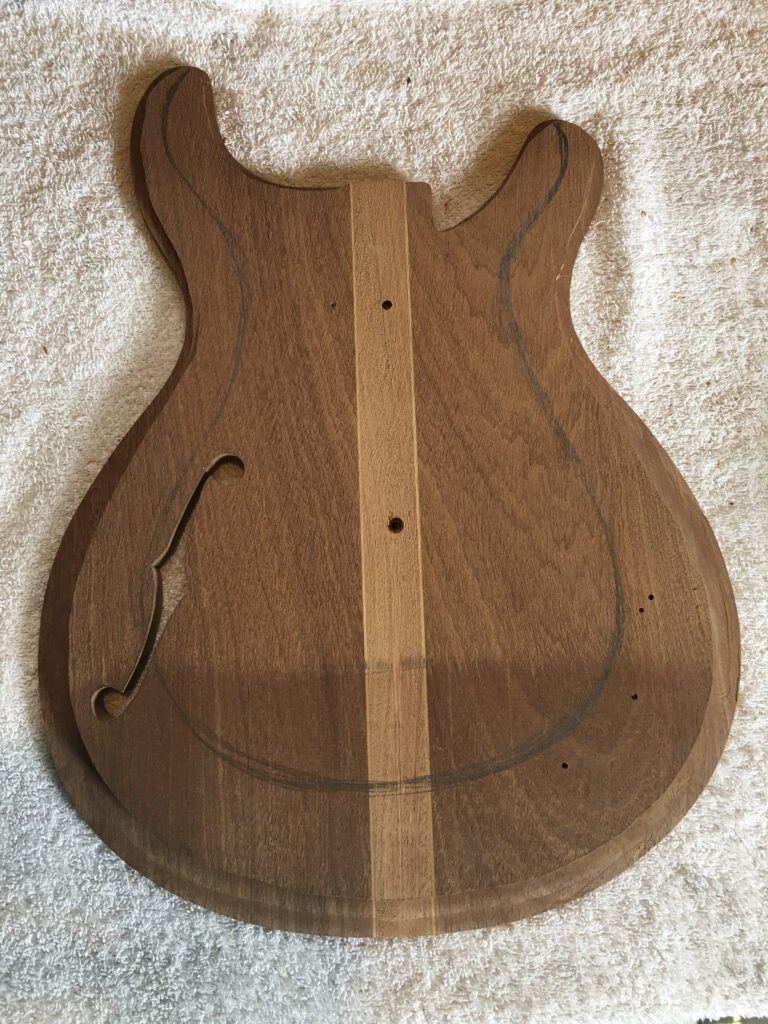
Then he places one on the other, draws the outline, and identifies the neck pocket and pick-up holes. He then screws the two pieces together through the planned pick-up holes.

Dave cuts out the shape with a bandsaw and sands the edges (both top and bottom at the same time)
The binding channel is cut using a router with a guide whee
Next, he draws the shape of the carve he wants and uses the router to cut the shelf at the bottom of the carve

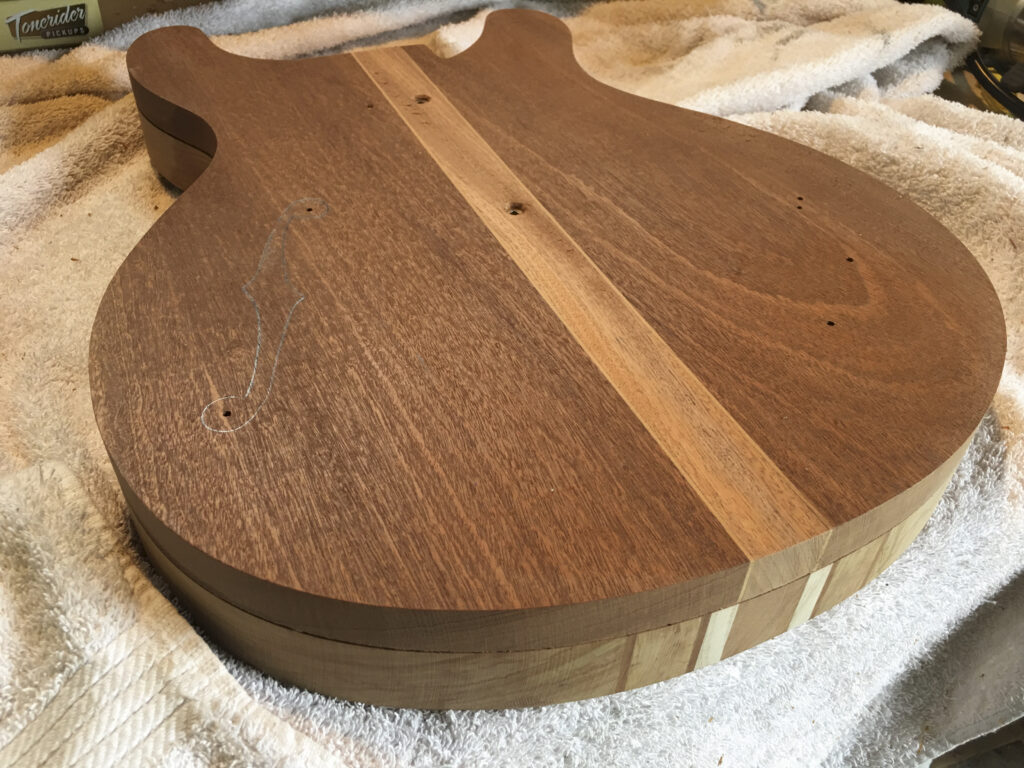
 The top is then sanded/cut down to a 3-4 per cent angle. The neck pocket is routed out, and the carving begins. Dave starts with chisels and planes, finishing with a scraper and sandpaper.

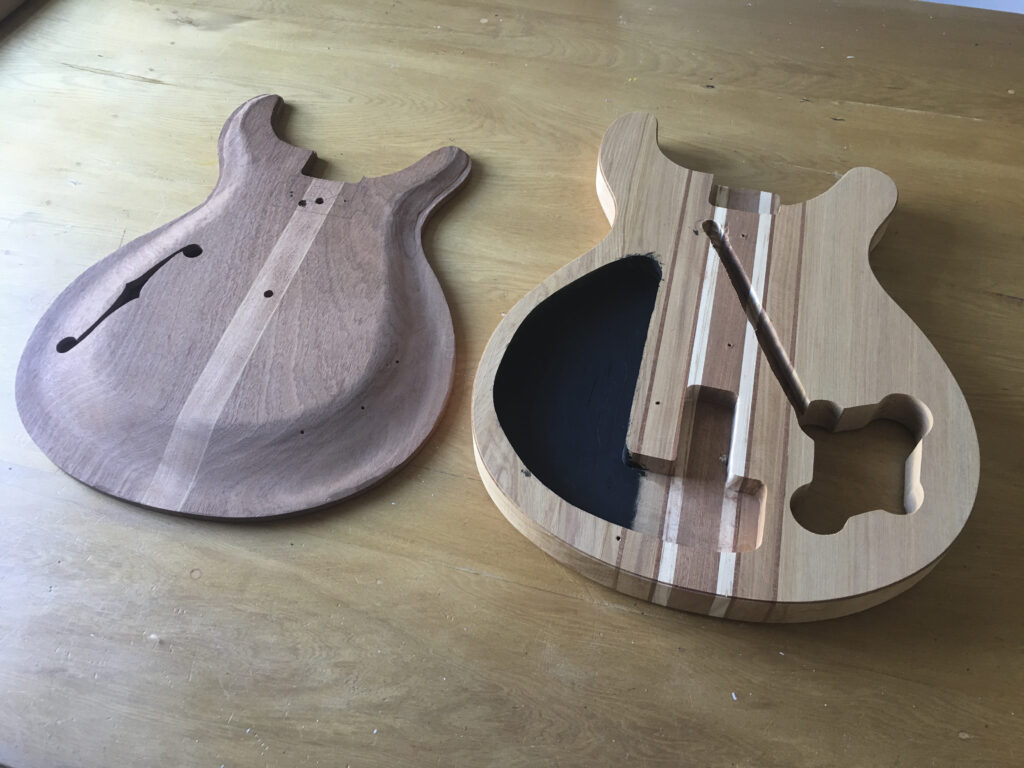
At this point, he unscrews the top and, if building a semi-hollow, will carve the underside. A custom wood template is used to trace the f-hole shape, which is cut out using a scroll saw.

The top side of the bottom now needs channels cut for the wiring as well as a cavity for the wiring and volume knobs. For a semi-hollow, there will also be a sizeable cavity under the f-hole

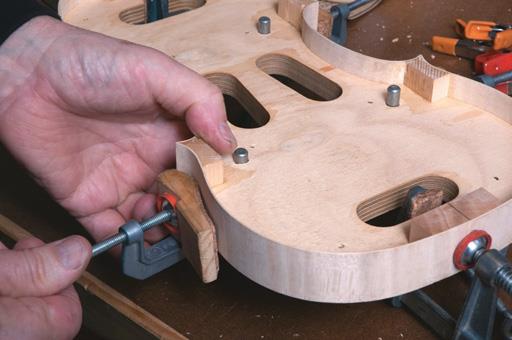
The top can now be glued on using clamps and the same pick-up hole screws for placing and clamping. Dave uses Titebond wood glue.

The pick-up holes are cut using a jig
The binding is glued around the body, trimmed and scraped. While decorative, it also hides the end-grain on top

The bridge is attached, allowing the neck to be fitted correctly. Dave builds the necks for some and buys others. The Korean-made neck comes as a paddle, which he cuts into his signature shape.

The final scraping, sanding, and staining takes place

The pick guard is fitted. Made from three-ply styrene or a pearloid material, Dave cuts them out with a scroll saw. He sometimes inlays paua, cats-eyes, and mother-of-pearl.

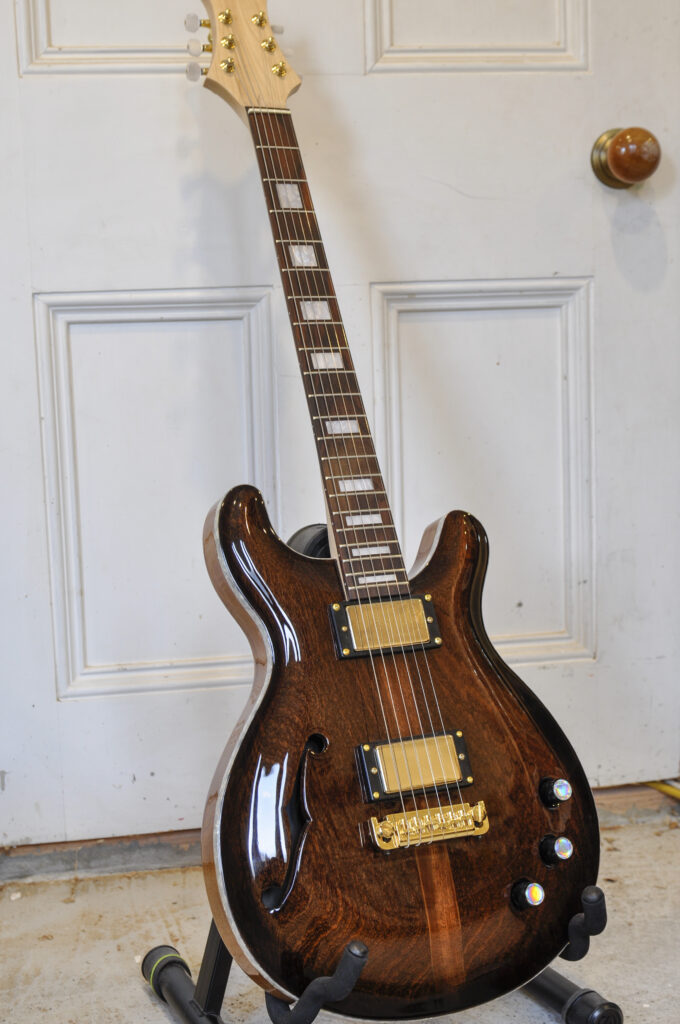
The finished product, a Solace Marlbarian semi-hollow guitar

Glossing
Dave sends his finished but unadorned electric guitars away to get glossed. “It’s a two-pot polyurethane, the same as they use for cars.” For acoustic guitars he uses a very thin layer of lacquer or French polish. “If you apply a heavy finish it affects the wood’s ability to resonate and changes the tone,” he says. “The pores in wood open and change the more you play the guitar over time, and you don’t want to stifle that by coating it with a heavy lacquer.”

Fitting them out 
Once the guitar comes back from glossing, Dave screws the neck on and puts the instrument together. “There’s a fair bit of work fitting them out. It takes a good half-day,” says Dave, who purchases good-quality metal hardware such as the frets and keys from the UK, and mostly uses gold-coloured nickel trimmings. 

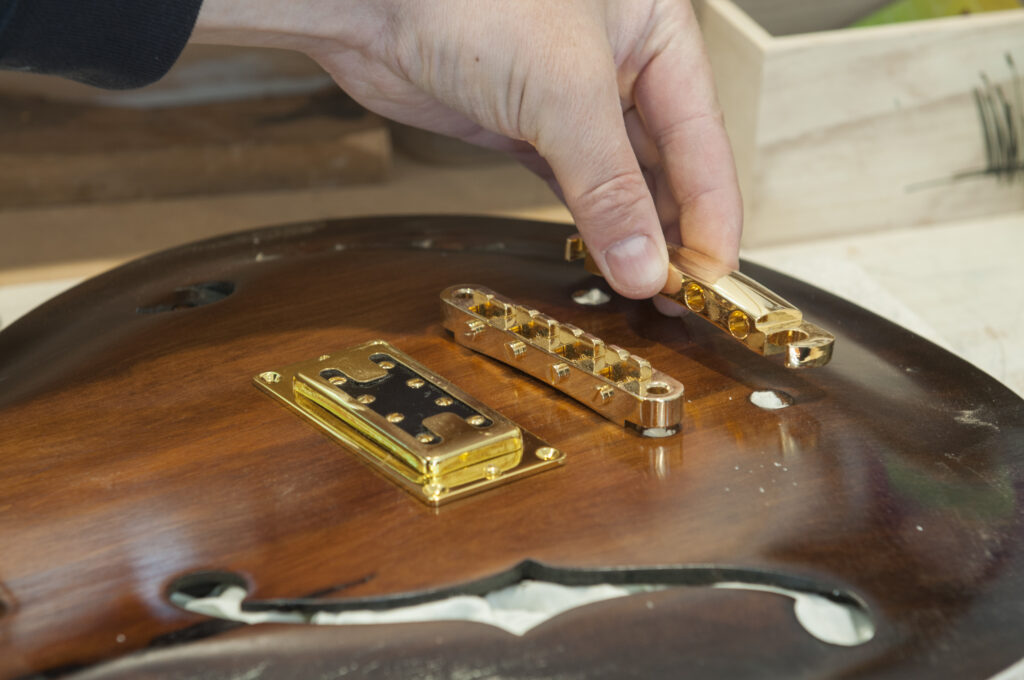
Setting up the tailpiece and bridge on a four-string semi-hollow bass
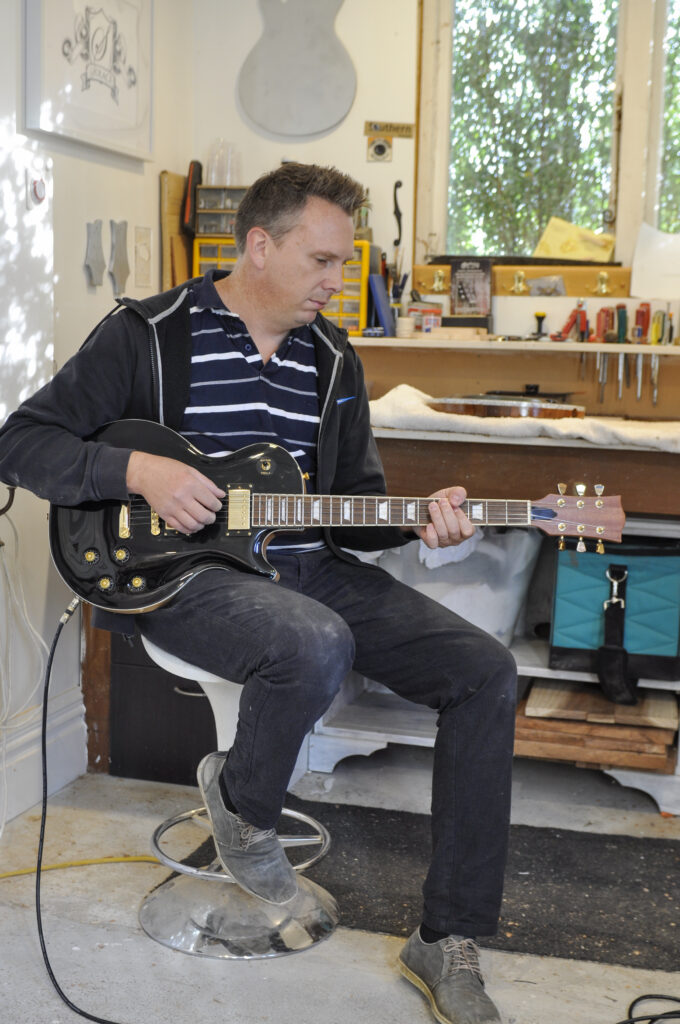
Playing a black and gold LP (“I call it the ‘Les Pauling’”)–style guitar made for a family member from a beam salvaged from his great-grandfather’s old drapery in Blenheim

For further information, check out Dave’s website:
https://www.solaceinstruments.co.nz/

Share:

More Posts

Making a violin – part two

Making a violin is a complex job involving around 40 pieces of wood of various types and sizes and plenty of patient, skilled woodworking. In Part One we chose the best maple for the back and spruce for the belly, shaped these plates and created the rib structure. Now it’s time to finish the construction.
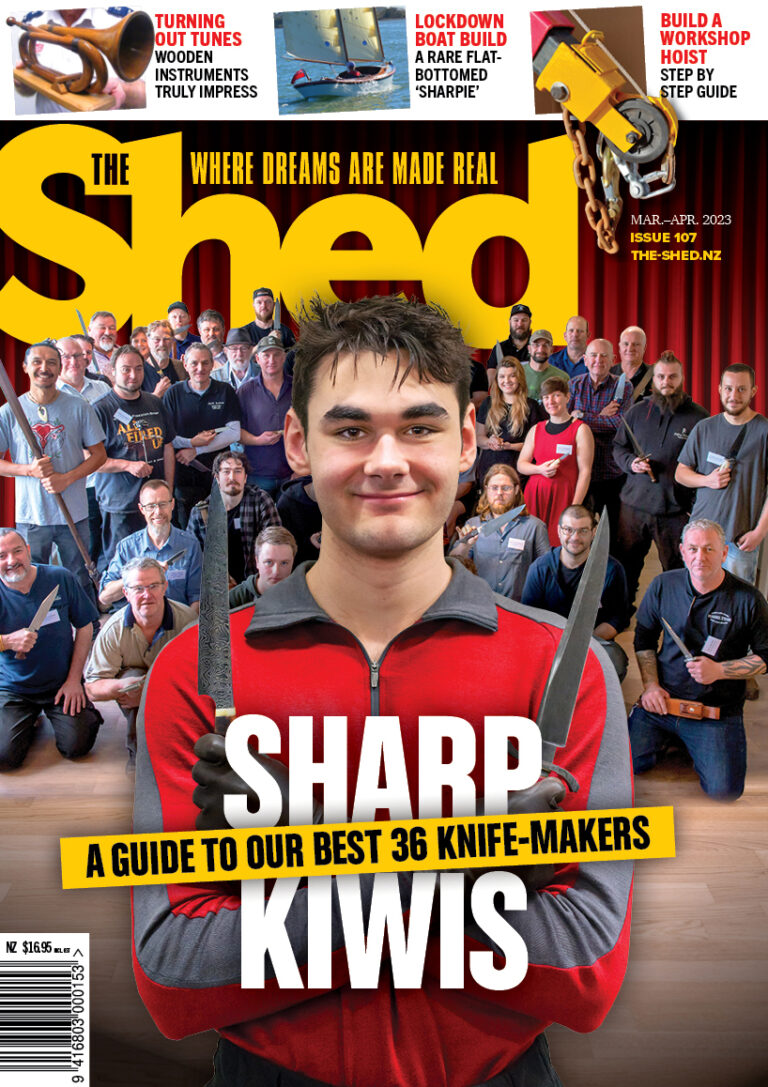
The Shed March/April 2023 issue 107, on sale now

In New Zealand, knife-making is increasing in popularity year by year. If the recent Auckland Blade Show was anything to go by, this pastime is now a full-time career for a large number of sheddies and of enormous interest to the general public. The hundreds who came through the doors over the two-day event are evidence of knife-making’s huge growth over these past few years.
Who are these knife-makers; what separates and what inspires them? Where are they, and what knives and blades do they create?
We’ll soon know more because in this issue of The Shed we profile 36 of NZ’s finest. Read our Who’s Who and Where’s Where in this issue in an extensive rundown of our 36 best Kiwi knife-makers.