
The Shed issue 77, March/April 2018

In the March/April 18 issue (#77) Jude revisits some good practices re harvesting rainwater. He gives some solid advice on how to set up your own system to collect rainwater, keep it clean and talks about some innovative products to help you get the best results.


In the March/April 18 issue (#77) Jude revisits some good practices re harvesting rainwater. He gives some solid advice on how to set up your own system to collect rainwater, keep it clean and talks about some innovative products to help you get the best results.
We head to the South Island to enjoy the work of Dave Neame and Lloyd Knowles, two sawmillers who have their own distinctive ways of prepping timber and then go through the steps to make your very own Longbow from Walnut timber. Christchurch is the home of Chris Gordon where Ritchie Wilson explores his shed where Chris builds motorcycles from scratch including a unique 1920s board-track racer then Jude is back again welding a new trolley for his old bbq, giving it a whole new lease of life.
Nathalie Brown introduces us to the team of rail enthusiasts at the Oamaru Steam & Rail Workshop where a team of retired tradies keep the trains and carriages running for all to enjoy. We discover the stunning work of potter Renae Galetzka whose distinctive pottery is sought after by folks all over New Zealand and Mark Beckitt gives us some awesome tips and tricks to get us soldering like a pro. In Part Four of our series on 3D printing, Enrico Miglano steps us all up to the next level by showing how to print a DSLR camera and in the final part in our outdoor fires feature, we show you how to plaster the block fireplace we built in the last issue. Coen Smit has some fun building some steampunk toys for young and old before we visit a refrigeration business in Auckland (MacDonald Refrigeration) who are about to close their doors for the last time. They share with us their treasure trove of lathes, presses, guillotines etc they have including some fine examples manufactured by Dyco, Tanner, John Heine, Edwards, Logan, Colchester’s and more – an Aladdin’s Cave for engineering buffs.
Share:

More Posts

Revving up Island-style

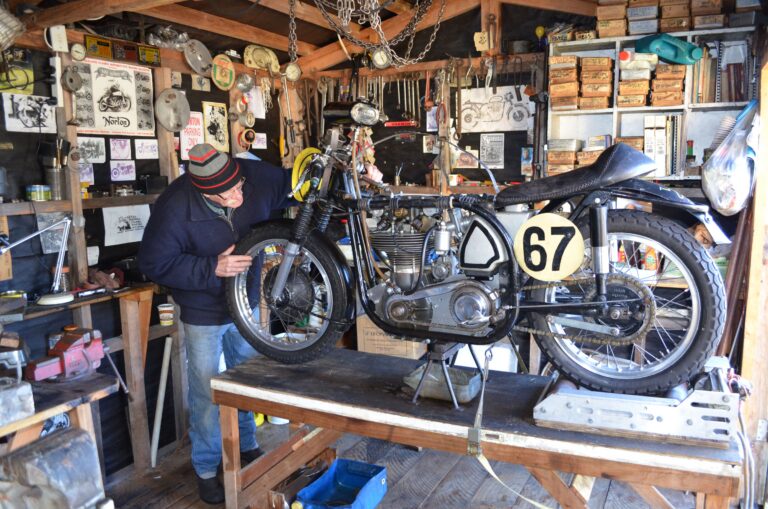
As you can imagine, on Great Barrier Island, the population is likely to have more than its share of characters, given the island’s remote location. Part of the charm is its lack of power supply and absence of a supermarket. If something breaks, there’s not likely to be a spare part sitting on a shelf anywhere on the Island, so if you don’t want to wait or to pay hefty freight charges on top of the cost of the part, you make one or use real no. 8 wire ingenuity. Even though it is New Zealand’s fourth largest island (after the North, South and Stewart Islands) and is only a half-hour flight from Auckland, it’s like a different world, and that’s why the locals love it.
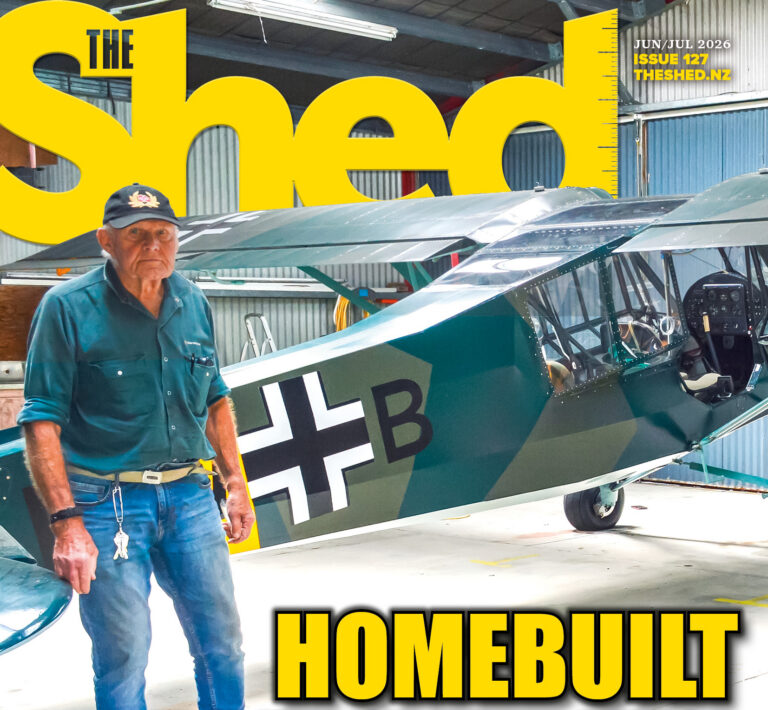
The Shed magazine June/July 2026 issue 127 on sale now

Murray Belfield is a phenomenon
He has built a few planes over the years, but none gave Murray the performance and thrills he really wanted until he built his scaled-down German paratrooper’s plane, a Storch. Building this rarest of planes consumed nine years of this 86-year-old’s life. And the result? He couldn’t be happier.
For most of us, stalking a deer across the back country, shooting it cleanly and lugging it home to furnish the table would be accomplishment enough for any evening’s bragging rights.
But when that involves landing an aeroplane you built in your shed onto a handkerchief-sized patch of hilltop scrub, finding and shooting the quarry, manoeuvring the carcase into the spare seat and getting off the ground again, and doing all that at the age of 86, bragging just vanishes in the slipstream. Murray Belfield is, anyway, far too practical and busy a guy to waste his evenings boasting to his mates, but he is, nevertheless, a phenomenon. His plane, the second he has built by hand, is another. Highly specialised for short take-offs and landings (STOL), it is a three-quarters-scale replica of a WWII flying legend, the Fieseler Storch.
The replica, designed by famed aircraft engineer Ladislao Pazmany, is so challenging to build that, to Murray’s knowledge, only one other Pazmany model has been completed to the flying stage, by an enthusiast in Alaska. As if that wasn’t a hard enough ask, Murray has incorporated many improvements of his own based on his many years of bush flying experience (and his dislike of fibreglass).

In the dining room shed

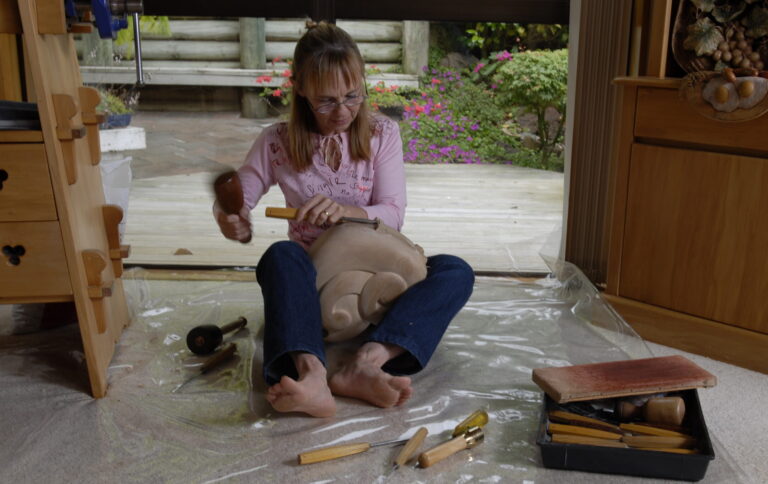
Jane Allnatt’s father was a commercial artist, a painter, model-maker and did a bit of carving, so there’s something of the family tradition in what Jane Allnatt is doing in working with wood. But it’s unlikely her father imagined her designs and creations coming out of a shed in the dining room.
Working on a sheet on the floor of a room in her house is the Howick resident’s “workshop” and preferred way of creating work. Yet that work has regularly taken prizes in various categories at the annual National Woodskills Festival at Kawerau, a central gathering place of woodturners and sheddies.
It is also unlikely you would find many men praising the convenience of their working space because, as the sculptor puts it, “the room is centrally placed and I can disappear to cook dinner or if there is any washing, I can do that. The light is good, too.”