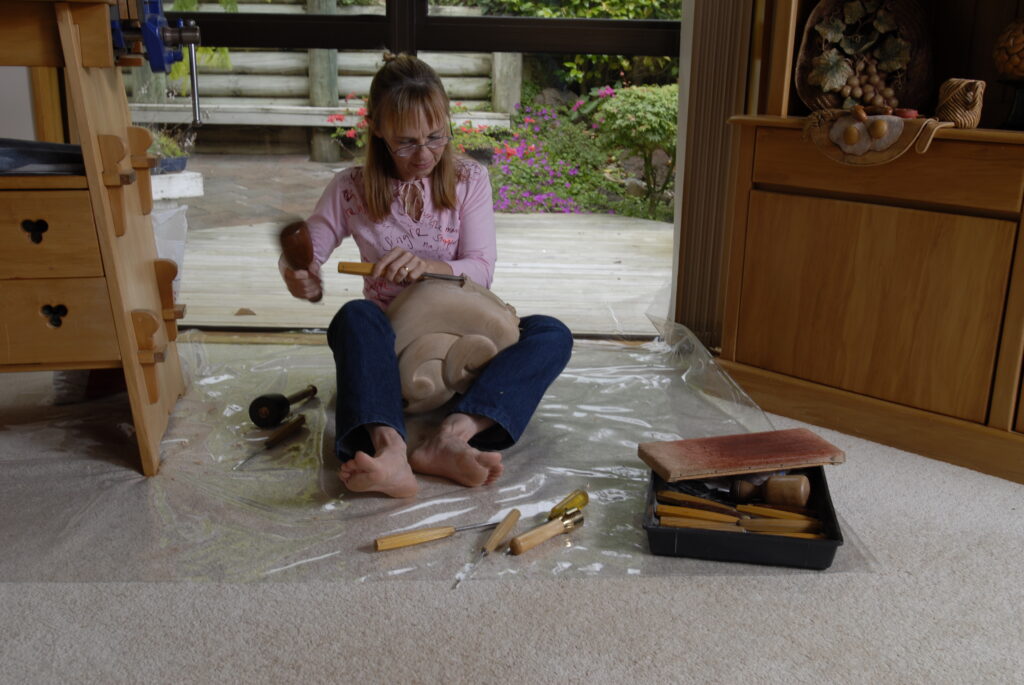

Wood carver Jane Allnatt is most comfortable working on the dining room floor
By Tony Fergusson
Jane Allnatt’s father was a commercial artist, a painter, model-maker and did a bit of carving, so there’s something of the family tradition in what Jane Allnatt is doing in working with wood. But it’s unlikely her father imagined her designs and creations emerging from a shed in the dining room.
Working on a sheet on the floor of a room in her house is the Howick resident’s “workshop” and preferred way of creating work. Yet that work has regularly taken prizes in various categories at the annual National Woodskills Festival at Kawerau, a central gathering place of woodturners and sheddies.
It is also unlikely you would find many men praising the convenience of their working space because, as the sculptor puts it, “the room is centrally placed and I can disappear to cook dinner, or if there is any washing, I can do that. The light is good, too.”
And it’s domestic all the way. When Jane Allnatt needs to work with her Dremel-like pendant drill, she gets out the ironing board to work on as a support.
Jane Allnatt’s woodcarving caused something of a stir at the wood skills festival. Not only was she an outside name when she first exhibited and took two seconds in 1996, but there was some disbelief at the way she worked.
A shed?
“When Kawerau first came up, Terry Christie (the then-local woodworker and tutor) said ‘go’,” explains Jane. “When I put pieces in and won, it was very surprising for the other entrants, who asked, ‘Where is she coming from?’ I said the dining room was my shed or workshop, and the floor was my workbench. But, they asked, ‘Don’t you have a workshop? You must have a shed?’
“Since that first time, they have asked me to be a demonstrator at the wood skills competition, so they had to have wanted me.”
Except it was a problem, because Jane Allnatt had discovered woodcarving and making 3D work was easier on the floor (on a bench, you had to walk around to get at the work).
“When I was asked to do some demos, I said I do my work on the floor. They told me that a lot of the attendees at the workshop would be elderly men woodturners, and if I did not do my demonstration on the bench, they would never get off the ground.”
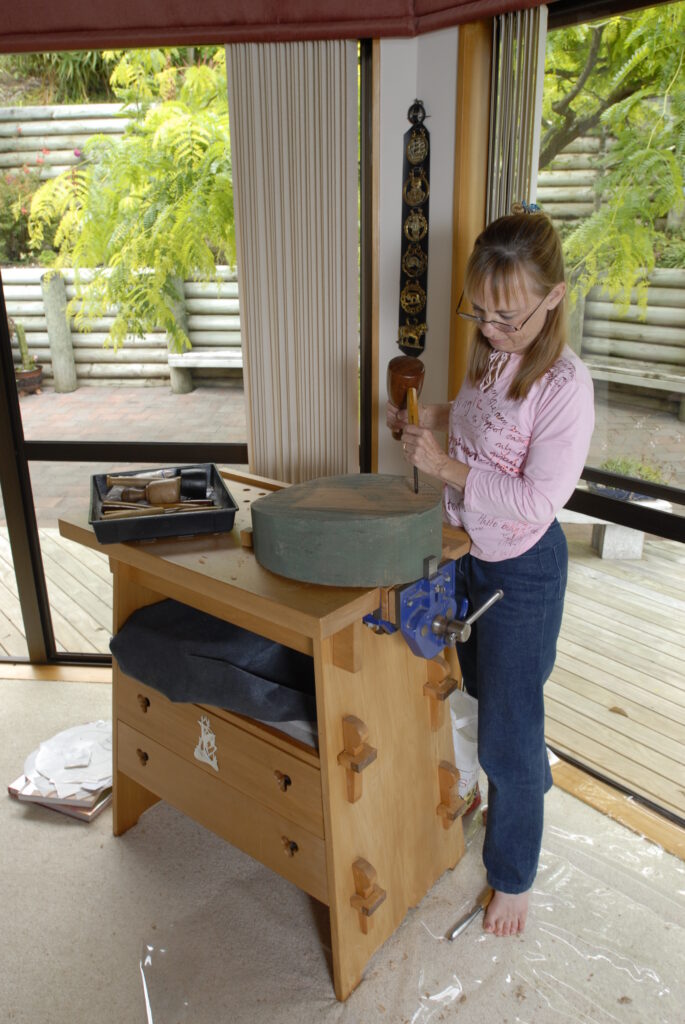
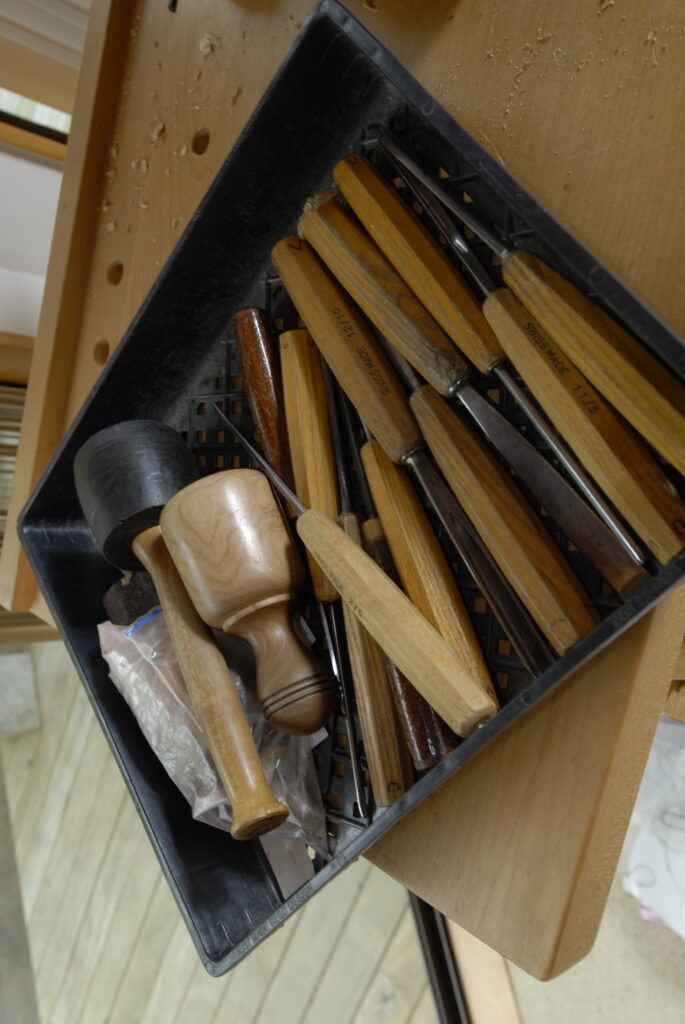
The result is that she now has a stylish kauri workbench made by Terry Christie. With all the drawers to hold chisels and tools, a top with peg holes and a vice, the bench is a versatile portable workshop. The top comes off, and the whole folds down flat and can be taken to demonstrations.
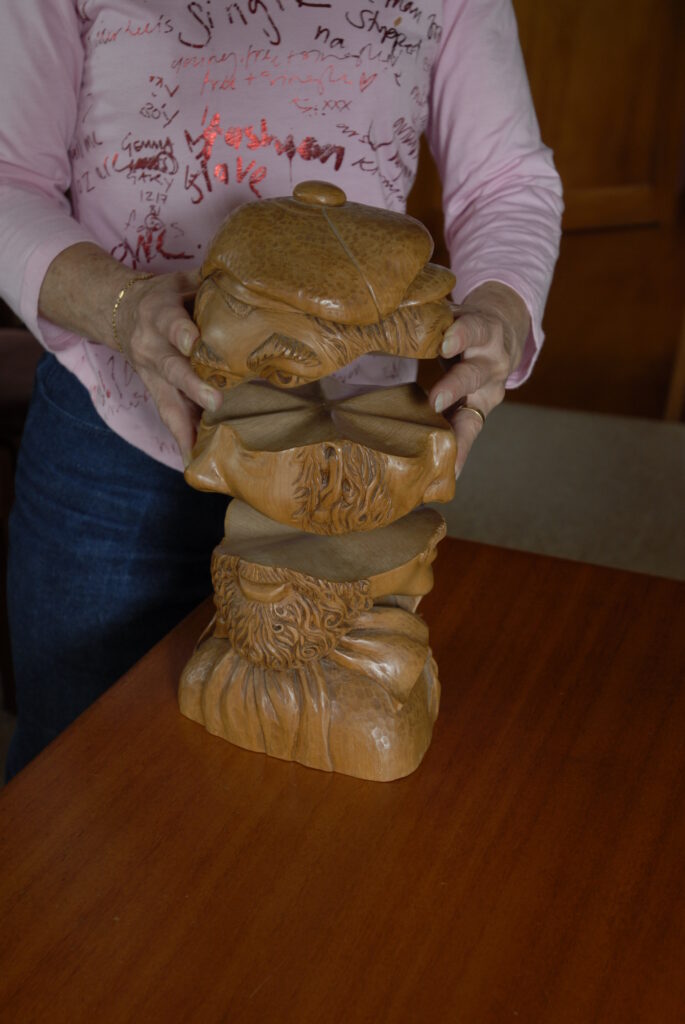
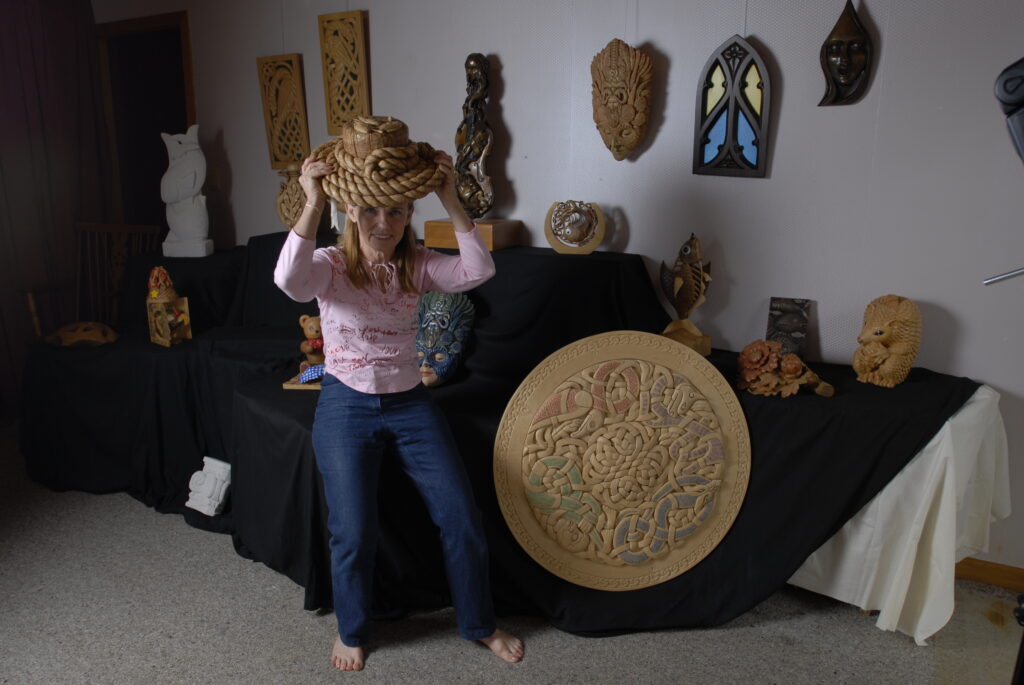
In 2006, the South Auckland Woodturners Guild invited Jane to be a Guest Exhibitor and Demonstrator to encourage and promote woodcarving in New Zealand. Her website (www.janeallnatt.co.nz) has photographs of 61 three-dimensional wood carvings (some sold, others not) as well as 20 wood reliefs, 17 wood puzzles, 19 textone puzzles, four bronzes and eight stone carvings. In the 2003 woodskills festival, the self-taught carver won the carving / open sculpture section with her upside-down jester, the New Zealand native birds section with her kaka carving and the fantasy section with her fishing hat made of gleditsia, a non-New Zealand extremely hard wood with an attractive straight grain (also known as the honey locust tree).
Reference
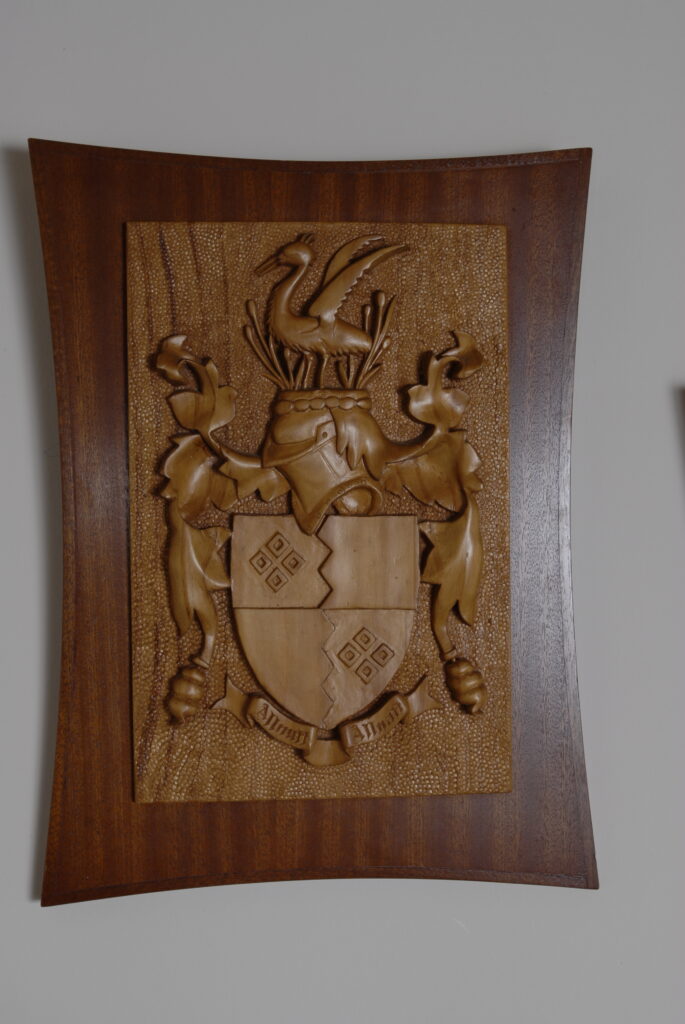
Her father’s advice was that the best artists would be those with the best reference material. She studied books, magazines and her father’s boxes of Modern Publicity, an annual American publication of advertising artwork as well as posters from the 1930s. She was not keen to take up painting as he suggested (“Dad was always trying to show me painting, but for me the competition was too great so I decided to keep off paintings”). But she did leather work and followed her father’s interest in heraldry with Celtic design relief pieces, knights in armour in copper repoussé and then her first wood carving – a coat of arms in relief. From there, she worked into full sculpture, encouraged by Terry Christie.
“When I first started at Kawerau, I had only a mallet and the smallest carpenter’s chisel. I was amazed when I saw that Hauraki district woodcarver Derek Kerwood had a lot of chisels. I decided I ought to have some, and I bought second-hand chisels from him. He learnt in England and carved wood for cathedrals. He taught people like Megan Godfrey to carve. She’s now well into her 80s and still carving. That’s why Kawerau is so good because you keep meeting other woodcarvers.”
Fantasy
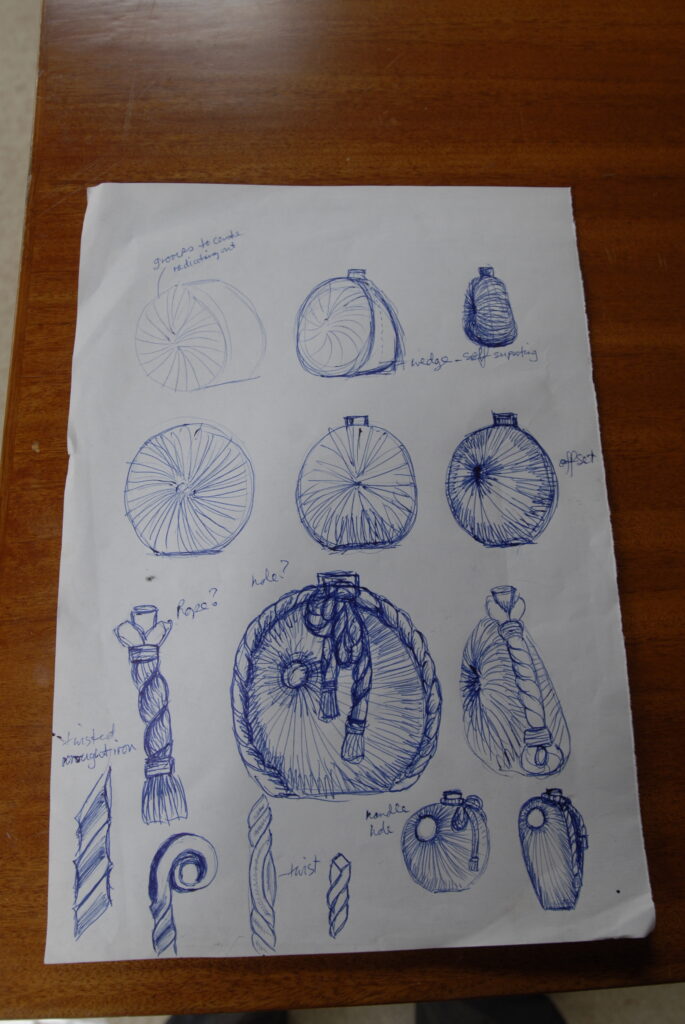
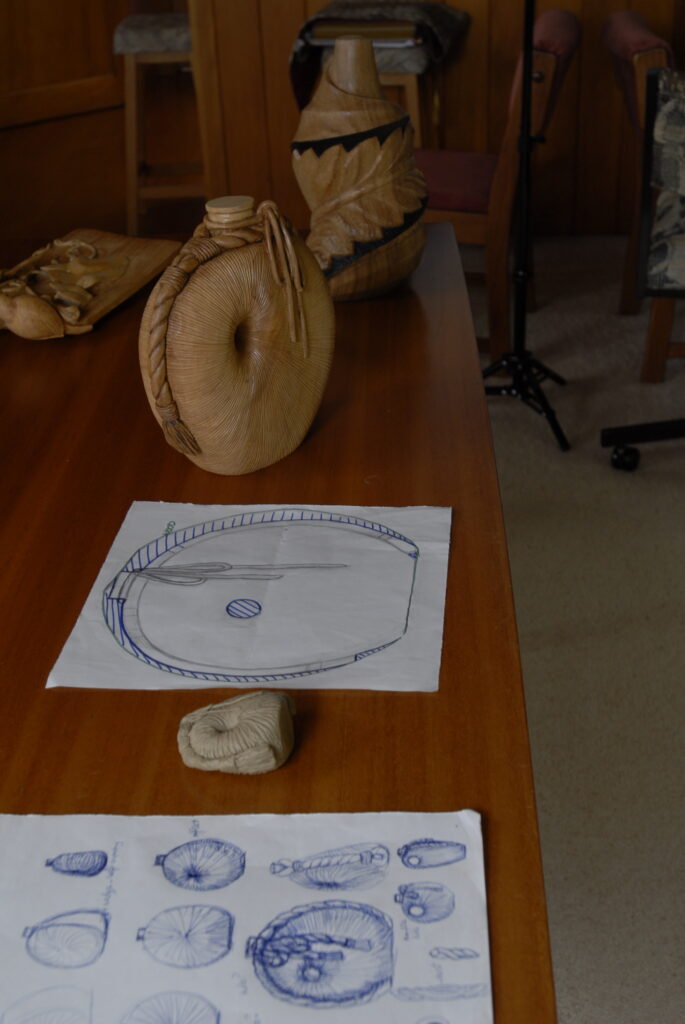
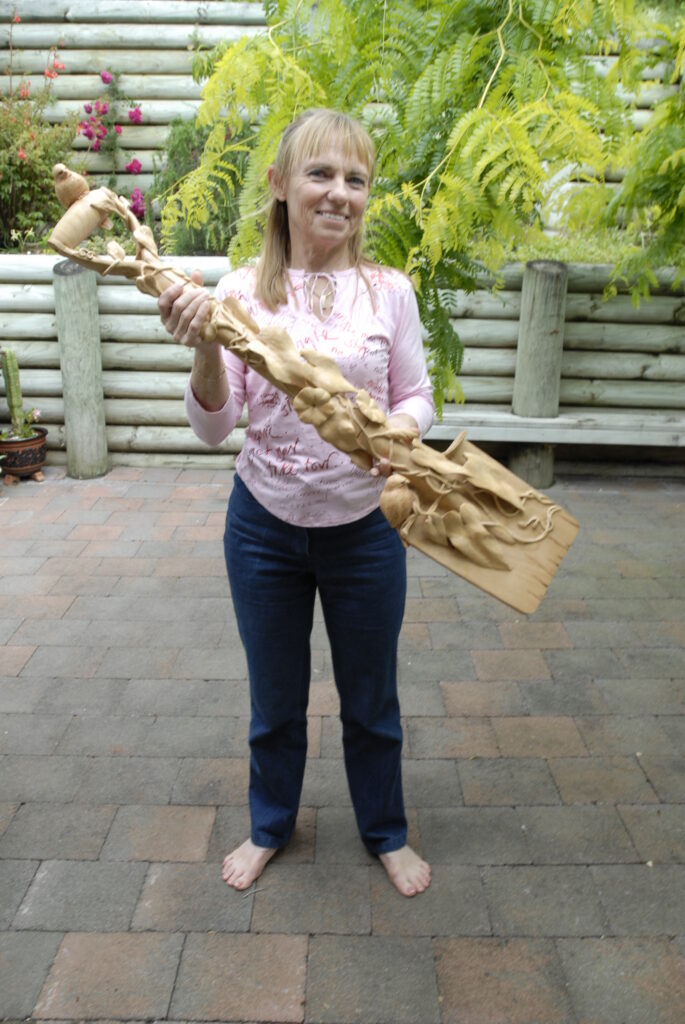
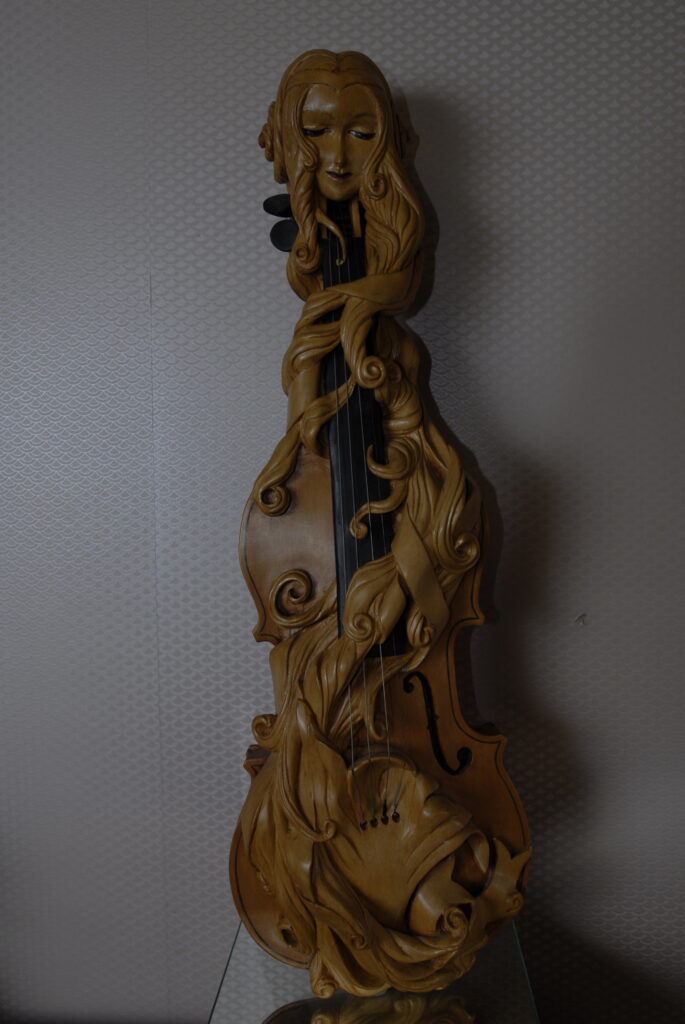
Jane Allnatt’s work mixes realism and fantasy – roses growing out of a fork or a spade, a pine cone hedgehog (Reggie Radiata – “I got tennis elbow working across the grain”), a woman with long hair intertwined with a violin. There’s often humour in there somewhere. She dreams up ideas anywhere, works from sketches through plasticine models – “you can play with it” – moves to detailed drawings and then freehand carving. “I wouldn’t be any good at making furniture,” she says, “you have to be too accurate.”
The wood she uses includes native timbers like totara when she can get them (the 1998 People’s Choice winner Lady of the Silver Strings was carved from a single piece of totara), pine and pine burr, poplar, American cherry, maple, bay tree (a dense wood that holds fine detail), and Lebanese cedar (“a wonderful aroma and a joy to carve”).
Her focus on one piece at a time is fierce, spinning out the whole day on the dining room floor.
“I would do ten hours a day if I were allowed. I am working a lot of hours a day.”
Her husband Jim, now retired from real estate, chimes in: “When I worked she would finish the housework at 9.30am and work till I came home, and I would ask where was the dinner? And she had been carving wood sculpture all the time. And Jane would then cook dinner.”
Jane: “You volunteered to do it sometimes.”
Interrupted
At another time, inevitably, with family gathering at Christmas, her work on the fork with roses was interrupted with demands on Mum’s time, and the piece took much longer than she wanted.
“The fork was interrupted and took so long, going on too long. And sometimes I would be halfway through a work and ask why am I bothering? I would see things from Asia costing next to nothing, and now it is good work. But creating a sense of beauty in my work keeps me going,” she says.
Apart from learning how to carve as she went, Jane Allnatt learnt the technique for holding sculpture on the ground after doing many pieces. She eventually discovered the ways of wood through doing it (covering sculpture with plastic to keep it from drying out) and now breaks out from the traditional wood look by incorporating texture and colour in her work. Her most recent carving for a local exhibition sold on its way to the show.
The humour is interesting because it sometimes takes people a while to grasp that side of a serious-looking business.
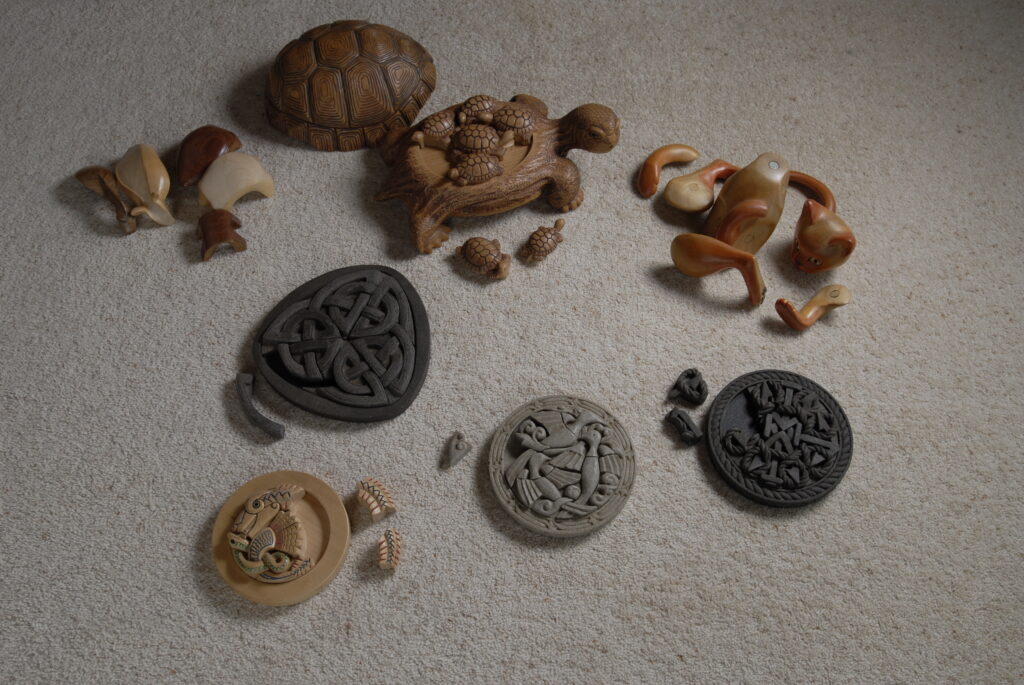
“I realised as a carver, if you did animals, you had to keep on your toes because people would pick you up if it was wrong. But when I made my tortoise with babies inside the shell, people said, ‘But a tortoise doesn’t carry babies there.’ My answer was that it was artistic licence. This is meant to be fun, but you always get somebody…”
Fillet of fish
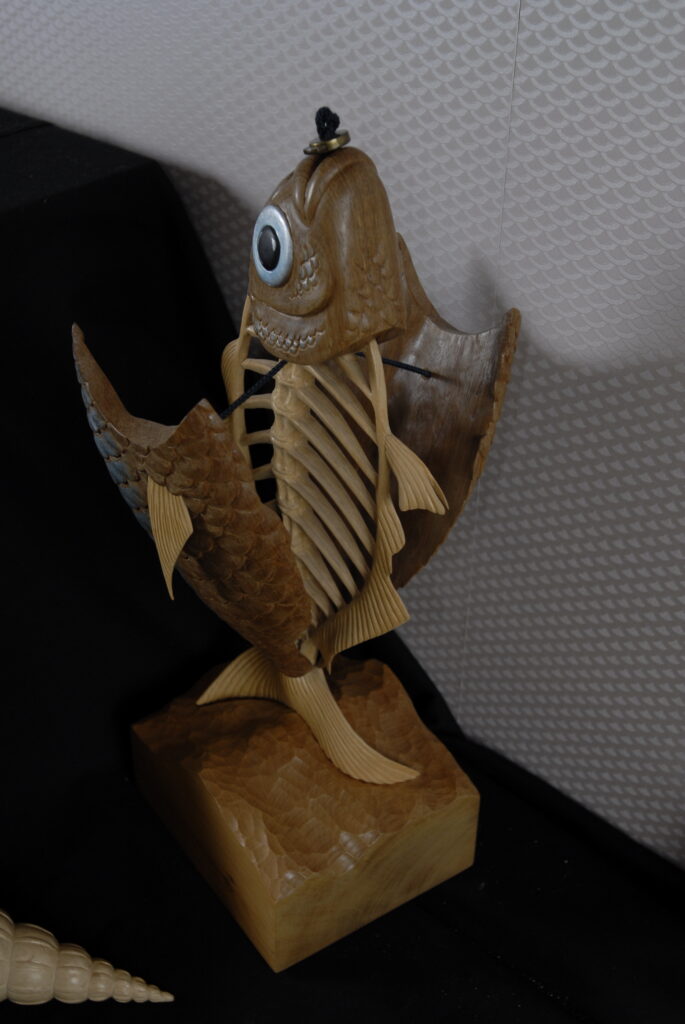
And humour can come from anywhere. Take the fish-and-chip shop inspiration.
“I was sitting waiting for my order and started thinking about carving a fish. Then the idea came to me that it would be fun to see the sides or fillets of the fish open and look inside to the skeleton. By the time I was hurrying home with the fish and chips, I was working out the idea for a sketch already.” The result, Fillet of Fish, is in her home gallery.
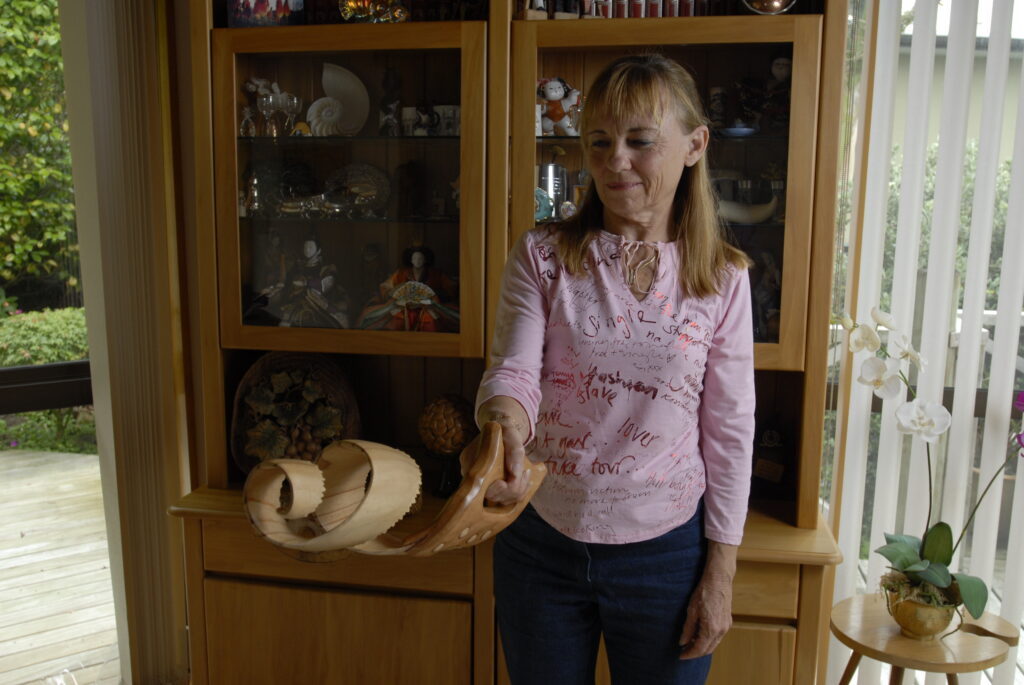
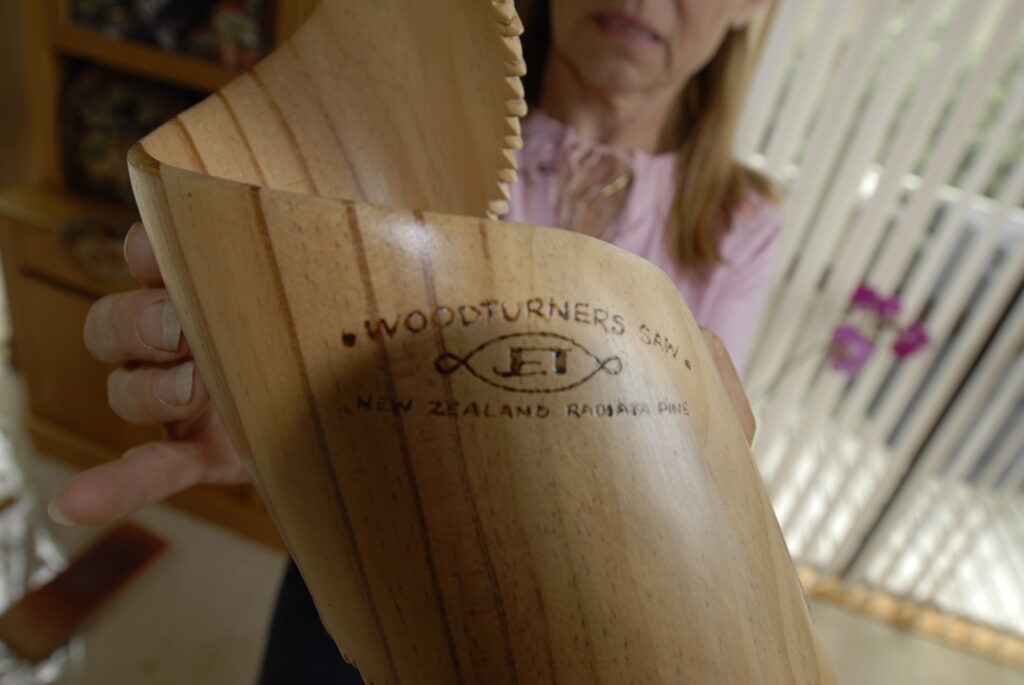
Another joke is that her woodturner’s saw contains the turns in the saw itself. Humour struck at home, too.
“To create a model, I made papier mache in the kitchen blender with toilet paper. I had a Japanese homestay, and he ate it thinking it was rice soup. He said politely that it was okay. The next day, he asked me to make some again. I am not sure if I wanted him to see the papier mache.”
Puzzles
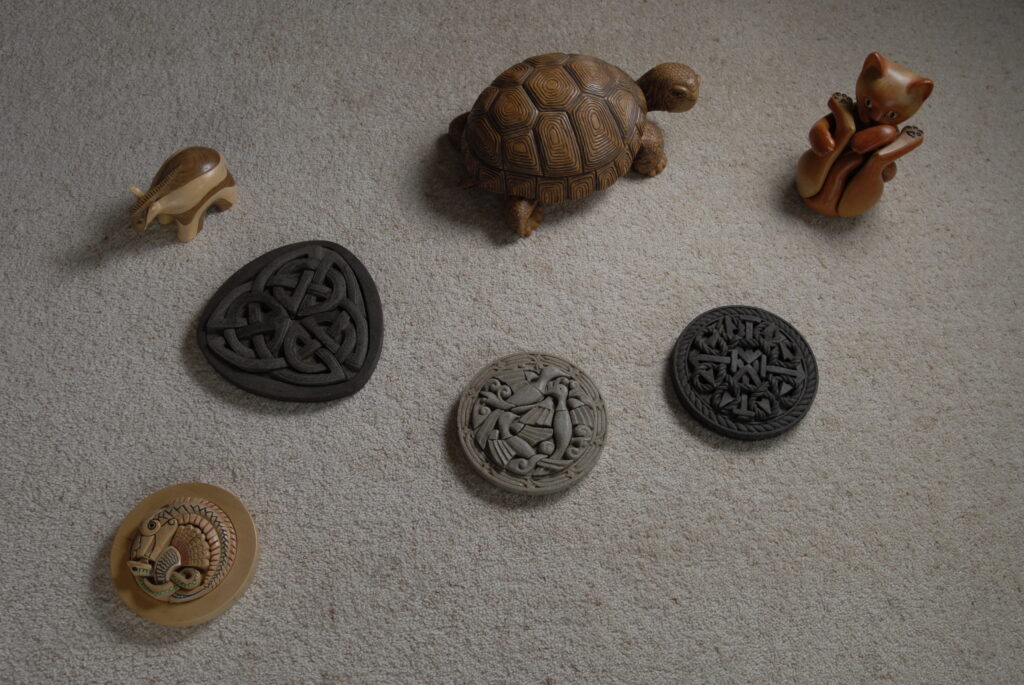
Then there are the puzzles, intricate interlocked shapes, often with a Celtic flavour and, predictably, someone who got stuck – a woman from Christchurch who, when the puzzle was taken apart, contacted its maker to complain that she couldn’t get it back again.
“But, it’s a puzzle, and I said to her, a good puzzle should take time. It should be puzzling,” says the puzzled artist. Eventually, she had to send the complainant the solution. Contrast that with Jane Allnatt’s memory of her son, then in his twenties, who, with a bunch of mates from his soccer team, was trying to put back together the various animals, circles and pieces of puzzle they had dismantled. “It looked funny to see a dozen young adults lying on their stomachs all over the place, trying to figure the puzzles out,” she says.
Recognising the intricacy of some of the bigger puzzles, the sculptor has incorporated magnets in the largest Celtic circle to stop the pieces falling out as it is moved.
Despite being reported as thinking, “Every year when I go down I look at the competition and think ‘wow’ and ‘where do those people get their ideas from?’” Jane Allnatt is never short of ideas. Even though some of them may be dreamed up on the dining room floor.