
Model Engine Sparkplugs

When I left school I took on an apprenticeship at William Cable in Wellington. Unknown to me at the time, this opportunity would lead to a life-long interest in model engineering. My apprenticeship gave me a wonderful grounding in all aspects of engineering.


BUSY IN THE SHED MAKING MODEL ENGINES AND SPARK PLUGS

When I left school I took on an apprenticeship at William Cable in Wellington. Unknown to me at the time, this opportunity would lead to a life-long interest in model engineering. My apprenticeship gave me a wonderful grounding in all aspects of engineering. I began in the tool room under the guidance of a great engineer and tremendous mentor who was prepared to take the time to pass on his knowledge and expertise. This definitely was the fuel that ignited my interest. The next step was time spent in the pattern-making shop at the foundry which gave me the knowledge of how to make small alloy castings in
my home workshop.

Engine bearings

In the general engineering shop I learned how to weld with both gas and electricity. It intrigues me to realise things have greatly changed since then. One particular skill I acquired was learning how to remetal engine bearings with white metal then machine them back to size. These bearings ranged from Austin 7s through to half-ton ship bearings—a broad spectrum. As my interest was really in the mechanics of what could be achieved in the tool room in my spare time, I began making miniature models for myself. This interest has continued and I have gathered numerous small tools over 50 years. I have a well-equipped workshop with two mills, two lathes and a large selection of hand tools and I spend many hours there. Over the years of making many different models—including steam

“In my spare time,
I began making
miniature models
for myself.”

trains, stationary steam engines and small jet engines—my interest and focus has been on internal- combustion engine models. All my engine components, including gears, pistons, rings, crank shafts, etc, are machined from scrap. I realised miniature spark plugs have become increasingly difficult to source, not to mention very expensive, so I decided to make my own. Trial and error ensued and then finally success.
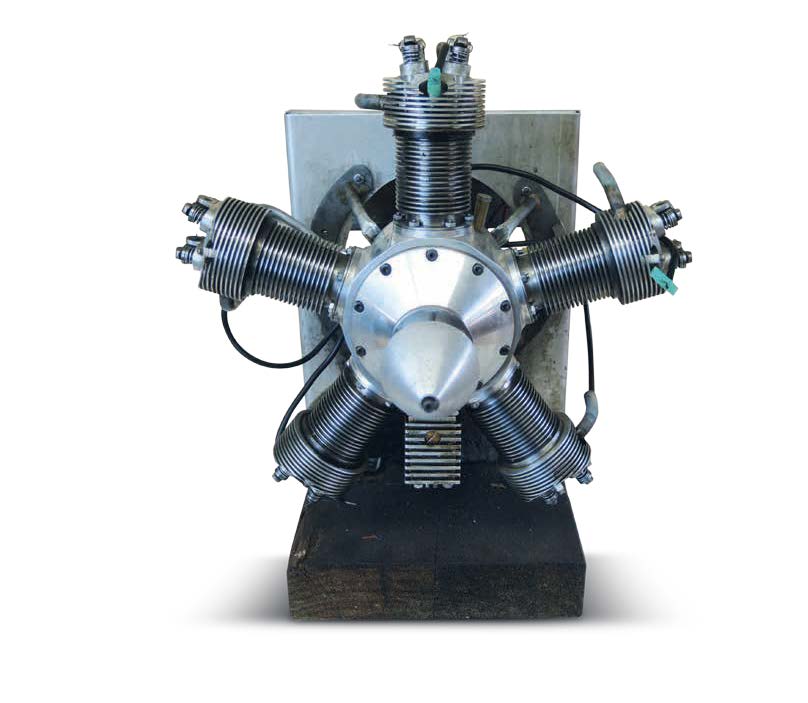
A 1930s Kinner k5 cylinder rotary aero engine over-head valve used in trainers prior to World War II.
 

A 1930s Kinner k5 cylinder rotary aero engine over-head valve used in trainers prior to World War II.

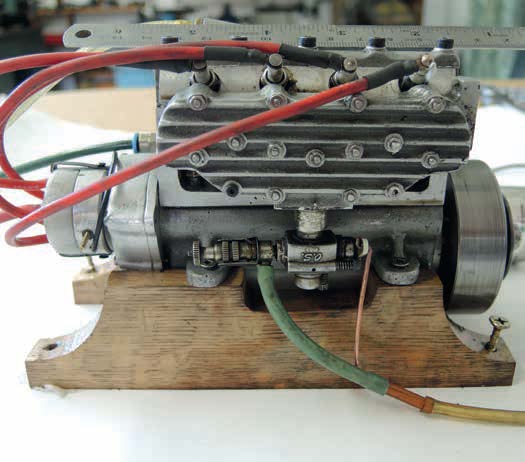
The same Morris Minor engine assembled


The same Morris Minor engine assembled

A double-acting single-cylinder steam engine built from scrap brass


A double-acting single-cylinder steam engine built from scrap brass

A 12cc overhead-valve marine engine built without castings 


A 12cc overhead-valve marine engine built without castings

DIY spark plugs

You can still purchase mini spark plugs from
overseas but being able to make your own
means you can vary the thread depth to suit
your own designs and you are saving in the
vicinity of $40 each.

The basic material components of a spark
plug are as follows:
• a piece of scrap mild steel
• ¼ pint (118millitres) old engine oil
• Corian off cuts (sourced from a kitchen
manufacturer)
• small piece of brass
• 1 mm tungsten welding electrodes

Method
First I machine the mild steel scrap to take
¼ inch (6.35 mm) x 32 model thread. I
transfer it to the mill and machine the blank
to take a 5
16 inch (7.94 mm) hexagon.
Reverse the piece on the lathe and mill a
4.8 mm blank hole for the insulator.
Reverse the body again and mill the end to
form an electrode.
When this is completed heat the body in a
gas flame to a blue colour and then quench
in old engine oil. The old oil produces a
black lustre on the surface finish.
Take a piece of Corian and cut it into suitably
sized lengths. Machine it into a round tube
4.8 mm diameter and drill a 1 mm hole the
full length to take the electrode.
A small brass cap is placed on top of the
electrode and welded so the ignition wire
can be attached.
Once all components are thoroughly
cleaned the electrode can be glued into
the insulator with superglue. Fit
a suitably sized gauge between
the two electrodes temporarily
and glue the insulator
into the body leaving the
required spark plug gap.

The beginning of making the outer body—a piece of old mild steel was machined to the diameters to take ¼ inch (6.35 mm) thread and a hexagon.
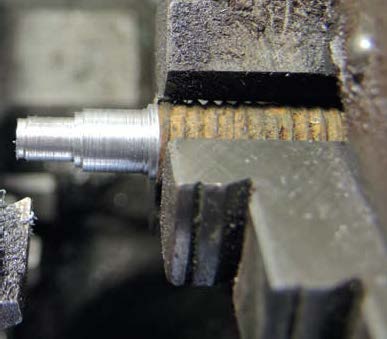
 

The beginning of making the outer body—a piece of old mild steel was machined to the diameters to take ¼ inch (6.35 mm) thread and a hexagon.

The finished diameters ready for threading


The finished diameters ready for threading

The completed body ready to be screwed into a mandrel in the milling machine


The completed body ready to be screwed into a mandrel in the milling machine

The hexagon being milled in the dividing head on the mill
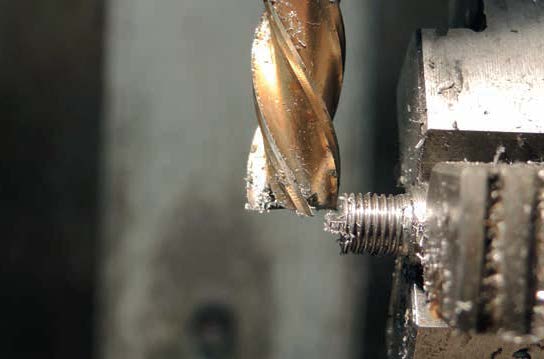
 

The hexagon being milled in the dividing head on the mill

The electrode being milled to the required width


The electrode being milled to the required width

The components partially assembled. The metal bodies were heated with a gas flame until blue and dunked in old oil producing a black lustre
 

The components partially assembled. The metal bodies were heated with a gas flame until blue and dunked in old oil producing a black lustre

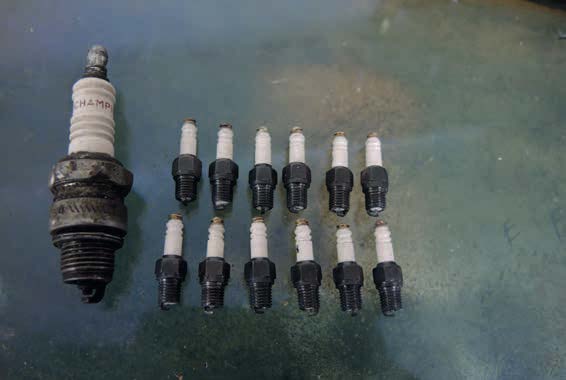
The completed plugs alongside a short-reach champion spark plug

 

The completed plugs alongside a short-reach champion spark plug
Share:

More Posts

Heart of glass

Parts of Carmen Simmonds’ cast glass studio glow with the ethereal, often surreal treasures that emerge from their creator’s imagination and the searing heat of her kiln. Radiantly coloured dolls’ heads, glass lace and crochet, headless dancing dresses, ballet shoes, lilies in milk bottles, flowers, and other organic forms are at once beautiful and disturbing.
Then there is the other side – the chemistry and chemicals, machinery, and tools; hours of modelling, firing, grinding, sanding, and cutting.
But this studio is also a home. Carmen and her husband Glen live at her work studio – a 100-metre-square shed on their 8.5-hectare lifestyle block in Brunswick, Whanganui. The shed was originally intended as Carmen’s full-time studio but when they sold their house in town they had nowhere else to live so they moved into the shed “to camp for a while” and have stayed, still temporarily, for eight years.  

Making a workshop bench video

Every shed needs a utility bench, and most sheds usually have one or two.
It’s a place where things can be worked on or stored. I have built a few recently, and I have developed a simple process that makes the process quite easy and results in a sturdy workshop asset with space for storage.
The advantage of this design is that it doesn’t require good, straight timber. In fact, I often buy very cheap, knotty 2nd or third grade timber from my local sawmill, who specialise in Macrocarpa. I can get long lengths, but they are rarely straight or twist-free. Sometimes I can get relatively straight pieces, or I can find 3 metres or so in a 4-5m length. For the most part, you can usually find enough pieces of around a metre that are relatively straight.

The Shed magazine April/May 2026 issue 126 on sale now

Hayden Scott’s road to crafting Damascus blades has been a journey of self-discovery, from an ambitious teen working the boning tables of the Balclutha freezing works to chef Al Brown’s right-hand man. Now, with over 25 years of experience using knives, he has found his calling: hand-forging the finest blades for cooks all over the world from his backyard sheds in the Waitākere Ranges.
“Hayden grew up in Balclutha surrounded by farmland and a practical family: his mum made the family’s clothes; dad was a chippie; an uncle built airplanes, and another uncle was a fitter and turner.
Hayden and his brother were often left to their own devices, usually with a pocket knife in hand. He remembers, “I always had a project on the go. What have we got here? What can I make from this?” Huts and bows and arrows lead to hovercrafts with electric motors, and later to bicycles, motorbikes, and furniture restorations.
His uncle Russell was a real inspiration, a builder who knocked together a Jodel airplane, which Hayden fondly remembers flying around Otago in. “I was in absolute awe that someone could build something like that, at home.” Another uncle, Allan, was a Fitter and Turner who rebuilt motorcycles. He had to dig out a cellar under his house to store his vast collection of vintage motorcycles. Hayden remembers, “He was always in there with his overalls on, working on them. Growing up around people like that was really motivating.”