The Shed Issue 81, Nov/Dec 2018 on sale now

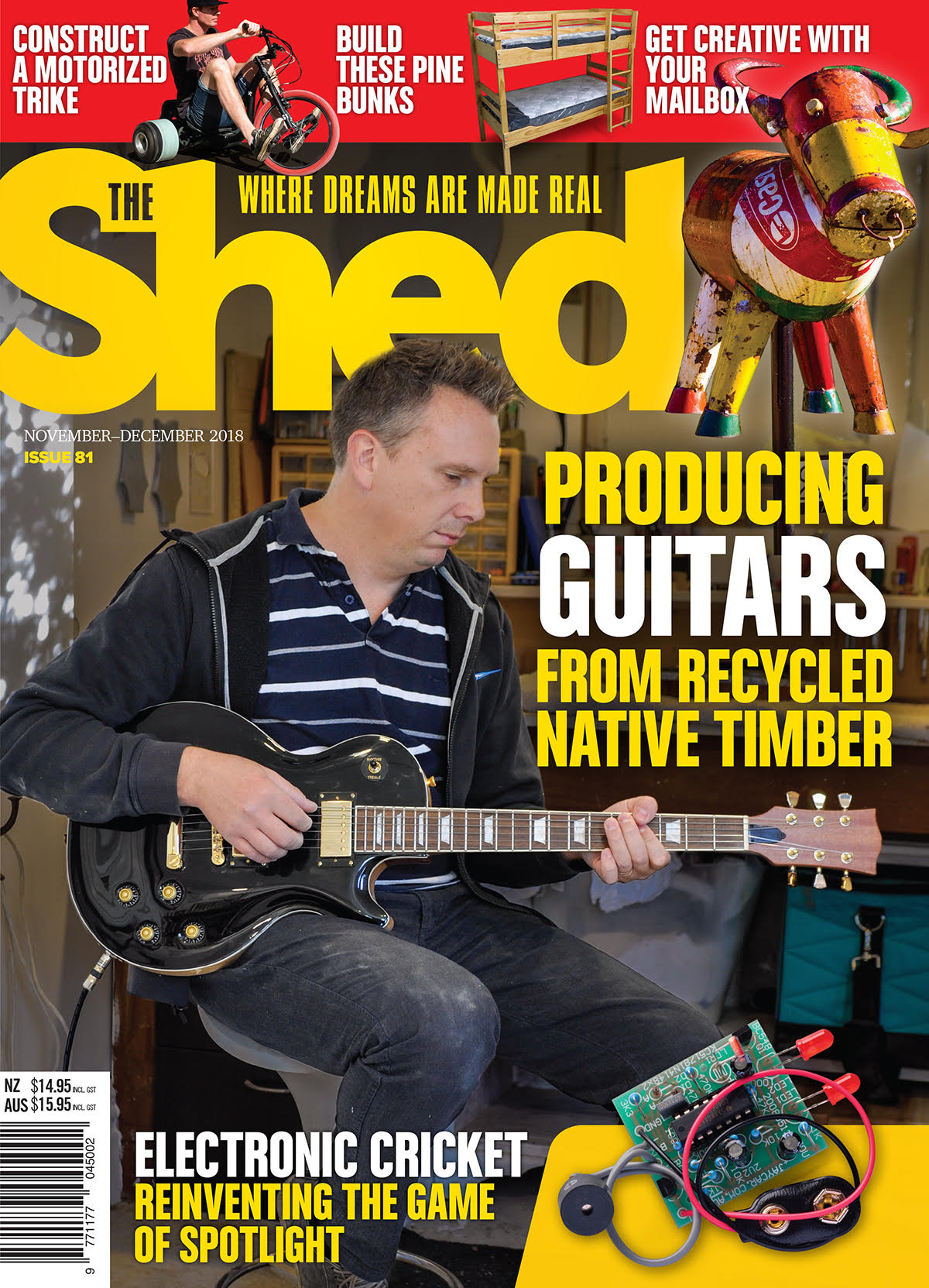
In The Shed 81, Nov/Dec 2018 issue, we head to Blenheim to meet school teacher and dedicated sheddie Dave Pauling.
Dave makes extraordinary guitars in his shed from recycled native timber and shares his skills with us so readers can have a go too. He nicknames some of his electric guitars ‘Les Paulings’ - nice touch.

Cover 81.jpg


In The Shed 81, Nov/Dec 2018 issue, we head to Blenheim to meet school teacher and dedicated sheddie Dave Pauling.
Dave makes extraordinary guitars from recycled native timber and shares his skills with us so readers can have a go too. He nicknames some of his electric guitars ‘Les Paulings’ – nice touch.
Another gifted sheddie, Kim Dawick of Cambridge, accepted a challenge after he built a motorised trike for a friend – build eight more for your other mates! Challenge accepted. He did just that and shows us how.
A young Taranaki inventor, Mark Horwell, talks with us about his shed-created gas and oil industry invention, a Switchfloat and The North Shore Men’s Shed in Auckland make a set of children’s pine bunks for a good cause.
Enrico Miglano uses more BBC microbit technology to make a fun cardboard robot and Des Thomson and his team at the Halswell Men’s Shed make a magnetic sweeper to gather all that messy swarf in your workshop.
Shed reader Richard Brown from Timaru tells us how he built a battery train set for his family and Mark Beckett sees this as an opportune time to discuss battery safety issues and good battery charging practice with readers. Jude gets making a set of fine high fidelity transmission line speakers using a Tri Trix kit designed by Curt Campbell then Ritchie Wilson tells us the history of the shed in a cupboard, plus does a few running repairs on, The Workmate portable workbench.
Our electronics team are busy again in this issue, Enrico is back with a guide to creating a Magic Mirror and Mark Beckett makes a fun toy for the kids, an electronic cricket that makes a noise when it is hit with light from a torch.
We close the issue with a look at some creative Tasmanian mailboxes with Coen Smit before Jude signs off the issue with his shed storage issue in his new regular spot in our Back ‘O the shed column
Share:

More Posts

Westland Industrial Heritage Park: From trash to treasure

The West Coast has a history as rich as it is rugged, with a past steeped in mining, logging, and dairy farming on a forest-clad strip between the mountains and the sea. Up by Hokitika airport is a sheddies’ paradise where relics from this past are being resurrected by an enthusiastic and capable band of volunteers.
“It all started back in 1981. Everything was going by train out to scrap, so we formed a club to stop it,” says Mort Cruickshank. The “we” were four young men – Spike Jones, Jim Straton, Mike Rooney and Mort. They formed the Westland Farm and Vintage Machinery Club and started salvaging old machinery that had been destined for the dump. With no premises, they kept it in their backyard sheds and met sporadically to plan the future.
Four decades on, and the Westland Industrial Heritage Park, spread over several acres up by Hokitika airport, is packed with machinery, sheds and enthusiasts. It is a hub of community activities, has a Menzshed on site and is increasingly a drawcard for tourists.

Making a gate – the blacksmith way

Joe Parkes is a blacksmith and as a youngster learned his trade the hard way. In 1958, aged 12, he was apprenticed to his grandfather and he quickly learned not to make mistakes. His giant Scots grandfather, Jack James, was a smithy of the old school. If young Joe got something wrong he had his head dunked in the half barrel of water used for cooling steel from the forge. He learned quickly.
“My grandfather, I called him Pop, was a big bugger, standing 6 ft 11 inches (1.8 metres) tall and weighing in at 20 stone (127 kg). He was a hard bastard, but he was my mentor. I once saw him pull a man through a high hedge and throw him over the top. You didn’t mess with him. If the blacksmiths got into a scrap you kept well clear.

Hot stuff in Taranaki

Hot rods – we see them rumbling round the highways and byways, big V8s burbling, immaculate finished body and paintwork and obviously someone’s pride and joy. Many people don’t realise the work that goes into customising one of these gleaming machines. Some are old cars reshaped and rebuilt, and some are made from scratch, often using the classic designs and lines of cars built in the 1920s, 30s and 40s.
In the little town of Normanby in South Taranaki there’s a workshop set up to create these beasts. We caught up with guys from three businesses in a row having smoko together. An upholstery business, a custom fabrication shop and an engineering shop. All mates who work in together in a way that can only happen in a small town.