Keeping an art alive
By Ray Cleaver
Photographs: Rob Tucker
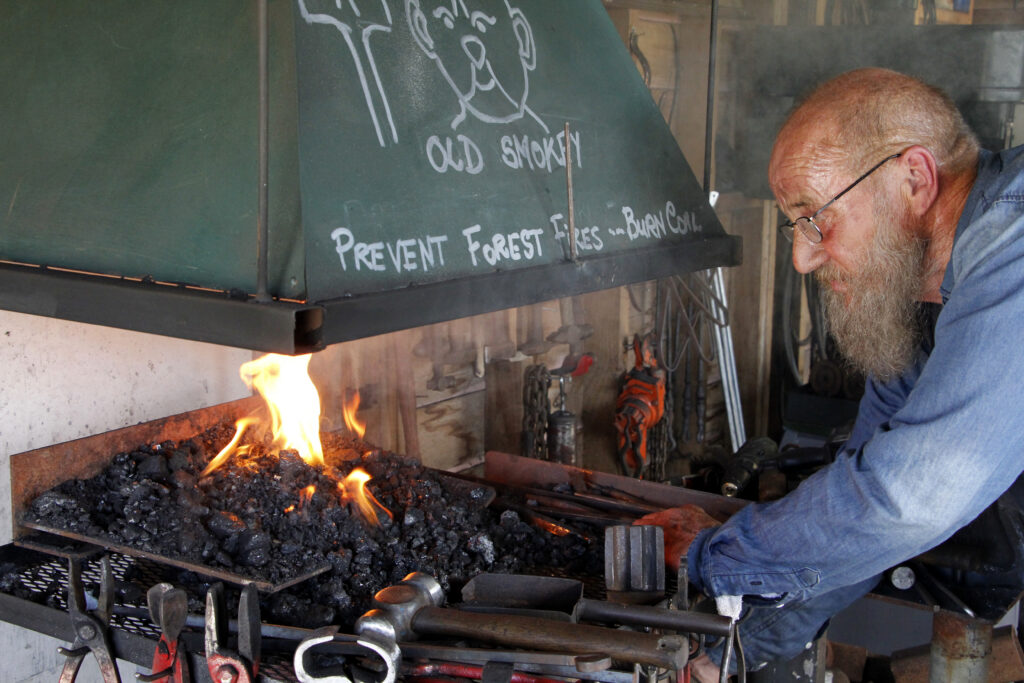
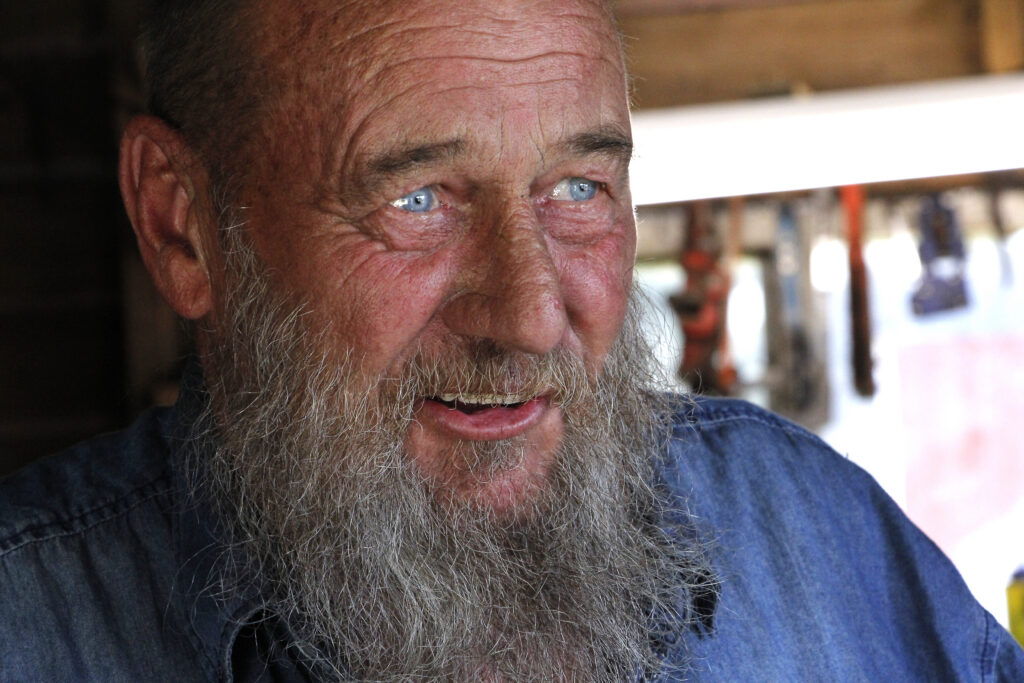
Joe Parkes is a blacksmith and, as a youngster, learned his trade the hard way. In 1958, aged 12, he was apprenticed to his grandfather, and he quickly learned not to make mistakes. His giant Scots grandfather, Jack James, was a smithy of the old school. If young Joe got something wrong, he had his head dunked in the half barrel of water used for cooling steel from the forge. He learned quickly.
“My grandfather, I called him Pop, was a big bugger, standing 6 ft 11 inches (1.8 metres) tall and weighing in at 20 stone (127 kg). He was a hard bastard, but he was my mentor. I once saw him pull a man through a high hedge and throw him over the top. You didn’t mess with him. If the blacksmiths got into a scrap, you kept well clear.
“If I got anything wrong, I had to fix it in my own time. If I did OK, he might allow me to join him in the pub and have one beer. He was still smithing in his 80s. I hope I’m still going at that age.”
Today, Joe, who lives in Stratford, Taranaki, has a deep love of the art of blacksmithing and has 56 years of smithy experience under his belt. He is a Fellow of the Worshipful Company of Blacksmiths, rated as an Eminent Master Blacksmith with a Silver Medal to his name.
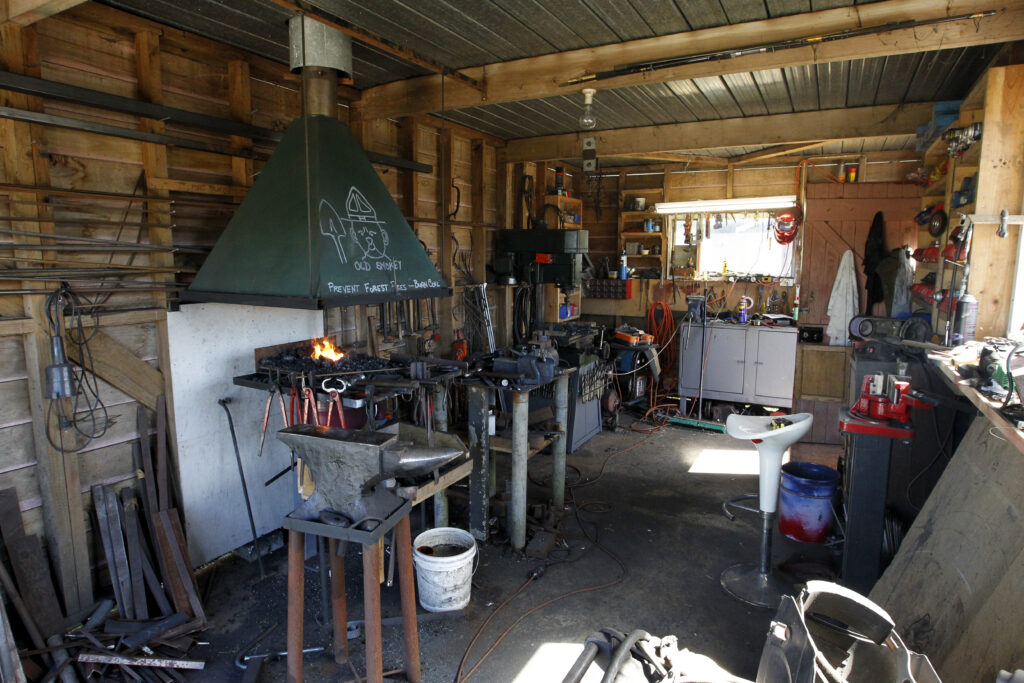
He gave us a good look at his shed, a well-set-up forge, showed us a gate he was making and told us a few yarns along the way.
Started young
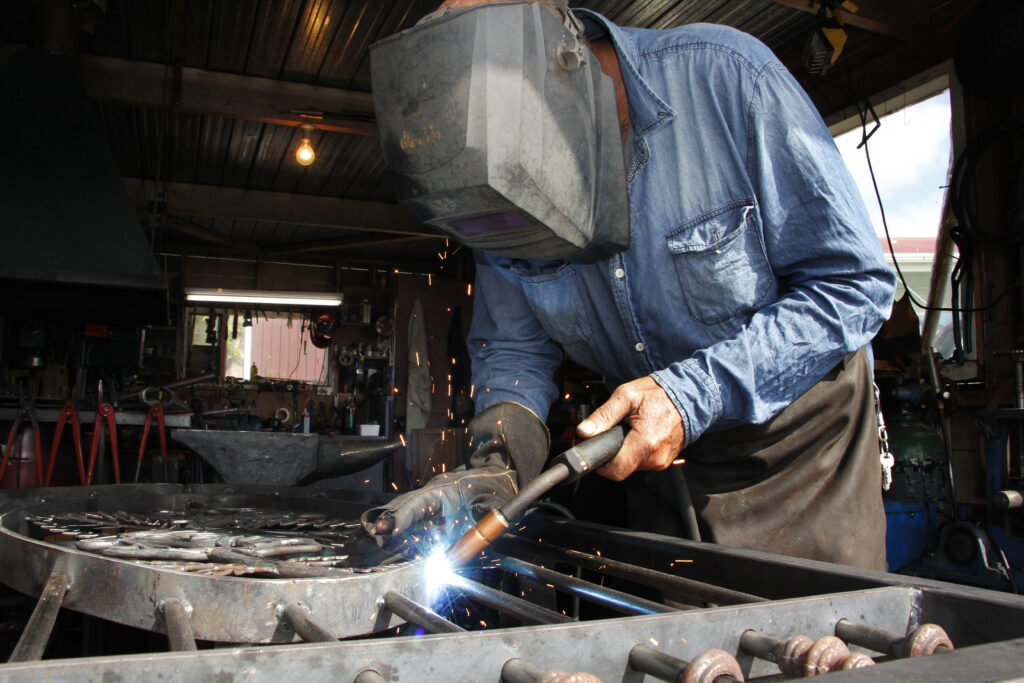
Joe learned to gas weld when he was 12 and to arc weld at age 14.
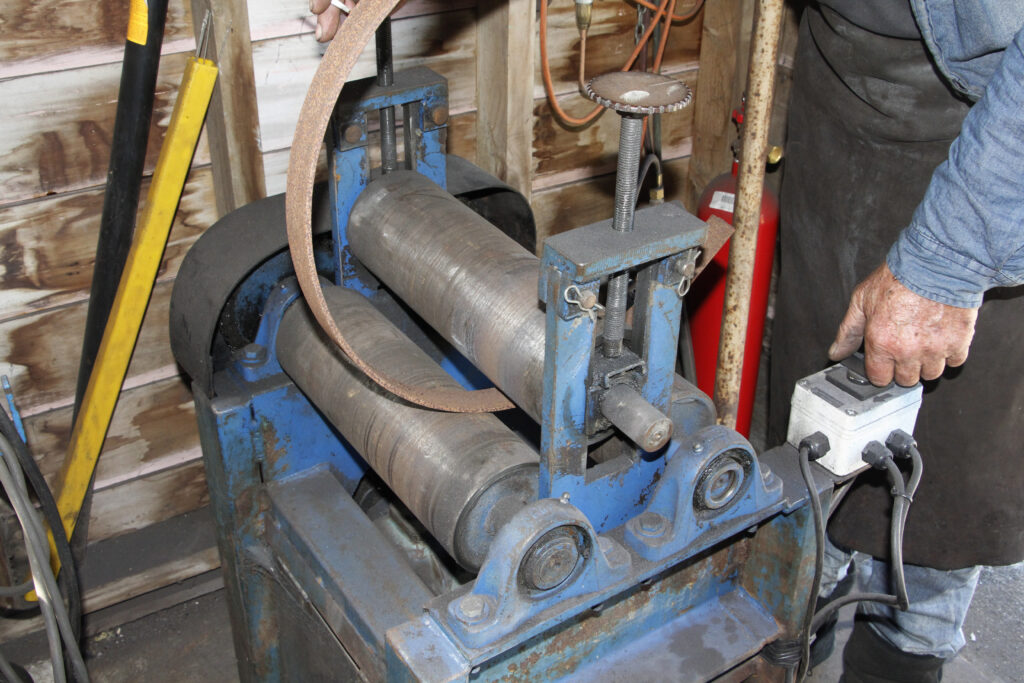
Nowadays, he has a 250amp Transmig welder. To bend steel, he has a manual Bramley bender that can bend steel bars up to 10 mm thick. Ten years ago, he made up a heavy-duty bar roller that can take steel up to 250 mm wide and up to 16 mm thick.
He turned a steel bar into a circle by putting it through the bender six times. It has big rollers, a powerful electric motor and a 60-to-1 reduction gearbox. He has even used this machine to bend steel into a circle for wagon wheels.
He has a heavy-duty drill/mill and a wide range of power tools. He has all his grandfather’s old hand tools and uses a set of heavy-duty, folding side cutters dating from World War I. It is a solid tool designed to cut through the German barbed wire in the trenches.
“I’d love to have a power hammer, but the neighbours may not be too keen on the noise they put out.”
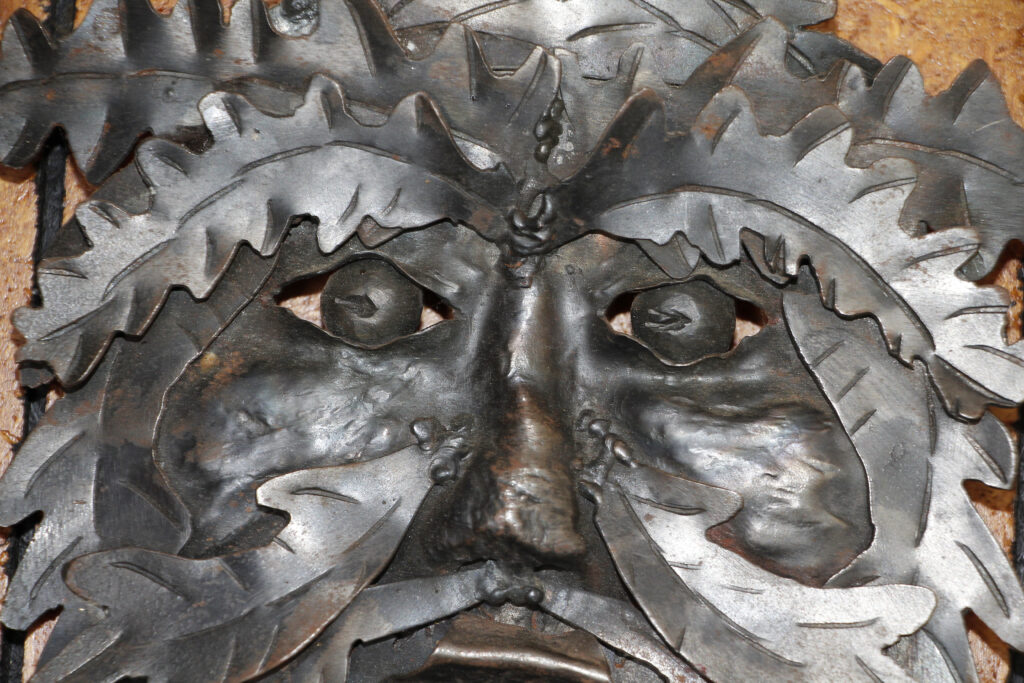
Anvil
Anvils go way back in time, and there are many references to anvils in ancient Greek and Egyptian times. Joe’s big anvil dates back to the mid-1800s. Stamped on the side is 1.75 cwt (188 pounds or, in today’s lingo, 85 kilograms). It is a Joshua Wilkinson anvil made of cast steel with the top two inches (50 mm) of high-carbon steel that is forge-welded onto it. A high-carbon steel horn protrudes from one side. Joe said in the old days, you were considered a man if you could carry the anvil across the forge floor and back.
Before modern welding arrived, forge welding was simply heating two pieces of metal and hammering them into one on the anvil. Joe’s forge is fashioned from an old 20-lb (9 kg) gas bottle, cut in two, with a commercial Canadian forge blower providing the airflow.
On the gas bottle is the base, also called the tuyere, which is a plate of mild steel three-quarters of an inch (18 mm) thick, with holes in it to let the air through.
“It doesn’t need to handle the extreme heat of the fire; the plate is kept cool by the air flow,” said Joe.
In the old days, an apprentice pumped the hand bellows to provide the air to heat the coal and coke.
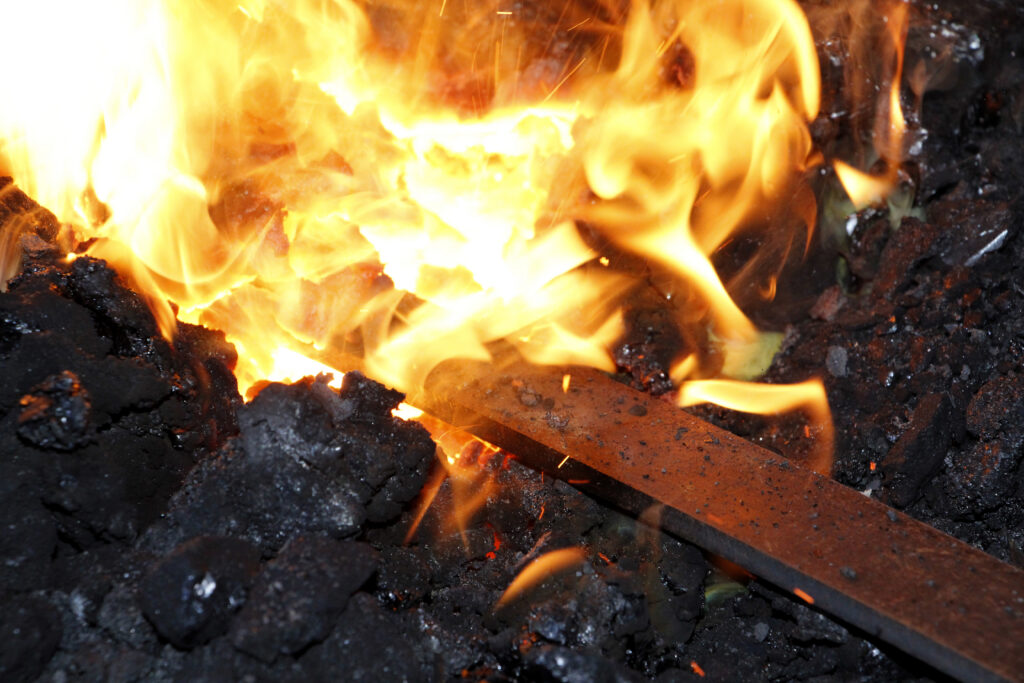
Joe fired up the forge for us. He threw a burning piece of cloth on the bed of coal and coke and switched on the blower. Within minutes, there was a red-hot centre in the flames. He put a small amount of water onto the blaze; the steam gets rid of the sulphur and coal oils.
Coke
“The secret of blacksmithing is burning coke. Coke comes from burning coal, and coal alone could never get hot enough for the job,” he says. “You get four times the volume of coke from a quantity of coal; it lasts three times longer and puts out a better flame. The coal turns to coke, which in turn becomes ash, with a small amount of clinker (slag) pieces left behind.
“The best coal is from Westport on the West Coast of the South Island. It has bitumen in it and is the only coal to make decent coke. There’s also virtually no ash. Huntly coal has too much clay in it.
“Once you’ve turned up the air flow into a bed of coke, you add some coal and make a little oven in the middle of the fire. A forge fire can get up to 1800 degrees Celsius.
“The coal smokes a bit; it’s the best thing for the wife’s washing,” Joe said with a grin. “It’s quite economical. A kilo and a half of coal will last six hours in the forge.”
Skills
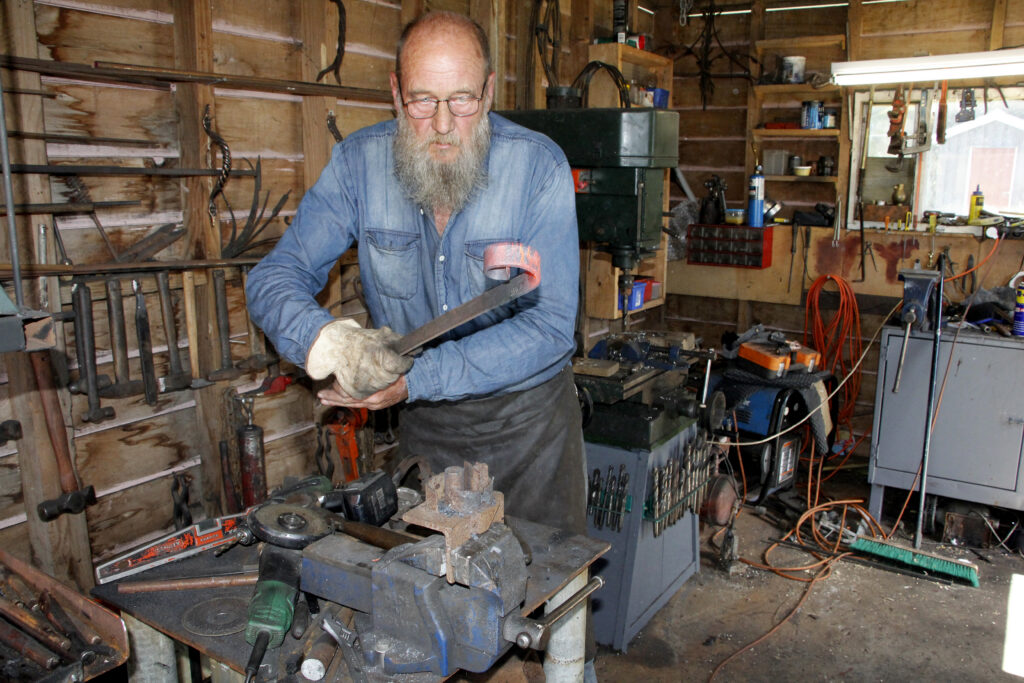
“You need to be dexterous to be a smithy. It’s hand-eye skills that are important, rather than strength, although you do need to be reasonably fit. I keep in shape by cutting firewood with a mate in my spare time,” he said. “To help apprentices to develop their hand-eye skills, I get them to play darts. I say, come back when you can easily shoot two twenties and a bull.”
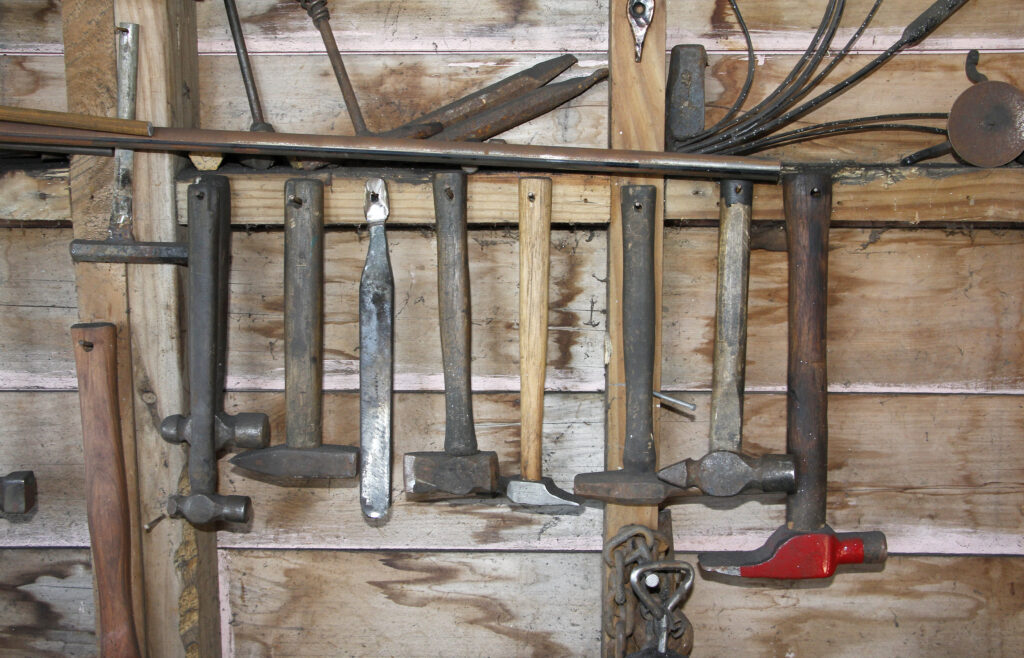
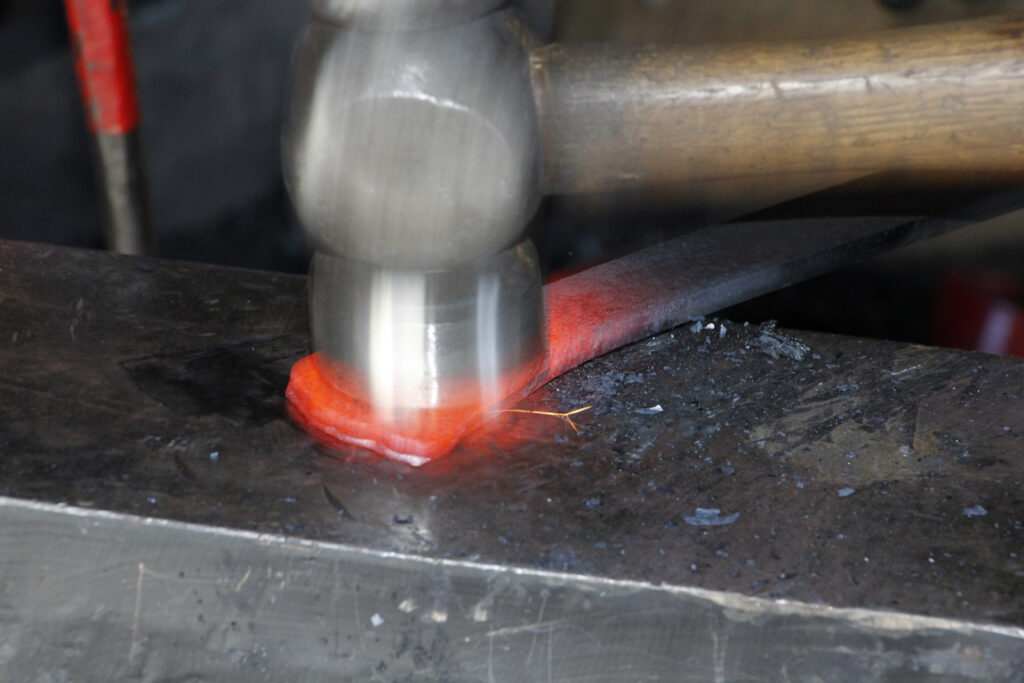
Joe’s collection of hammers consists mostly of special smithing hammers, though he occasionally uses engineering hammers. To make the gate in this article, he used a hammer given to him when he was 12 years old. It is a typical blacksmith’s rounding-and-facing hammer, the round side used for stretching and the flat side for flattening.
“When using a hammer, it’s also important to know the difference between a hard shot and a soft shot,” he says.
Some of the dies he uses fit into special holes on the anvil called pritchel holes (round holes) or hardy holes (square holes). He showed us a half-round die used for making wagon axles.
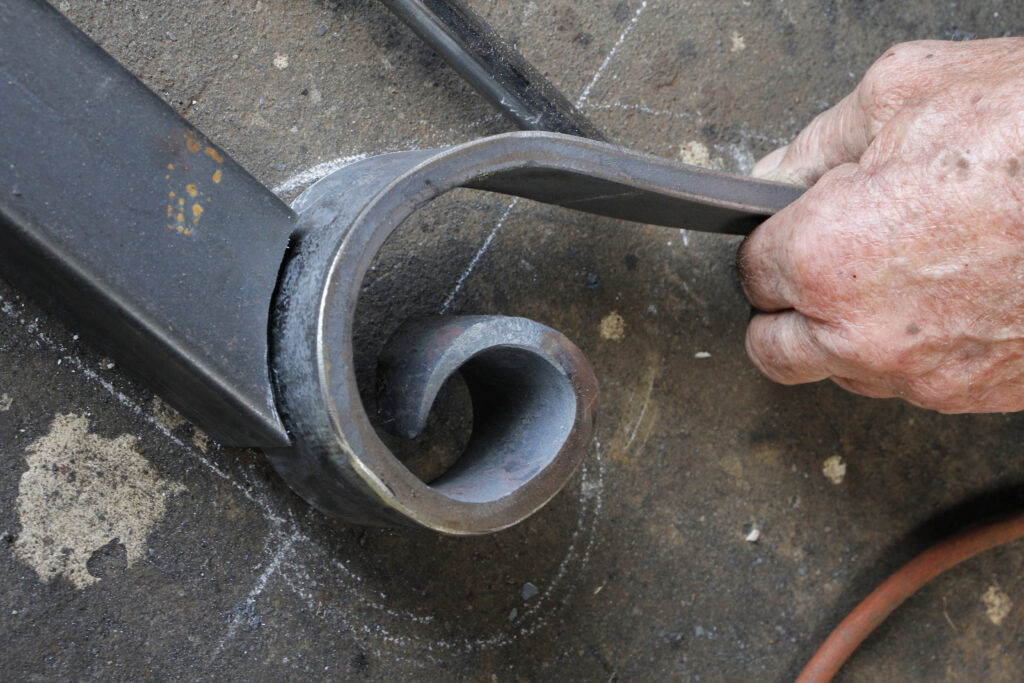
“You also have to improvise a lot as you go along. I make my own dies to bend and shape steel. They look like pieces of junk, but they all have specific purposes,” he said, indicating a pile of steel shapes on the floor.
Steel
He said he mostly uses 300-grade mild-to-low-carbon steel. New Zealand steel comes from Australia and China, but Joe isn’t impressed with a lot of the Chinese steel.
“Sometimes it’s called steel, but it’s really every bit of junk they can find melted down. It doesn’t last,” said Joe, spitting on the floor for emphasis.
“A lot of iron work today is done with a gas torch, rather than a forge. Real blacksmithing is a dying art.
Joe spent quite some time shoeing horses. “I never want to do that again. The smell of burning hooves and, now and then, a big horse that would like to kill you. No more.”
Joe can make almost anything. He makes gates, chairs, tables, stair balustrades, you name it. He also makes fine artistic pieces from steel and copper to sit on tables and hang on walls. One of these is a courting candle. In days long gone, these were used for a father to determine how long a suitor could visit his daughter while courting. The spiral candle holder is measured, and the time is marked with a small lug.
Joe is very keen to pass on his skills. He welcomes anyone of any age to come along and learn the skills that were the backbone of human technology for thousands of years. He can be contacted at hotiron305@hotmail.com.
“It’s a great skill. It’s about aesthetics and style. It’s not about speed. You have to have a love of it, or you’re wasting your time,” he added.
Joe’s story in his own words
“From the early stages of my working life, I found an affinity with ironwork and the creative side of blacksmithing. Working for my grandad, a Hamilton blacksmith, I learned my trade and even now still try to do justice to what he taught me, both in attitude and workmanship. In those days, in the late 50s and early 60s, it was horse-drawn drays, horse shoes, iron tyres and all the gear that went with it . General engineering was also part of it. Anything that needed fixing got our attention, including the seats at the pub across the road (a long repair job with fringe benefits).
“Occasionally, we would get gates to do, and I really enjoyed this – scrolls, shapes, latches, points and fittings all made in the shop. This was the boy’s job and that boy was me. I started in the shop at 12 years old, missed heaps of school and did a full day most days for the massive sum of eight shillings a week (equivalent to about $16 today).
“My mum paid my indenture to my grandad. It was three pounds five shillings a year for training for five years. I think she got sick of me not going to school. I kept doing the smithing, but later on realised that the blacksmithing was no longer a commercial entity, so I went on to qualify as an engineer.
“Nowadays we’re into a revival of the art, and it’s become fashionable to have all these things again, apart from parking horses in the shed for shoeing and smelling burnt hoof along with the aftermath of shovelling up the rose food [manure] after the job.
“For six years, my family and I had an engineering business in Bell Block that specialised in iron products and forging work in all manner of places. We did restoration on the ironwork in Tupare, the home built in the 1930s and owned by Sir Russell and Lady Matthews, and I competed at the Ellerslie Flower Show, doing sculpture and winning silver and bronze awards.
“Now allegedly retired, I still work every day making products for sale and doing repairs, using the forge with the same hand tools. The only things that have changed are the way we do things; no files, just a grinder with lots of different wheels, a bender to bend corners and bars and so on.
“Short, heavy fantail and fish tail scrolls and shapes are all hand-made, and markings are put in with heat and hammer. Small heavy scrolls can’t be bought, so are made in the forge and worked by hand, as are all the bits and pieces that can’t be readily supplied. So too are animals, birds etc. It’s a lot of heat and sweat, but with a bit of care, it can be done. My next project has got to be a power hammer. I’m getting too old to swing a big bloody hammer all day.
“Rivets look cool but are sometimes impractical to keep the job moving and that, my friends, is money. There are not many rivets used today, just dabs of MIG weld here and there. I don’t think I have even one rivet snap in my kit any more. Materials have changed, too. No two bundles are the same; some are easy to work and some hard, the rolling of the product can leave hard- or soft-edged flats and squares, square tube always has different corners and so on.
“The marketplace is flooded with imitations of good iron carefully disguised by the Chinese as the real deal. Joints and collars, fittings, fleur de lys patterning, balls and decorations are all made offshore and shipped in to be welded on. I say to customers, ‘Tell me again in six months where you bought the damn thing and don’t bring it to me to repair.’ But I use a lot of those fittings now because I cannot compete with the online Chinese ‘fabricators of iron’ and people have grown to expect the look of welded-on fitments. The Chinese make good power hammers, though; the big Anyang hammers are brilliant.
“Welders have changed, too—for the good, I might add—from the box that hums in the corner to the extensive control now possible in MIG and TIG, making the job easier.
“I will always remember Pop’s roller for flat bar, a real mongrel, a big fly-wheeled, hand-powered machine with open gears everywhere. It was not only hard to wind up but if you slipped it would eat your T-shirt right off you before you could stop it. How the hell I never lost fingers, I don’t know. I have a home-built roller now. I just bend the preset, turn the switch one way and off it goes, stop it, adjust the tension, reverse the switch, and it goes the other way; a precious machine for sure.
“To do scrolls, I needed consistency, so I made jigs; they look like a scrappy’s dream, but they work well. Making small scrolls is easy; it’s when you have to make them two-plus metres long and from 50 mm-thick steel by 12 or 16 mm on its edge that it gets tough, with lots of heat and sweat.
“Blacksmithing is a good skill, and I believe one that is still relevant, satisfying, artistic and, as I now teach it, gratifying. To see a young person create in iron for the first time is magic. To see the lights come on, the spirit dance and the pride in their eyes is a wonder to behold. I would to encourage anyone to have a go , not just heat and bash.”
Garden gate
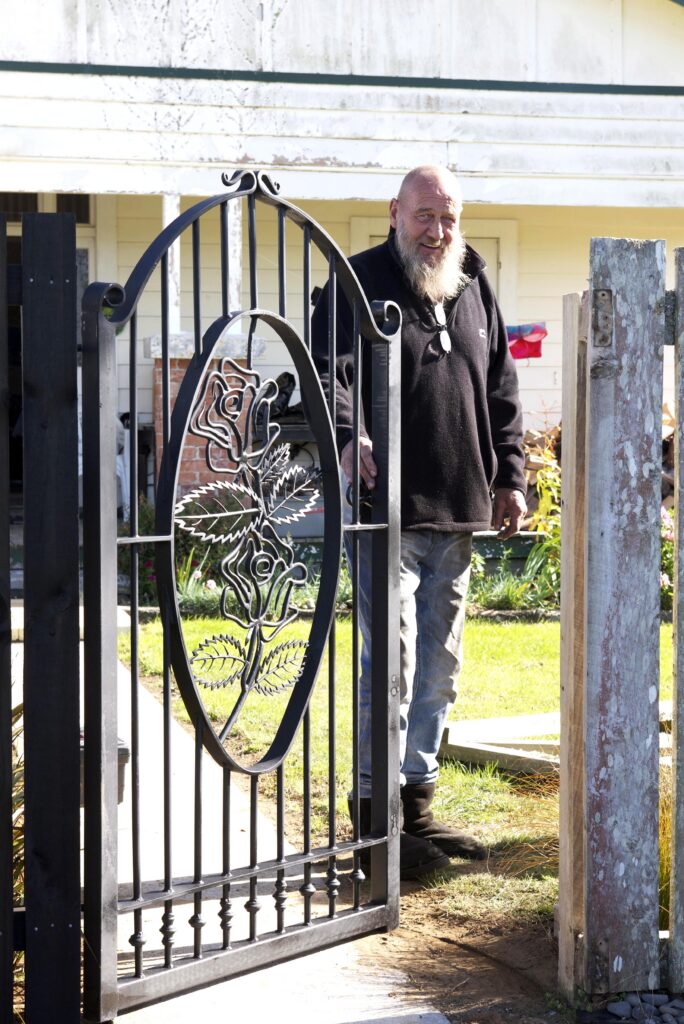
Joe showed us a garden gate he was making from box section, steel bars and pipe, fired in the forge and hammered by hand. For the frame of the gate, he used box-section steel, 50 mm x 50 mm. The decorative inset in the middle of the gate is framed by curved 50 mm x 10 mm steel bar. In this frame are steel leaves made from 20 mm x 10 mm bar, fashioned with a grinder, bent cold and with a tip welded on each end with a MIG welder. The leaves are slightly twisted in different directions to give a 3D effect.
A row of 16 mm hollow steel pipes running down the gate finishes the job. On the bottom ends, metal collars were slid on and welded. Joe said he uses hollow pipe to keep the weight of the gate down and reduce the cost of galvanising, which is charged by the kilogram.
He made a scrolled latch for the gate from 12 mm x 12 mm bar, flattening it out on one end to create a fantail scroll, scouring lines with a hot chisel and bending it to shape on a homemade die. Joe said the difference between a hot chisel and a cold chisel is that, while they are a similar shape, the cold chisel has more bulk.
This is a gate that will be around for a very long time.
Rose
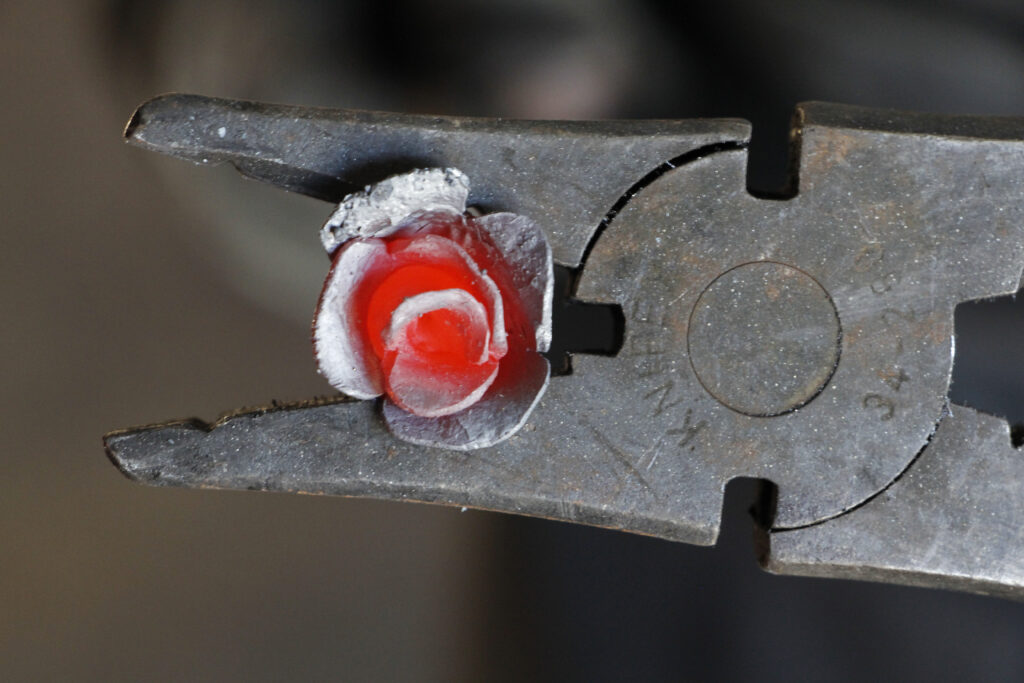
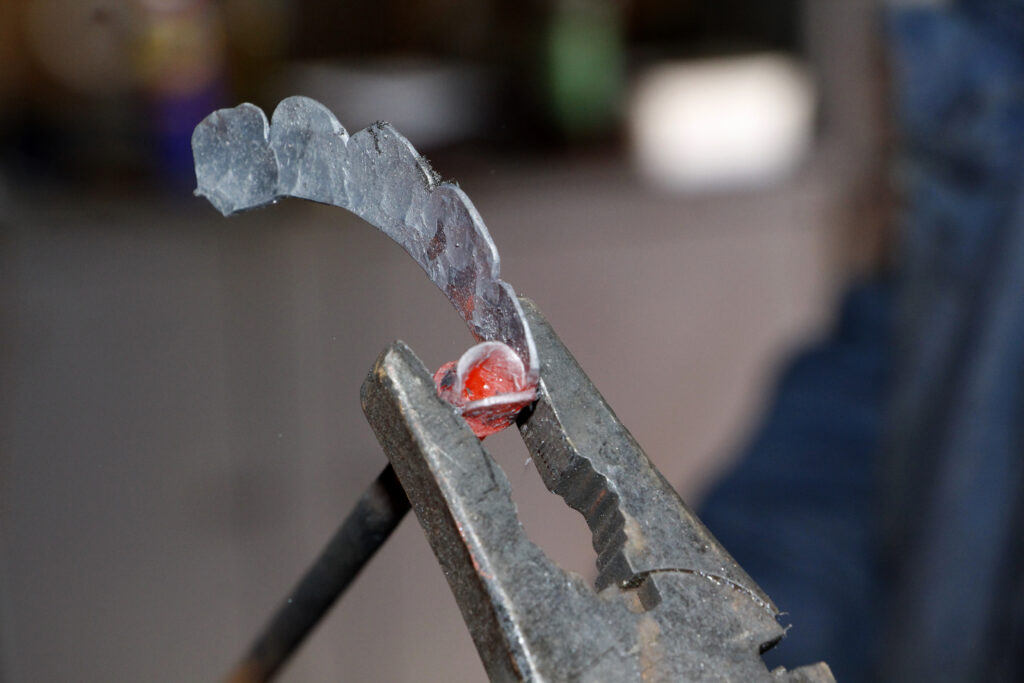
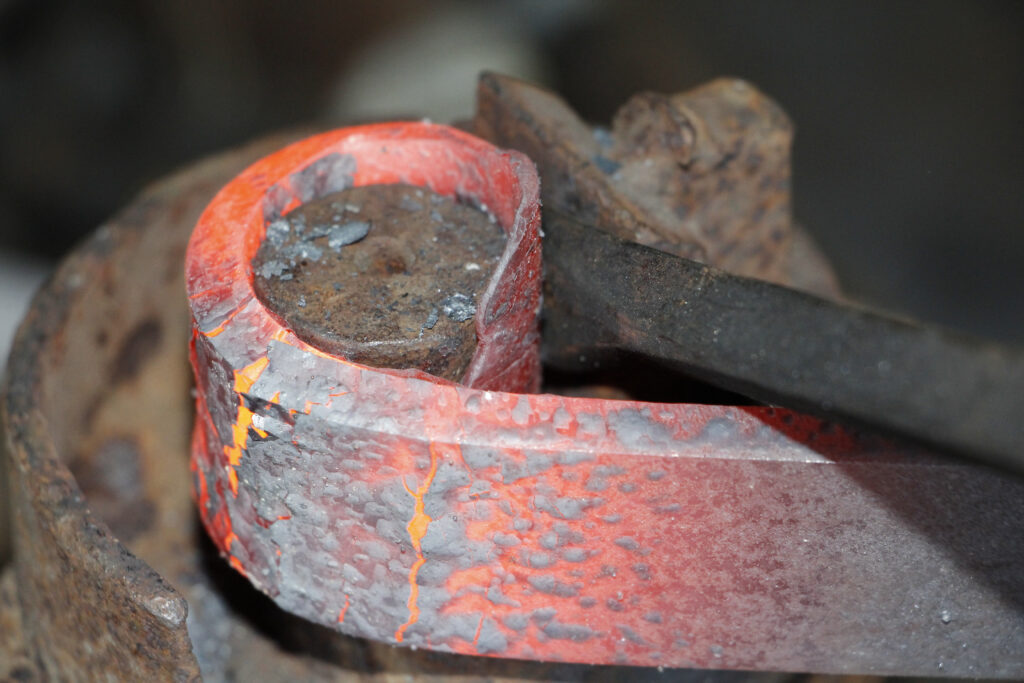
Joe made us a tiny, delicate rose petal in the forge to show it’s not all heavy-duty hammering. He heated a thin rod on the fire and beat the end with a hammer to make it flat, then scoured lines with a hot chisel. While the metal was still hot, he bent the rounded end around itself to make a rose bud. This was a skill he learned from an American blacksmith. He makes these and tack-welds them onto a vine.