
Diamond jubilee for boots that shine in the mud

Surprisingly, the modern Red Band gumboot is virtually identical to the original model, apart from the addition of a sponge innersole. Skellerup made the boots in its Woolston factory in Christchurch until the late 80s. It continues to make all the components and the boots are still handmade the same way in Skellerup’s factory in Jiangsu, China.

Iconic Kiwi Red Band gumboot keeps on keeping on
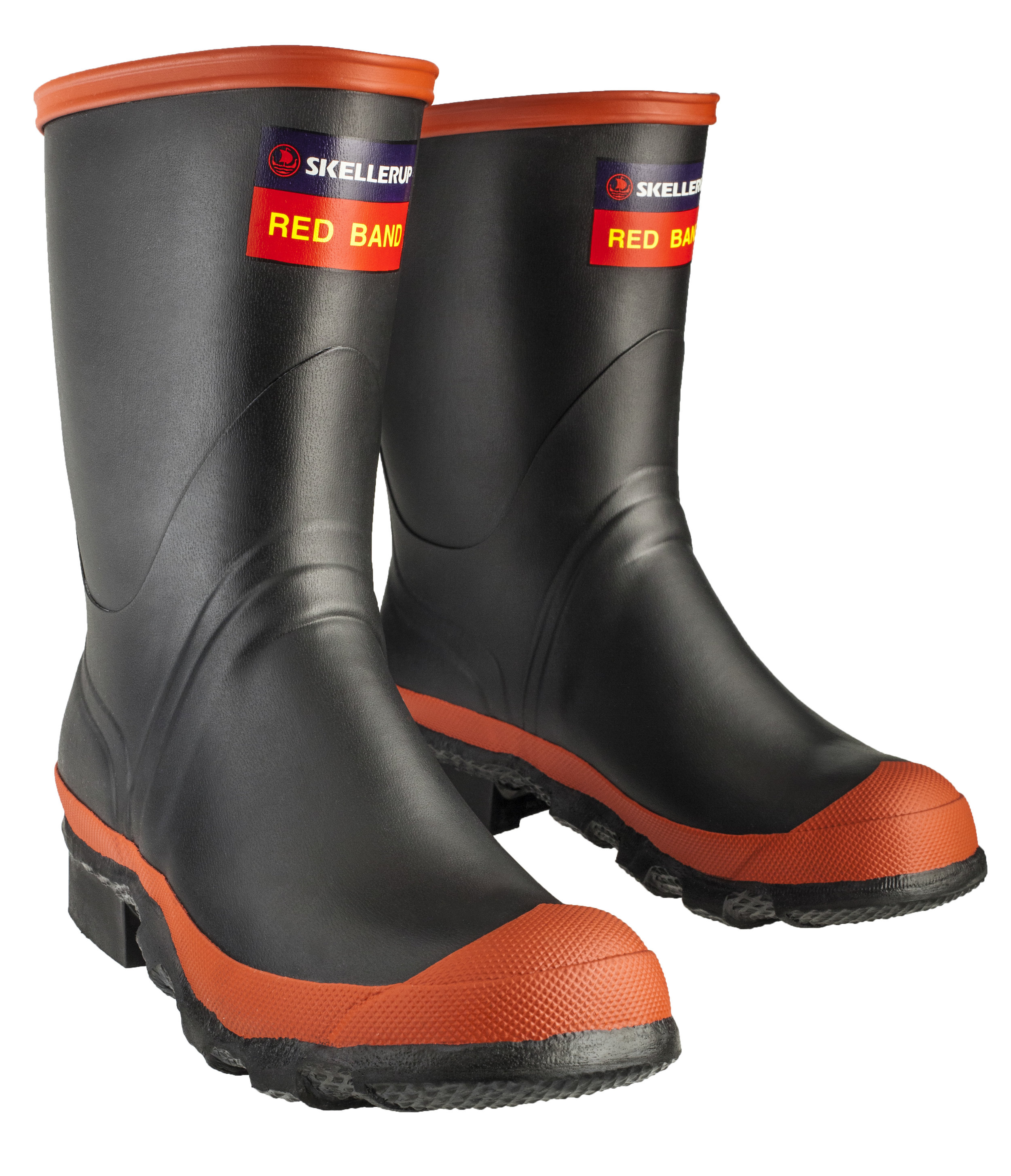
Red Band gumboot angled.jpg


The Aussies have their dangly cork hats and the Brits their waxed cotton jackets, and this month marks 60 years since the creation of one of New Zealand’s iconic outerwear essentials – the Red Band gumboot.
John Clarke, aka Fred Dagg, cemented our identification with practical rubber footwear in his alternative national anthem, The Gumboot Song. To be fair, Clarke borrowed freely from Billy Connolly’s If It Was’nae For Your Wellies, which he in turn adapted from an older song.
Even if the song isn’t original, Red Bands can claim to be a Kiwi invention. Traditional gumboots topped out just below the knee, like riding boots. Skellerup says their Red Bands were the first short gumboot marketed in New Zealand, and possibly the world. They were also designed from the start to fit the slightly wider Kiwi foot.
“No-one is quite sure who it was at Marathon Rubber Footwear – the forerunner to Skellerup – who had the idea to create a shorter boot but sometime during 1958 the new concept was tried out,” says Skellerup’s national manager footwear, Perry Davis.
The first pair of Red Band gumboots rolled off the production line on 21 October 1958 and became “an instant hit” around the country, he says.

image001.jpg


If it ain’t broke
Surprisingly, the modern Red Band gumboot is virtually identical to the original model, apart from the addition of a sponge innersole. Skellerup made the boots in its Woolston factory in Christchurch until the late 80s. It continues to make all the components and the boots are still handmade the same way in Skellerup’s factory in Jiangsu, China.
They are assembled from 38 individual rubber components using six different natural rubber formulations, with UV inhibitors added for New Zealand conditions. The panels are rolled and pressed and cut, rather than just moulded, to make them more flexible and robust. A cotton liner covers a rubber-infused, heavy-duty canvas which adds structure to the boot, protecting them from tearing or separating like cheaper boots. The boots are assembled on metal lasts, then baked in a vulcanizing oven to cure and set the rubber.
Davis says Skellerup has worked hard to preserve Red Band’s reputation for quality and excellence. It has also expanded the brand into several models of gumboots for children, as well as socks, work boots and clothing.
“Red Bands have become part of the Kiwi landscape because they are the no-nonsense gumboot that works, and last a lifetime,” says Davis.

 

Share:

More Posts

Introducing the New Linbide.co.nz

Linbide is proud to announce the launch of its newly redesigned website, linbide.co.nz, marking an exciting step forward in how we connect with the woodworking, engineering, and tooling communities across New Zealand.
For decades, Linbide has been dedicated to producing high-quality carbide cutting tools built for accuracy, durability, and performance. Our new website carries that same commitment into the digital space—designed to be faster, clearer, and more intuitive, giving customers a better way to explore our products and understand the value behind the Linbide name.

Woodwork: getting started (2)

A home workshop is a special place and will function much better if you are able to plan how it is set out. My first workshop was in a single garage which was also the home of a very old Austin 7. As I bought machines, things became a little tricky. It was not that motivating on a winter’s evening, knowing I had to shift the Austin and re-arrange the workshop before I started. Our architect’s major renovation to our home included the redevelopment of my workshop area and from a single garage to a 9 m x 6 m workshop was a massive leap forward, even if it is shared with an MG.

The Shed magazine December/January 2026 issue 124 on sale now

The Stude-Maker
Studebaker marketed their groundbreaking 1950 Aero-Nose models as “luxury for everyman.” A young Trevor Halstead thought this was a bit of him, so he began purchasing Studebakers in the early 1970s. The fact that the Champion model he chose was $50 less than the Ford he really wanted did play a small role in that life-changing decision. As they say, the rest is history.
“To the man on the street, they became known as bullet noses, and while they proved to be Studebaker’s best-selling model in 1950, those aero-lines did not age so well, and by 1952, the company reverted to a more conventional front end.
Fast forward a couple of decades into another hemisphere, and a one-man Studebaker ‘Next Look’ revival was about to begin, in the workshop of Studebaker devotee and custom-builder, Trev Halstead. This time, though, those vintage lines would take on wild and offbeat shapes.