The Shed Issue 81, Nov/Dec 2018 on sale now

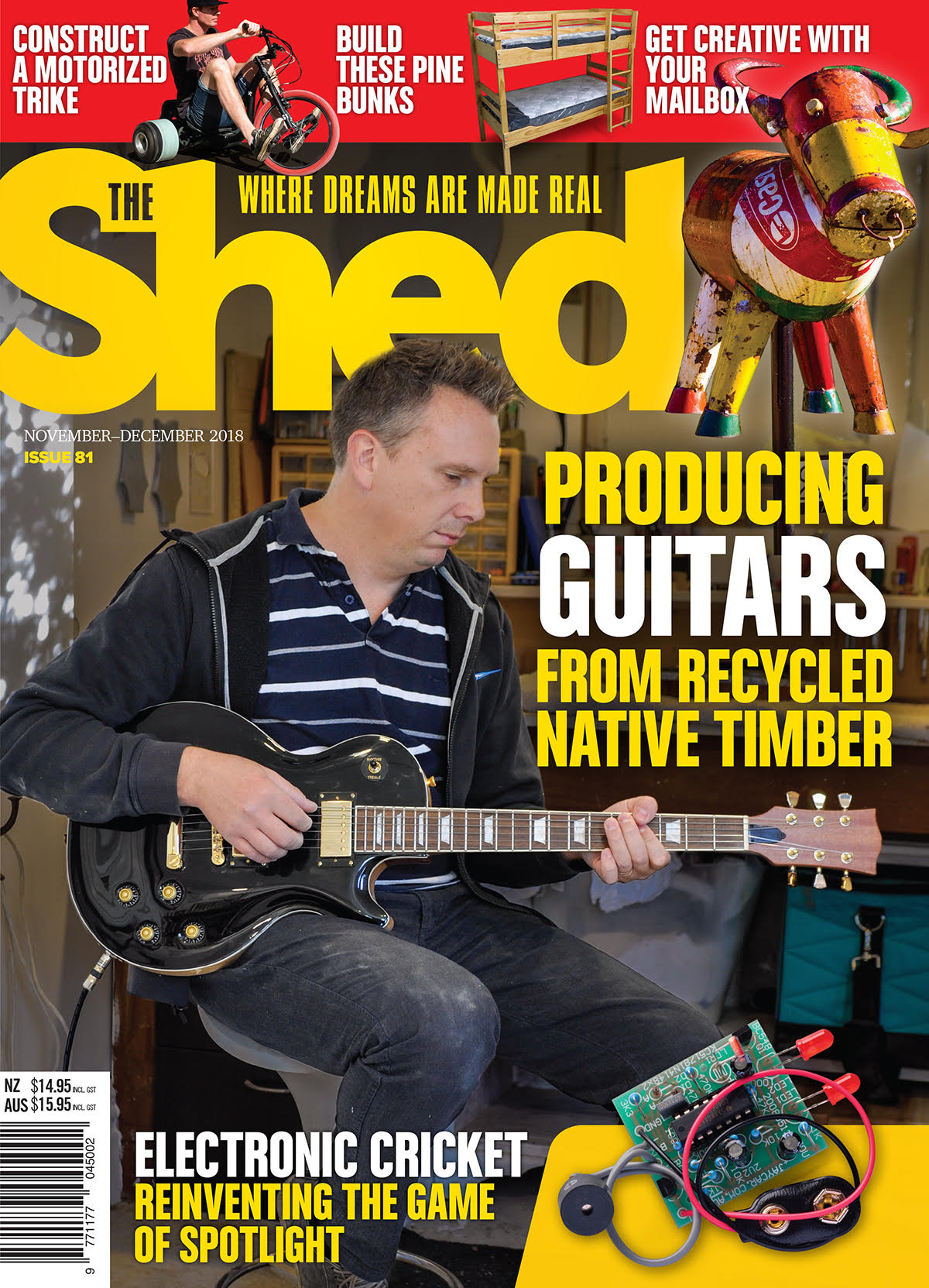
In The Shed 81, Nov/Dec 2018 issue, we head to Blenheim to meet school teacher and dedicated sheddie Dave Pauling.
Dave makes extraordinary guitars in his shed from recycled native timber and shares his skills with us so readers can have a go too. He nicknames some of his electric guitars ‘Les Paulings’ - nice touch.

Cover 81.jpg


In The Shed 81, Nov/Dec 2018 issue, we head to Blenheim to meet school teacher and dedicated sheddie Dave Pauling.
Dave makes extraordinary guitars from recycled native timber and shares his skills with us so readers can have a go too. He nicknames some of his electric guitars ‘Les Paulings’ – nice touch.
Another gifted sheddie, Kim Dawick of Cambridge, accepted a challenge after he built a motorised trike for a friend – build eight more for your other mates! Challenge accepted. He did just that and shows us how.
A young Taranaki inventor, Mark Horwell, talks with us about his shed-created gas and oil industry invention, a Switchfloat and The North Shore Men’s Shed in Auckland make a set of children’s pine bunks for a good cause.
Enrico Miglano uses more BBC microbit technology to make a fun cardboard robot and Des Thomson and his team at the Halswell Men’s Shed make a magnetic sweeper to gather all that messy swarf in your workshop.
Shed reader Richard Brown from Timaru tells us how he built a battery train set for his family and Mark Beckett sees this as an opportune time to discuss battery safety issues and good battery charging practice with readers. Jude gets making a set of fine high fidelity transmission line speakers using a Tri Trix kit designed by Curt Campbell then Ritchie Wilson tells us the history of the shed in a cupboard, plus does a few running repairs on, The Workmate portable workbench.
Our electronics team are busy again in this issue, Enrico is back with a guide to creating a Magic Mirror and Mark Beckett makes a fun toy for the kids, an electronic cricket that makes a noise when it is hit with light from a torch.
We close the issue with a look at some creative Tasmanian mailboxes with Coen Smit before Jude signs off the issue with his shed storage issue in his new regular spot in our Back ‘O the shed column
Share:

More Posts

All hands to the tanks

The call goes out. The volunteers pour into the military camp at Waiouru in the centre of the North Island. The only war, though, is going to be on rust, handbrake cables,
driveshafts, seized brake systems, the battered cylinders of tank engines and the ongoing tussle to turn out new truck engine parts.
Here is a group of willing sheddies who meet about once every six weeks under the keen oversight of George Pycraft. Their job: to continue repairing the heritage vehicles of the Army Museum at Waiouru.
Their “shed” is a group of four storage sheds housing 85 vehicles in various states of repair. They are as diverse as tanks, the 24-tonne M41 Walker Bulldog, the Centurion, and Valentine tanks (the latter still in World War II Pacific theatre camouflage), a 1941 Canadian Pattern Chevrolet gun tractor, an MB Jeep still wearing its 1942 Long Range Desert Group livery, an M113A1 Armoured Personnel Carrier (APC) painted in UN colours and of the type used in Bosnia, a 1943 Ford F30 truck, a 39-inch searchlight and an M816 recovery wrecker truck made by American Motor Corporation in 1969.
Pycraft, the museum’s Assistant Curator – Technology, says with the help and dedication of the museum’s volunteers they are slowly coming closer to having a complete running collection of heritage vehicles.

A weighty subject

One problem with working alone in the shed and having a liking for large pieces of Victorian cast iron is the difficulty of safely moving or lifting them.
They can be moved with load skates and pipes as rollers, but how do you lift the weight onto the rollers? Trying to push down on a crowbar while arranging pipe rollers under a machine is inviting trouble. A toe jack allows you to lift and hold the weight in the air as you arrange the rollers and put in safety blocks. It is not intended for great weights or high lifts due to stability, but it allows you to lift the weight.

From armour to fighter

An unassuming garage in the Hunua Ranges south of Auckland is the current shed of Gordon Turner and home to his latest project – a full-sized replica cockpit of a Messerschmitt Bf 109E fighter plane. Made from plywood, timber and aluminium and five years in the making so far, it will never take to the skies. But it is eventually intended to become a flight simulator, giving the ‘pilot’ a realistic experience of flying one of World War Two’s most famous aircraft.