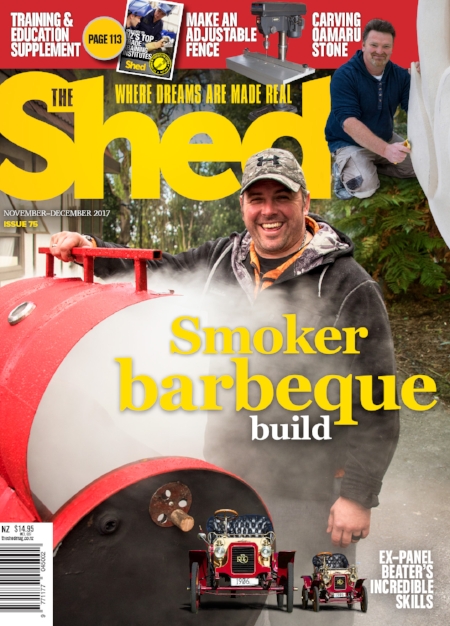
The Shed, November–December issue out now!

In the November–December 2017 issue of The Shed we get ready for all that summer fun outside the shed and get building a Cold Smoker Barbeque out of a couple of metal drums. Evan Wade and Jude Woodside show us how.

In the November–December 2017 issue of The Shed we get ready for all that summer fun outside the shed and get building a Cold Smoker Barbeque out of a couple of metal drums. Evan Wade and Jude Woodside show us how. This issue also boasts our Annual Training and Education Supplement for youngsters looking for a trade career, see page 113 for that 16-page guide. We head to Whanganui, to the home and shed of ex–panel beater Ian Chamberlain,  a man of extraordinary talents. From restoring a 1906 REO, to building a 64-note organ and placing it on a vintage truck, to repairing and restoring the Waimarie paddle steamer and, much, much more — a true Sheddie is Ian. We learn how to be a Solar Buddy light builder and how to build a simple stylish desk made with minimal hand tools. Shaugn Briggs is a limestone carver from Christchurch who took a risk with his career to follow his passion; and we meet another artist, Gregor Kregar of West Auckland whose sculptures of metal, wood, lead-crystal glass and neon are created in a shed with all the tools every Sheddie could wish for. Michael Wolfe shows us his amazing model build of a Swiss train, an SBB RAe II, before Enrico Migliano shows us the basics of 3D printing, including some really useful tips. We have a step-by-step guide to the dying art of chrome plating and part two of Bob’s tips for the ideal metalworkers’ shed. As Christmas is just around the corner Mark Beckitt creates a unique LED light as a gift and Coen Smit shows us how to modify your trailer to ease hooking up to your vehicle on your own. Bob Browning makes a very useful addition to a drill press with his guide on how to build an aluminium fence, and Jim Hopkins closes this issue from his sickbed writing his Back O The Shed column. What a soldier!
Share:

More Posts

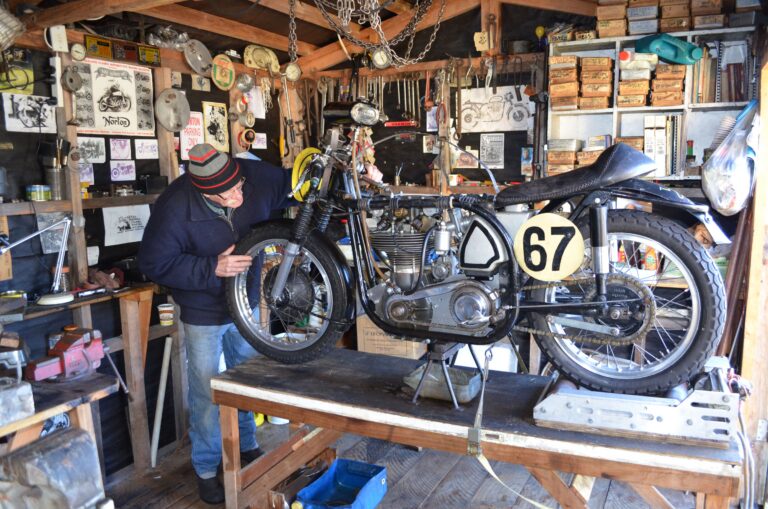
Revving up Island-style

As you can imagine, on Great Barrier Island, the population is likely to have more than its share of characters, given the island’s remote location. Part of the charm is its lack of power supply and absence of a supermarket. If something breaks, there’s not likely to be a spare part sitting on a shelf anywhere on the Island, so if you don’t want to wait or to pay hefty freight charges on top of the cost of the part, you make one or use real no. 8 wire ingenuity. Even though it is New Zealand’s fourth largest island (after the North, South and Stewart Islands) and is only a half-hour flight from Auckland, it’s like a different world, and that’s why the locals love it.

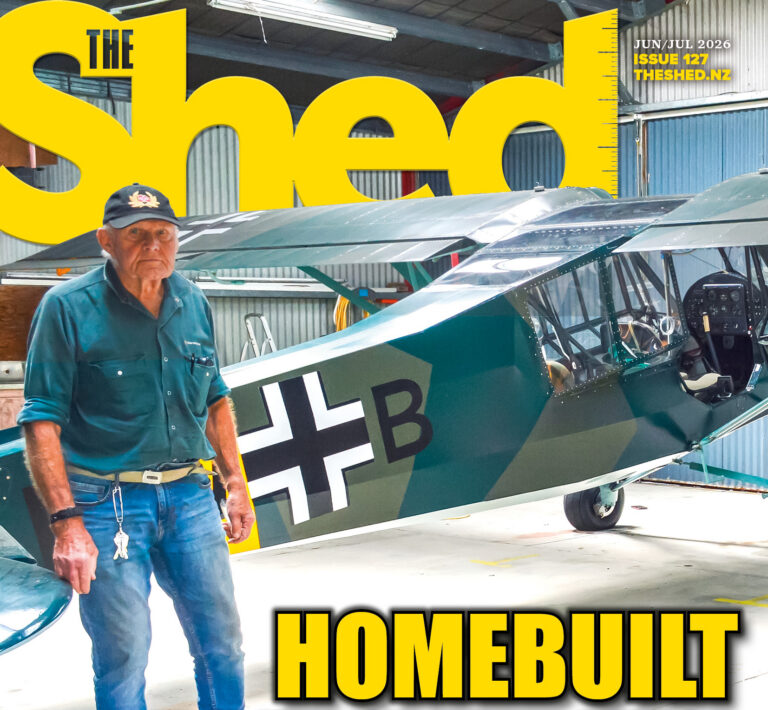
The Shed magazine June/July 2026 issue 127 on sale now

Murray Belfield is a phenomenon
He has built a few planes over the years, but none gave Murray the performance and thrills he really wanted until he built his scaled-down German paratrooper’s plane, a Storch. Building this rarest of planes consumed nine years of this 86-year-old’s life. And the result? He couldn’t be happier.
For most of us, stalking a deer across the back country, shooting it cleanly and lugging it home to furnish the table would be accomplishment enough for any evening’s bragging rights.
But when that involves landing an aeroplane you built in your shed onto a handkerchief-sized patch of hilltop scrub, finding and shooting the quarry, manoeuvring the carcase into the spare seat and getting off the ground again, and doing all that at the age of 86, bragging just vanishes in the slipstream. Murray Belfield is, anyway, far too practical and busy a guy to waste his evenings boasting to his mates, but he is, nevertheless, a phenomenon. His plane, the second he has built by hand, is another. Highly specialised for short take-offs and landings (STOL), it is a three-quarters-scale replica of a WWII flying legend, the Fieseler Storch.
The replica, designed by famed aircraft engineer Ladislao Pazmany, is so challenging to build that, to Murray’s knowledge, only one other Pazmany model has been completed to the flying stage, by an enthusiast in Alaska. As if that wasn’t a hard enough ask, Murray has incorporated many improvements of his own based on his many years of bush flying experience (and his dislike of fibreglass).

In the dining room shed

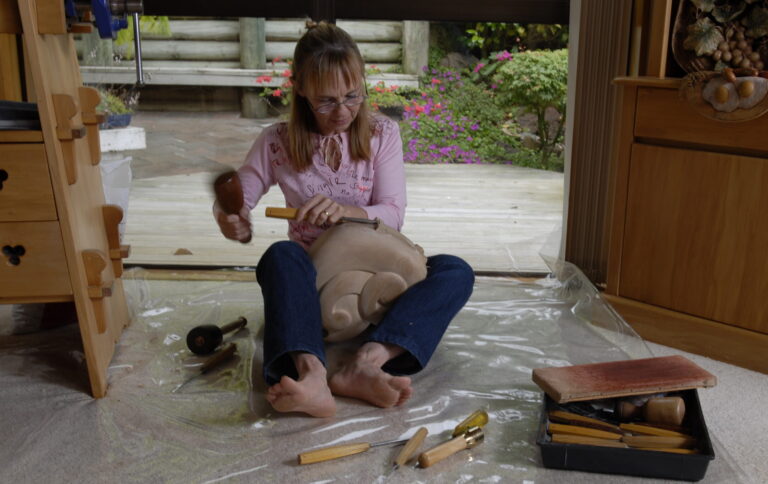
Jane Allnatt’s father was a commercial artist, a painter, model-maker and did a bit of carving, so there’s something of the family tradition in what Jane Allnatt is doing in working with wood. But it’s unlikely her father imagined her designs and creations coming out of a shed in the dining room.
Working on a sheet on the floor of a room in her house is the Howick resident’s “workshop” and preferred way of creating work. Yet that work has regularly taken prizes in various categories at the annual National Woodskills Festival at Kawerau, a central gathering place of woodturners and sheddies.
It is also unlikely you would find many men praising the convenience of their working space because, as the sculptor puts it, “the room is centrally placed and I can disappear to cook dinner or if there is any washing, I can do that. The light is good, too.”