
Simple bins

Many black plastic bins from the hardware shops don’t allow enough air through or are only big enough for postage stamp-sized sections or blocks of land. I make my own compost bins. Now that might seem fairly easy, but how many compost systems either take a huge amount of effort, or produce something reminiscent of milking-shed sludge? These bins require very little intervention besides putting stuff in.

Make your own simple compost bins
By David Todd
Photographs: David Todd
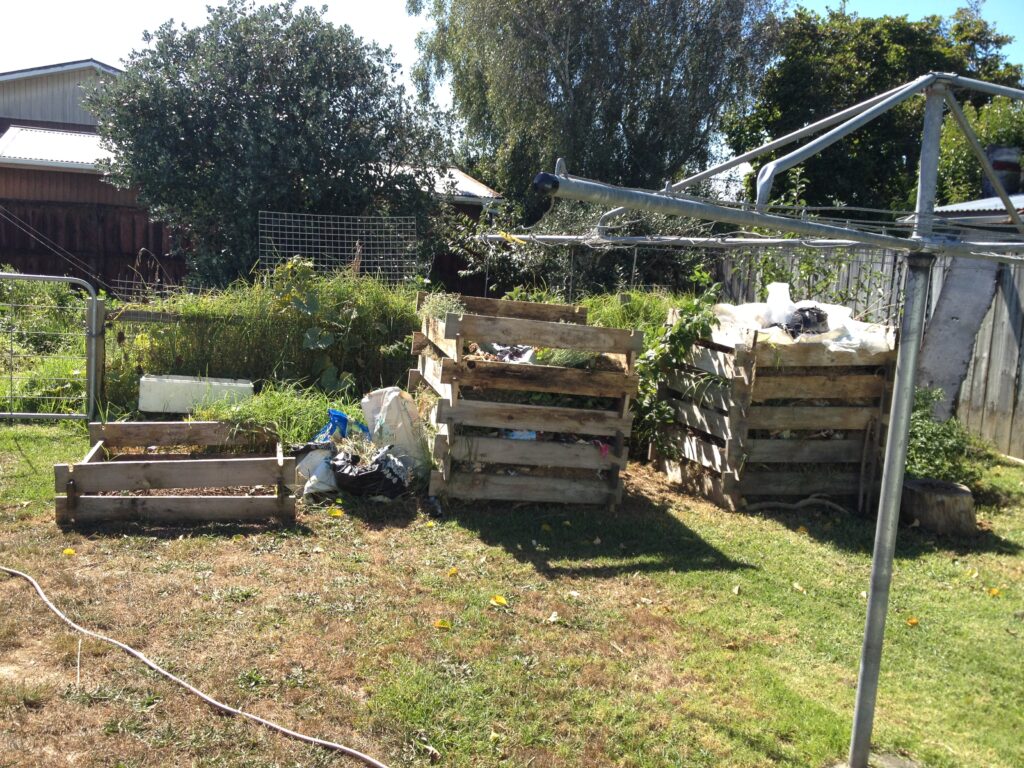
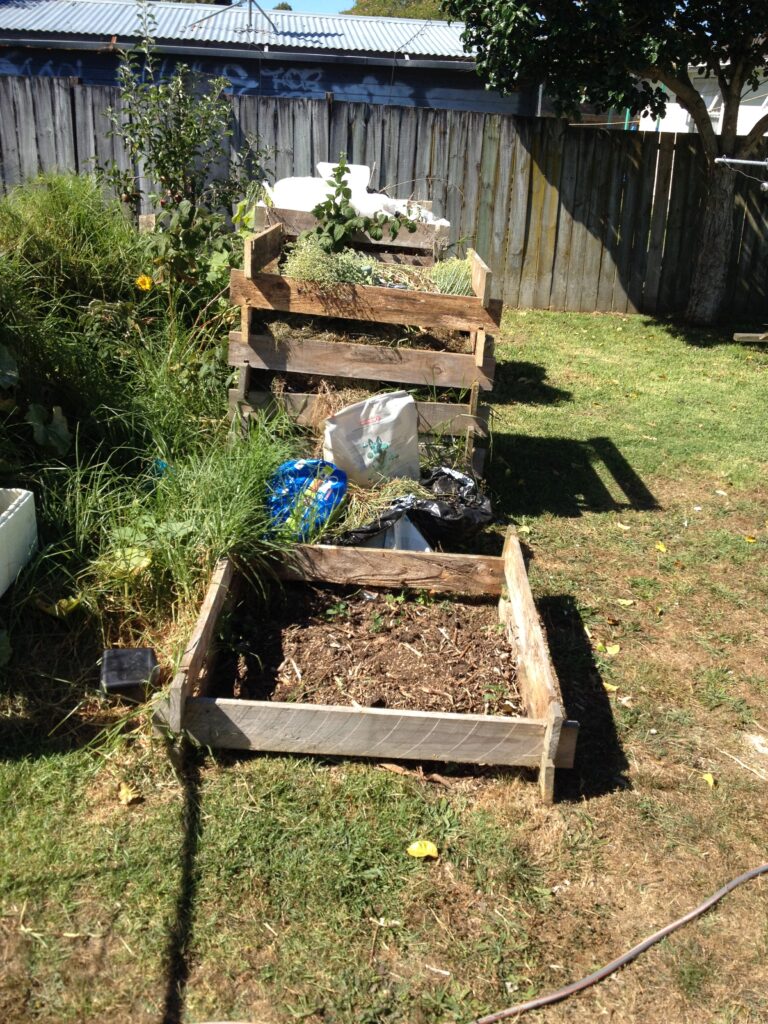
Some Shed magazine projects, while inspiring, are way out of the league of many of us. So, here is how I made my own simple  compost bins. 
I’ve spent summer holidays with technicians and riggers and electricians and fitters, but I’m just a home handyman. I’ve done a minor amount of renovations to previous houses and much of my own house maintenance. I like growing my own veggies. We were nearly self-sufficient in potatoes last year and are hoping to do better this year. Currently I’m self-employed in IT.
Good compost needs balanced grist for the mill:

  • green stuff (lawn clippings, kitchen food scraps and the like); and
  • brown stuff (untreated sawdust, leaves, shredded paper, cardboard packaging)

and air and water.

Many black plastic bins from the hardware shops don’t allow enough air through or are only big enough for postage-stamp-sized sections or blocks of land.
I make my own compost bins. Now that might seem fairly easy, but how many compost systems either take a huge amount of effort, or produce something reminiscent of milking-shed sludge? These bins require little intervention besides putting stuff in.
Materials
I used 4.8 metre lengths of 150 mm x 25 mm untreated pine (rough-sawn boxing). The reason for 4.8m lengths is that I cut them into four 1198mm lengths. That is, measure 1200 mm, and cut on the wrong side of the line. Do this three times, and on the fourth time,  measure for the actual length of 1200 mm with the saw kerf. It’s important to do this reasonably accurately.
For the notches, set the fence on your router with a 25 mm bit so there is about 65 mm from the end of the wood to the edge of the notch. Rout a notch that is around 37 mm deep.
I set the fence on the router as above. I set the combination saw for 37 mm, then clamp a length of wood to the sawhorse so that each end is clear of the end. Have the clamp so the handle is up (I prefer a G clamp to an F clamp as they clamp harder).

Cutting notches
On the left-hand end (matches the way I set the fence on the router), I mark a line indicating the depth of the notch on the far side of the wood. On the right-hand end, I do this on the near side.
I use the router by pulling it towards me. Then once one notch is cut, I can flip the sawhorse around and do one notch on the other end. Flip the wood over the sawhorse, mark for the other two notches and repeat.
Four lengths is the minimum, really. The actual notches don’t need to be done 100 per cent accurately, and the first ones I did (read: sloppy first attempts) worked best. The wood doesn’t have to nest together properly.
I’ve found the huge amount of air available, and the addition of brown stuff makes a nice light compost and not the usual sludge. It doesn’t require a huge amount of effort to turn (and aerate).

Share:

More Posts

The Shed magazine June/July 2026 issue 127 on sale now

Murray Belfield is a phenomenon
He has built a few planes over the years, but none gave Murray the performance and thrills he really wanted until he built his scaled-down German paratrooper’s plane, a Storch. Building this rarest of planes consumed nine years of this 86-year-old’s life. And the result? He couldn’t be happier.
For most of us, stalking a deer across the back country, shooting it cleanly and lugging it home to furnish the table would be accomplishment enough for any evening’s bragging rights.
But when that involves landing an aeroplane you built in your shed onto a handkerchief-sized patch of hilltop scrub, finding and shooting the quarry, manoeuvring the carcase into the spare seat and getting off the ground again, and doing all that at the age of 86, bragging just vanishes in the slipstream. Murray Belfield is, anyway, far too practical and busy a guy to waste his evenings boasting to his mates, but he is, nevertheless, a phenomenon. His plane, the second he has built by hand, is another. Highly specialised for short take-offs and landings (STOL), it is a three-quarters-scale replica of a WWII flying legend, the Fieseler Storch.
The replica, designed by famed aircraft engineer Ladislao Pazmany, is so challenging to build that, to Murray’s knowledge, only one other Pazmany model has been completed to the flying stage, by an enthusiast in Alaska. As if that wasn’t a hard enough ask, Murray has incorporated many improvements of his own based on his many years of bush flying experience (and his dislike of fibreglass).

In the dining room shed

Jane Allnatt’s father was a commercial artist, a painter, model-maker and did a bit of carving, so there’s something of the family tradition in what Jane Allnatt is doing in working with wood. But it’s unlikely her father imagined her designs and creations coming out of a shed in the dining room.
Working on a sheet on the floor of a room in her house is the Howick resident’s “workshop” and preferred way of creating work. Yet that work has regularly taken prizes in various categories at the annual National Woodskills Festival at Kawerau, a central gathering place of woodturners and sheddies.
It is also unlikely you would find many men praising the convenience of their working space because, as the sculptor puts it, “the room is centrally placed and I can disappear to cook dinner or if there is any washing, I can do that. The light is good, too.”

The Workmate – a shed in a cupboard

In 1961, Ron Hickman, a just-married South African immigrant to the UK, was making a wardrobe using expensive Scandinavian chairs as sawhorses (as you do) when he inadvertently cut one of the chairs as well as the plywood. This was his eureka moment. The need for a workbench which could be stored away in an apartment cupboard when not being used was obvious.
His prototype folding workbench had a classic cast-iron and steel Record brand wood vice attached to it. 
Ron was known in the Lotus Cars factory, where he was director of engineering, as someone who could always see an alternative approach to design problems, and so it was with his workbench. His final design used the top of the bench as a vise; one half of the top being fixed, the other being moved by two threaded rods to clamp the object being worked on, vaguely similar to a book-binder’s vise. His background in car manufacture led to him design the folding workbench with a metal frame. Because it was intended to be used for woodwork the top was wooden – solid wood in the original design.