Latest Issue

The Shed magazine April/May 2026 issue 126 on sale now

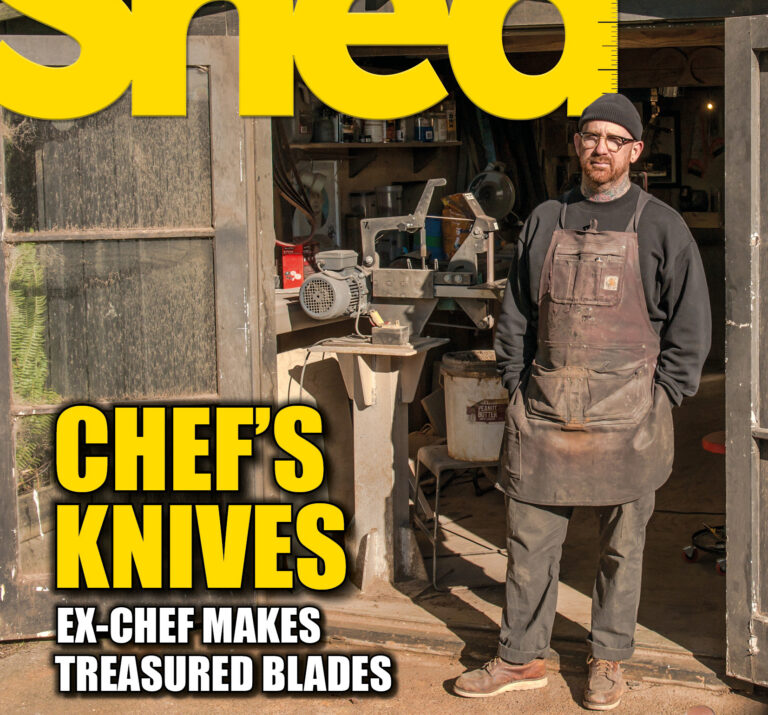
Hayden Scott’s road to crafting Damascus blades has been a journey of self-discovery, from an ambitious teen working the boning tables of the Balclutha freezing works to chef Al Brown’s right-hand man. Now, with over 25 years of experience using knives, he has found his calling: hand-forging the finest blades for cooks all over the world from his backyard sheds in the Waitākere Ranges.
“Hayden grew up in Balclutha surrounded by farmland and a practical family: his mum made the family’s clothes; dad was a chippie; an uncle built airplanes, and another uncle was a fitter and turner.
Hayden and his brother were often left to their own devices, usually with a pocket knife in hand. He remembers, “I always had a project on the go. What have we got here? What can I make from this?” Huts and bows and arrows lead to hovercrafts with electric motors, and later to bicycles, motorbikes, and furniture restorations.
His uncle Russell was a real inspiration, a builder who knocked together a Jodel airplane, which Hayden fondly remembers flying around Otago in. “I was in absolute awe that someone could build something like that, at home.” Another uncle, Allan, was a Fitter and Turner who rebuilt motorcycles. He had to dig out a cellar under his house to store his vast collection of vintage motorcycles. Hayden remembers, “He was always in there with his overalls on, working on them. Growing up around people like that was really motivating.”

READ MORE »

The Shed magazine February/March 2026 issue 125 on sale now

Going solar
Solar power seems like a great idea; who doesn’t want free power, right? But, what to choose, and what are the pitfalls of solar?
Regular The Shed writer, Andrew Broxholme, has just completed a large solar installation on his property and shares all the good, the bad, and the ugly aspects of his solar power journey.
I’m environmentally aware, but am not an environmentalist, so I’ve gone solar for only one reason, because it makes good financial sense to do so, that said it isn’t necessarily going to be right for everyone and its impact on your power bills will depend on where you are in New Zealand and the orientation and design of your house relative to where the sun rises and sets.
I’ve been interested in renewables for many years. I first looked at it while living in the UK. The early systems had promise, but really didn’t make financial sense as the cost of installation and ongoing maintenance wasn’t offset by big enough reductions in power bills. They wouldn’t repay that investment during their service life, which at the time was 15–20 years (maximum).
That’s no longer true, with higher volume, the equipment has got a lot cheaper, it is more efficient, but we have also seen huge increases in energy costs; this, in particular, changes the economics dramatically. That doesn’t, however, mean that you can buy the first solar system presented or recommended to you. Read on to find out why.

READ MORE »

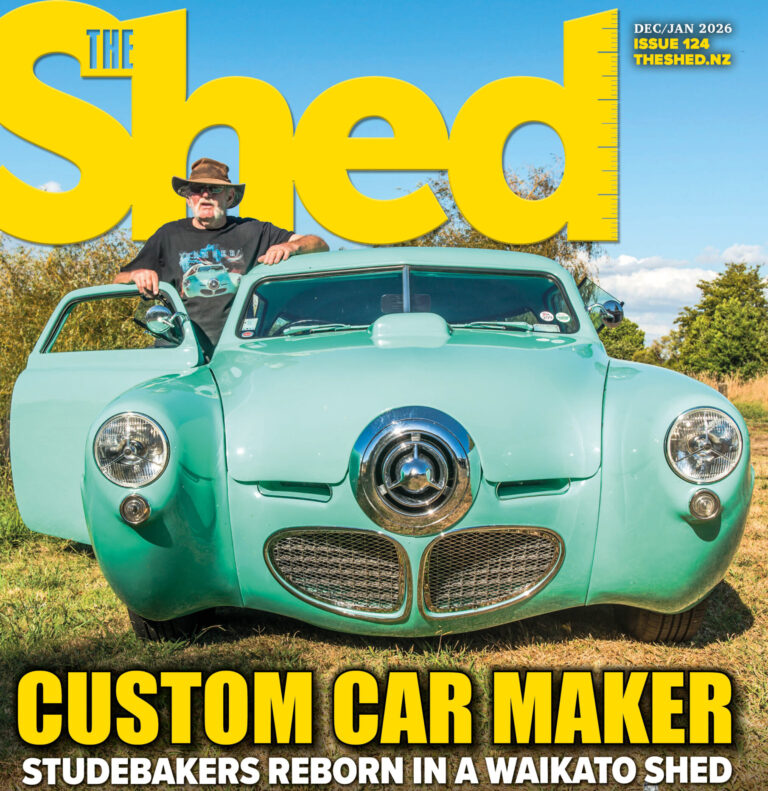
The Shed magazine December/January 2026 issue 124 on sale now

The Stude-Maker
Studebaker marketed their groundbreaking 1950 Aero-Nose models as “luxury for everyman.” A young Trevor Halstead thought this was a bit of him, so he began purchasing Studebakers in the early 1970s. The fact that the Champion model he chose was $50 less than the Ford he really wanted did play a small role in that life-changing decision. As they say, the rest is history.
“To the man on the street, they became known as bullet noses, and while they proved to be Studebaker’s best-selling model in 1950, those aero-lines did not age so well, and by 1952, the company reverted to a more conventional front end.
Fast forward a couple of decades into another hemisphere, and a one-man Studebaker ‘Next Look’ revival was about to begin, in the workshop of Studebaker devotee and custom-builder, Trev Halstead. This time, though, those vintage lines would take on wild and offbeat shapes.

READ MORE »

The Shed magazine October/November 2025 issue 123 on sale now

Beyond the grain
At age 15, Edward Prince declared to his Dad, “I’m going to be a cabinet maker”. Nowadays, Edward the furniture maker is pushing timber’s boundaries through innovative projects like bodging chairs, carving bowls, crafting bows, and designing bass guitars.
A forest of lithe, towering ricker Kauri, adolescent Rimu and tall ferns shade the glade around Edward’s workshop. Leaf mulch, bark chips and forage strips camouflage the paths. Twisted logs rest against a small retaining wall awaiting a fresh designation, and a cluster of rustic timber chairs encircle a brazier on the lawn above. From the tree tops, invisible Tui chime and call while through a set of dusty French doors, an apparition of Edward can be seen and heard, cutting, carving and creating.
Edward remembers when he first set eyes on this place; it reminded him of an image on a postcard that he had saved in England. He recalls, “It was a picture of a small church in a hollow, surrounded by trees. It struck me as a place of peace and tranquillity. I thought how nice it would be to live in such a sanctuary. This place is what I had in my mind.”

READ MORE »

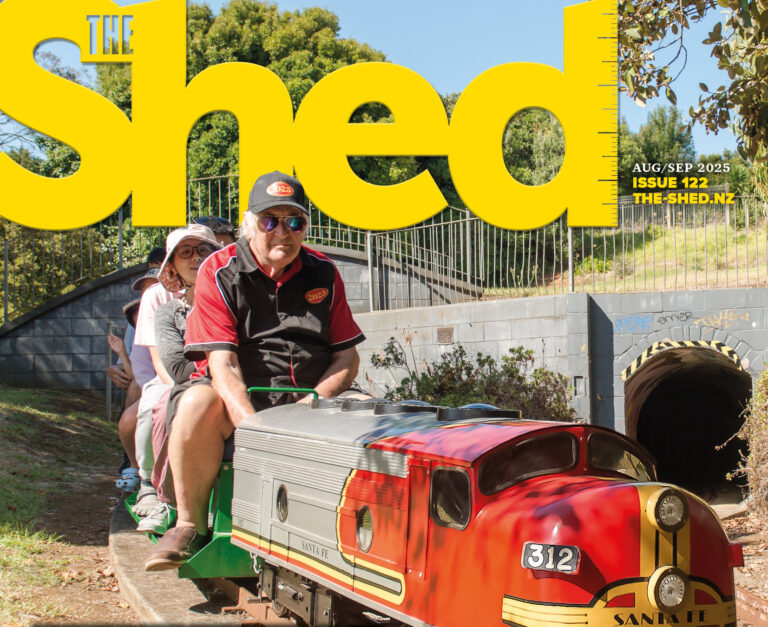
The Shed magazine August/September 2025 issue 122 on sale now

Keep on rolling
Growing up near a railway station sparked Greville Wills’ lifelong love for trains. Throughout his working career, he has experienced a diverse range of jobs. Today, he identifies as an old-school tinkerer, a model engineering enthusiast, and a “Mr. Fix-it.”
Space is definitely at a premium in Greville Wills’ garage workshop. On first look, the visual jumble of tools, projects, ornaments, neons, and former business equipment is confounding. Yet despite the wriggle room between the maze of workstations, there is an underlying order.
Greville is an old-school tinkerer, model engineering enthusiast, and a Mr. Fix-It to his neighbours. He always knew the space here was going to be tight, so before he moved in, he pre-measured and drew a plan for everything from machine placement to car park spaces, factoring in ergonomics and power supply locations to make certain everything would fit and work efficiently.
He is adamant that the layout suits his needs and says, “When I’m making things, everything is here. It is a single person’s workshop, where I can do most things. If assembling or constructing something of size, I just push the cars out to use that space temporarily.”

READ MORE »

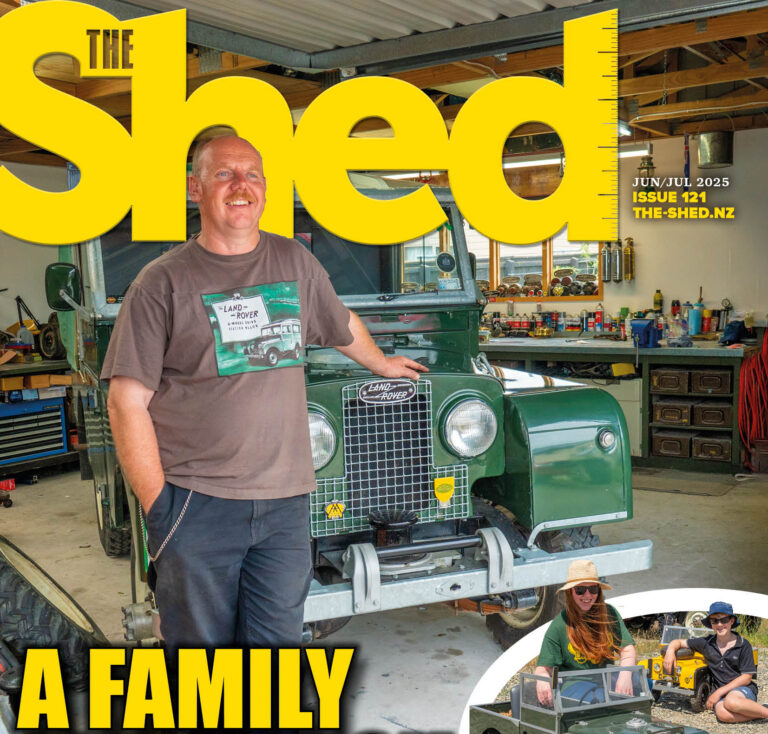
The Shed magazine June/July 2025 issue 121 on sale now

With the genealogy of the five generations of South Island engineers in the family, Ross Hayes thinks nothing of rebuilding Land Rovers for fun, family and farm.
Ross Hayes was 17 when he bought his first Land Rover. It was road-legal, but that was about it. It turned out that it was cosmetically covering up a huge amount of rust, so it wasn’t going to make the long haul.
Ross bunches his lips. “I got a bit disheartened and decided that if I couldn’t trust anybody to sell me a good one, I’d build myself one.”
He bought a 1954 short wheelbase Series 1 Land Rover in December ’96, just after he turned 18. “I paid six hundred bucks to a guy out of Naseby called Owen Rawcliffe, who’s since passed. I brought it back to Oamaru through the Danseys Pass and set to pulling it to bits.”
He bought workshop and parts manuals from the UK and a set of Whitworth sockets and Whitworth spanners and got stuck in.
The Mistress, as he came to call this ‘54 Series 1, spent five years, three months in the workshop – 6000 hours – while he pulled it to bits and rebuilt it.
His idea was to start with a chassis, and everything that went onto the chassis was either rebuilt or brand new. It was hard to get parts back then in the 1990s.

READ MORE »

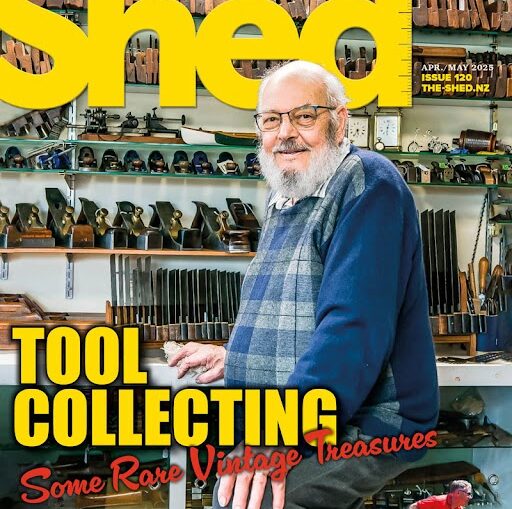
The Shed magazine April/May 2025 issue 120 on sale now

On the road again – new life for old caravans
The allure of a classic caravan can be strong, and many of these gems are being lovingly restored – in fact, Beach Hop even has a prize for the best retro caravan.
In this issue, we showcase three very different caravan restorations—one by a man who owns a company that has been building caravans commercially since the 1950s and is now a household name in caravans and Motorhomes.
The second is a lovingly restored 10-footer that started off a real basket case, and the third, well, friends christened it a turd emoji when they saw the project bought by Marty and Zoe.
Their caravan was destined for their annual pilgrimage to Beach Hop, where thousands gather to show off their super-primped or lovingly restored classic vehicles and caravans

READ MORE »

The Shed magazine February/March 2025 issue 119 on sale now

On the road again – new life for old caravans
The allure of a classic caravan can be strong, and many of these gems are being lovingly restored – in fact, Beach Hop even has a prize for the best retro caravan.
In this issue, we showcase three very different caravan restorations—one by a man who owns a company that has been building caravans commercially since the 1950s and is now a household name in caravans and Motorhomes.
The second is a lovingly restored 10-footer that started off a real basket case, and the third, well, friends christened it a turd emoji when they saw the project bought by Marty and Zoe.
Their caravan was destined for their annual pilgrimage to Beach Hop, where thousands gather to show off their super-primped or lovingly restored classic vehicles and caravans

READ MORE »

The Shed magazine December/January 2025 issue 118 on sale now

Full tilt with Dynamite Dave.
Dynamite Dave Alexander is a self-taught doer, with an eye for detail, unquestionable discipline, and a passion for motorsports. He’s been making things since he was a nipper, and has never stopped. He was raised on a remote Hawke’s Bay farm, where the shed was his university.
Dave says he “grew up doing it”, working alongside his father Neil, learning how to keep the property and equipment maintained and running. His first job was welding all the farm gates. His next was putting in a box-section chassis for a 1942 Willys Jeep, which served as the farm’s workhorse.
At 18, Dave commenced his first customisation of his Mk ll Zephyr, installing a V8, dual headlights, and Vauxhall tail lights. Since then, he has restored, driven, and raced an impressive list of classic muscle cars, scratch-built stocks, rods, and record-breaking Bonneville salt cars.
Now – at 70-something – this multitasking, project-a-holic is closing in on his latest quest: to break 262mph (422kph) at Bonneville in his shed-built, RB-powered Lakester – a project that has been close to a decade in development.
Dave says, “I guess I could be playing golf or in the pub. But you have to do something to get you out of bed in the morning, to keep the old man out.”

READ MORE »

The Shed magazine October/November 2024 issue 117 on sale now

Meet 21st century sheddie, Tim O’Connor of Army Bay Engineering, who has created his own unique brand of mini bikes from his small Whangaparaoa peninsula workshop, Hustler Mini Bikes.
In the true spirit of the Kiwi DIY tradition, Tim rallied from the disappointment of a Covid-related job loss to create his own very successful, satisfying, and special business.
“There is no room for mediocrity nor false modesty in the shed of precision engineer Tim O’Connor. His Instagram tagline is: ‘Maker of the world’s finest minibikes,’ and it would be a hard ask to find someone more motivated and committed to improving their product than this self-confessed perfectionist.
For Tim, designing, building, and marketing his ‘Hustler’ minibikes is not just about selling units. His scaled-down, pocket-rockets have a deeper, almost sentimental significance. He has been riding small bikes since the age of 12, and remembers building minibikes in the garage with his father.
He says, “That is where my love for bikes and engineering started.”

READ MORE »

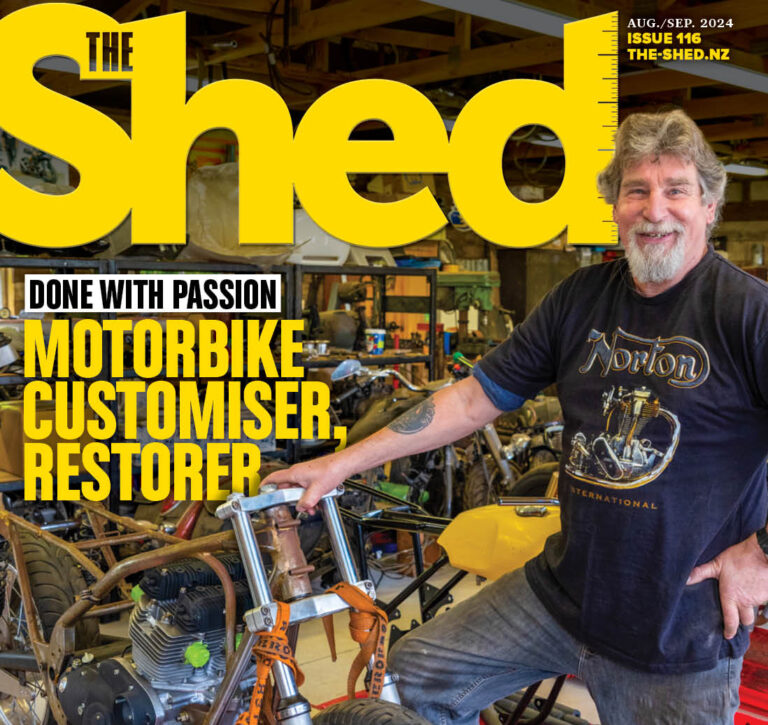
The Shed magazine August/September 2024 issue 116 on sale now

When life deals you lemons, make lemonade: a business collapse led John to build a new, bigger business based on his passion for motorcycles
“I really want an old dairy factory”– that’s what John thought when contemplating the move from Katikati to Taranaki a few years ago.
He sat down after his divorce and thought: “What do I need for the rest of my life?
“Well, I need a shed, a bed in the corner, and a place to stuff around with my motorbikes.”
John’s search took him all over the North Island; he was looking for something that was cheap enough. It didn’t have to be flash, as he wanted a few bob to help his kids to get on the property ladder as well as to be able to follow his passion for building and customising motorbikes – something that he had been doing for a long time.
An old garage in Patea came into the picture but, although it met all the criteria, it became too complicated to purchase. Then an acquaintance told him of a house he had for sale in a small town a little further up the coast. In the end, that turned out to be the perfect location.”

READ MORE »

The Shed magazine June/July 2024 issue 115 on sale now

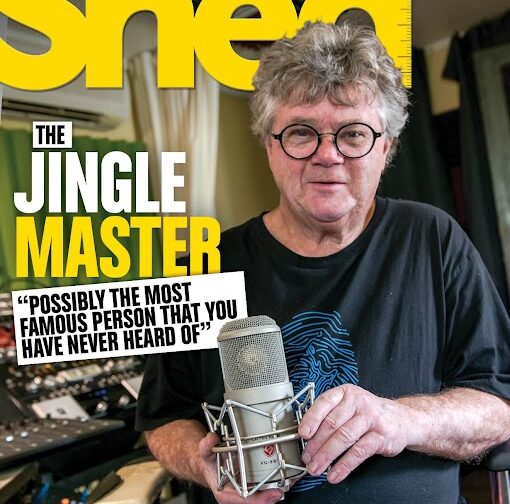
A ministry of sound
An under-the-radar icon of New Zealand music history tells how it all happened
Larry Killip’s love of playing music dates back to 1966, when he first jammed rhythm and blues with schoolmates in a band called the Zarks.
Since then, he has played in various iterations of that band; performed solo at the Nambassa festival to a crowd of 30,000 right before the headline act, Little River Band; been featured on the compilation album 20 Studio One Hits Volume 2; released seven albums and plenty of singles of his own; made appearances on Happen Inn, Telethon, Shazam, Drop of Kulcha, and Radio with Pictures TV shows; mastered the first two albums by Indie rock darlings, The Beths; and performed a medley of his best-known advertising jingles on the TV show 7 Days. With more than 500 jingle writing credits to his name, Larry laughs when he says he is “Possibly the most famous person that you have never heard of”.

READ MORE »

The Shed magazine April/May 2024 issue 114 on sale now

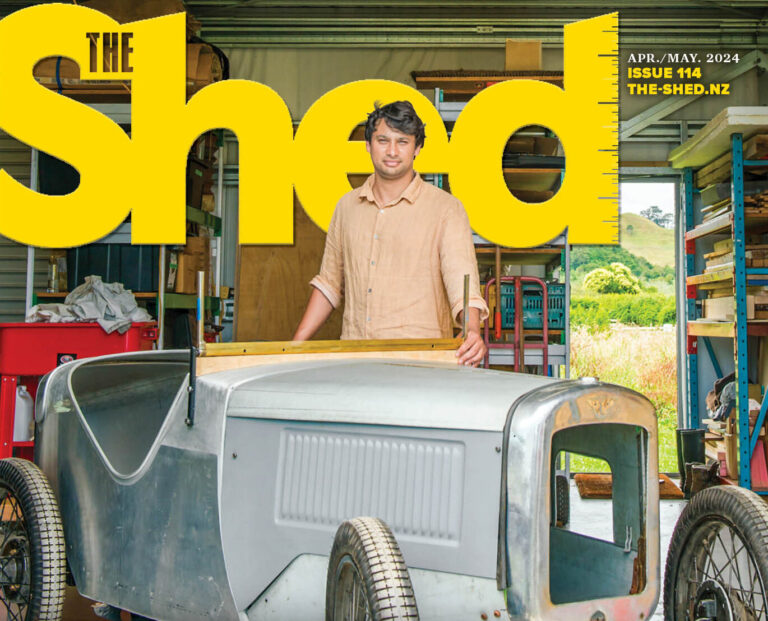
When Athanasius (Athow) Santamaria made an “impulse decision”, to buy a pile of old Austin parts in 2015, he didn’t really have a project in mind.
But this young kiwi sheddie, with no car building experience at all, figured he would have a crack at building a car from this pile of parts. Now, he is well down the track to completing an authentic reproduction Austin Seven Ulster; a scratch-built, boat-tail, two-seater sports car.
Athow south guidance and advice from Austin and vehicle restorers far and wide and the result is really quite remarkable. There is still some way to go but the skills he has acquired on his journey is apparent for all to see.
“The Ulster body is shaped from 5005 aluminium, which is a little harder than industry standard 3003.

READ MORE »

The Shed February/March 2024 issue 113 on sale now

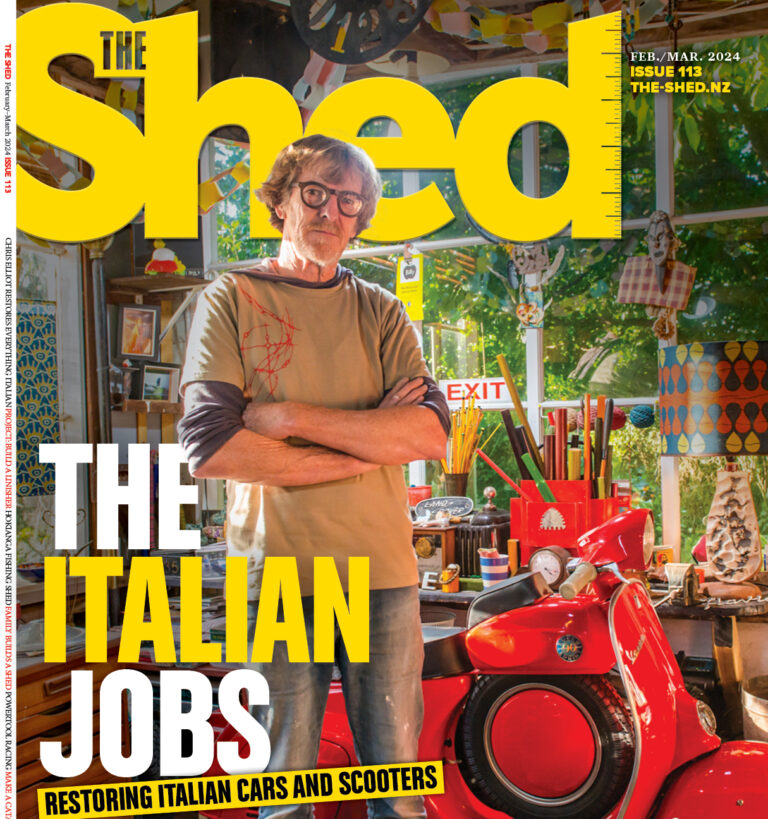
This February/March 2024 issue 113, we visit a whole bunch of sheds around NZ and in fact all around the world. We start with a profile of the talented Auckland sheddie Chris Elliot.
Chris has a small shed in Central Auckland from where he restores Italian scooters and cars, well, cars that don’t take up a lot of space such as Fiat Bambinas. With a background in movies and TV set design, Chris is never idle and not only restores all the Italian autos he can but gets his creative side going with household artefacts as well. One talented sheddie.
Jason Burgess writes “A cinematic late-afternoon light pours through the corner window of Chris Elliott’s vest-pocket shed. The miscellany of collected artefacts, fabric, and vehicular memorabilia conjures up a neat yet cluttered bazaar in some exotic foreign land rather than an active workshop on the fringe of Auckland City. This concrete single garage is a celebration of creativity and productivity. Swinging a cat – or, for that matter, a hammer – might seem problematic in such confines but, when it comes to fulfilling a wide array of job briefs and cross-disciplinary commissions, Chris somehow makes things come together.”

READ MORE »

The Shed magazine December/January 2024 issue 112, on sale now

The cover story in our 2023 year ending issue is on the jaw dropping memorabilia collection of Terry Dalton. This is not simply a small room filled with a few bits and pieces, this is an enormous cathedral-like shed, crammed with memories. The collection is truly varied but includes a huge chunk of 1950s American Graffiti Americana including the cars and diners from that decade. Our own Kiwana has not been overlooked and there is an enormous swag of that as well. You really need to see it to appreciate it. Terry’s shed probably houses the most significant private collection of memorabilia in NZ.
“Terry likes collectibles. He has several extensive collections of different sorts of memorabilia, much of which he has bought online. He collects, for instance, oil bottles and tins, 1957 Chevrolet memorabilia, F1 stuff, musicians’ autographs, and the picks of well-known guitarists.
One corner of the shed, furnished with plush theatre seats, is devoted to the display of his treasures. He likes the collectibles not only for their own sake but also because they have a known value and are readily saleable; there is a market for them. He says that most will be sold as he gets older.“

READ MORE »