In the March/April 18 issue (#77) Jude revisits some good practices re harvesting rainwater. He gives some solid advice on how to set up your own system to collect rainwater, keep it clean and talks about some innovative products to help you get the best results.
We head to the South Island to enjoy the work of Dave Neame and Lloyd Knowles, two sawmillers who have their own distinctive ways of prepping timber and then go through the steps to make your very own Longbow from Walnut timber. Christchurch is the home of Chris Gordon where Ritchie Wilson explores his shed where Chris builds motorcycles from scratch including a unique 1920s board-track racer then Jude is back again welding a new trolley for his old bbq, giving it a whole new lease of life.
Nathalie Brown introduces us to the team of rail enthusiasts at the Oamaru Steam & Rail Workshop where a team of retired tradies keep the trains and carriages running for all to enjoy. We discover the stunning work of potter Renae Galetzka whose distinctive pottery is sought after by folks all over New Zealand and Mark Beckitt gives us some awesome tips and tricks to get us soldering like a pro. In Part Four of our series on 3D printing, Enrico Miglano steps us all up to the next level by showing how to print a DSLR camera and in the final part in our outdoor fires feature, we show you how to plaster the block fireplace we built in the last issue. Coen Smit has some fun building some steampunk toys for young and old before we visit a refrigeration business in Auckland (MacDonald Refrigeration) who are about to close their doors for the last time. They share with us their treasure trove of lathes, presses, guillotines etc they have including some fine examples manufactured by Dyco, Tanner, John Heine, Edwards, Logan, Colchester’s and more – an Aladdin’s Cave for engineering buffs.
Creative duet
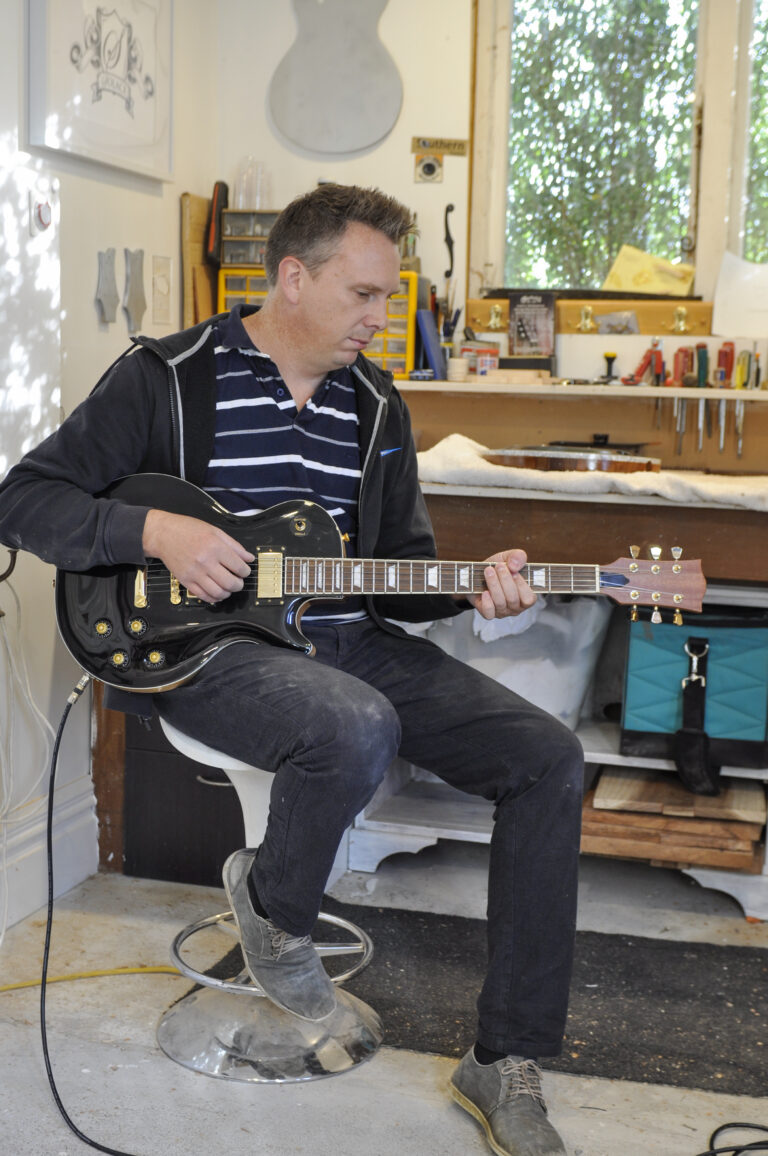
For Dave Pauling, making guitars is the natural fusion of two passions – music and wood.
Dave, who has been playing the guitar since he was 13, also knew the pleasure of pottering in sheds from a young age. His father is a “sheddie” from way back who, among other things, still spends many hours restoring vintage vehicles.
“I grew up helping him with his Model Ts, making bows and arrows, or working on a model railway we had in the loft,” he says.
While Dave himself has spent a fair few hours restoring a 1965 Mustang imported from San Francisco, he prefers working with wood. There’s something about the malleability and smell of wood, as well as its provenance, he says. Wood, especially the recycled timber he uses to construct his guitars, has had a previous life. “Every guitar I make comes with a pre-history.”