
Model Engine Sparkplugs

When I left school I took on an apprenticeship at William Cable in Wellington. Unknown to me at the time, this opportunity would lead to a life-long interest in model engineering. My apprenticeship gave me a wonderful grounding in all aspects of engineering.


BUSY IN THE SHED MAKING MODEL ENGINES AND SPARK PLUGS

When I left school I took on an apprenticeship at William Cable in Wellington. Unknown to me at the time, this opportunity would lead to a life-long interest in model engineering. My apprenticeship gave me a wonderful grounding in all aspects of engineering. I began in the tool room under the guidance of a great engineer and tremendous mentor who was prepared to take the time to pass on his knowledge and expertise. This definitely was the fuel that ignited my interest. The next step was time spent in the pattern-making shop at the foundry which gave me the knowledge of how to make small alloy castings in
my home workshop.

Engine bearings

In the general engineering shop I learned how to weld with both gas and electricity. It intrigues me to realise things have greatly changed since then. One particular skill I acquired was learning how to remetal engine bearings with white metal then machine them back to size. These bearings ranged from Austin 7s through to half-ton ship bearings—a broad spectrum. As my interest was really in the mechanics of what could be achieved in the tool room in my spare time, I began making miniature models for myself. This interest has continued and I have gathered numerous small tools over 50 years. I have a well-equipped workshop with two mills, two lathes and a large selection of hand tools and I spend many hours there. Over the years of making many different models—including steam

“In my spare time,
I began making
miniature models
for myself.”

trains, stationary steam engines and small jet engines—my interest and focus has been on internal- combustion engine models. All my engine components, including gears, pistons, rings, crank shafts, etc, are machined from scrap. I realised miniature spark plugs have become increasingly difficult to source, not to mention very expensive, so I decided to make my own. Trial and error ensued and then finally success.
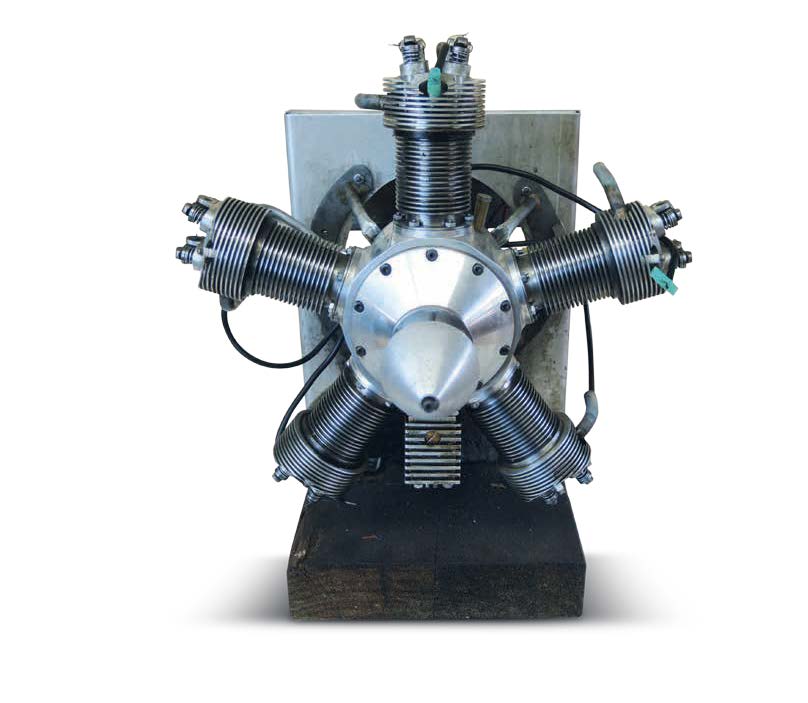
A 1930s Kinner k5 cylinder rotary aero engine over-head valve used in trainers prior to World War II.
 

A 1930s Kinner k5 cylinder rotary aero engine over-head valve used in trainers prior to World War II.

The same Morris Minor engine assembled


The same Morris Minor engine assembled

A double-acting single-cylinder steam engine built from scrap brass


A double-acting single-cylinder steam engine built from scrap brass

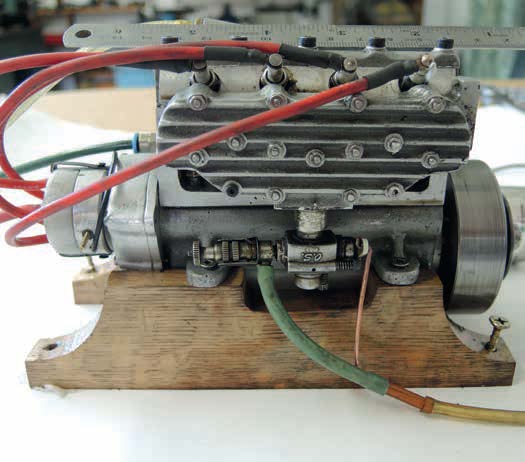
A 12cc overhead-valve marine engine built without castings 


A 12cc overhead-valve marine engine built without castings

DIY spark plugs

You can still purchase mini spark plugs from
overseas but being able to make your own
means you can vary the thread depth to suit
your own designs and you are saving in the
vicinity of $40 each.

The basic material components of a spark
plug are as follows:
• a piece of scrap mild steel
• ¼ pint (118millitres) old engine oil
• Corian off cuts (sourced from a kitchen
manufacturer)
• small piece of brass
• 1 mm tungsten welding electrodes

Method
First I machine the mild steel scrap to take
¼ inch (6.35 mm) x 32 model thread. I
transfer it to the mill and machine the blank
to take a 5
16 inch (7.94 mm) hexagon.
Reverse the piece on the lathe and mill a
4.8 mm blank hole for the insulator.
Reverse the body again and mill the end to
form an electrode.
When this is completed heat the body in a
gas flame to a blue colour and then quench
in old engine oil. The old oil produces a
black lustre on the surface finish.
Take a piece of Corian and cut it into suitably
sized lengths. Machine it into a round tube
4.8 mm diameter and drill a 1 mm hole the
full length to take the electrode.
A small brass cap is placed on top of the
electrode and welded so the ignition wire
can be attached.
Once all components are thoroughly
cleaned the electrode can be glued into
the insulator with superglue. Fit
a suitably sized gauge between
the two electrodes temporarily
and glue the insulator
into the body leaving the
required spark plug gap.

The beginning of making the outer body—a piece of old mild steel was machined to the diameters to take ¼ inch (6.35 mm) thread and a hexagon.
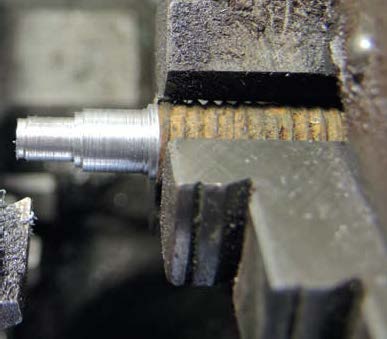
 

The beginning of making the outer body—a piece of old mild steel was machined to the diameters to take ¼ inch (6.35 mm) thread and a hexagon.

The finished diameters ready for threading


The finished diameters ready for threading

The completed body ready to be screwed into a mandrel in the milling machine


The completed body ready to be screwed into a mandrel in the milling machine

The hexagon being milled in the dividing head on the mill
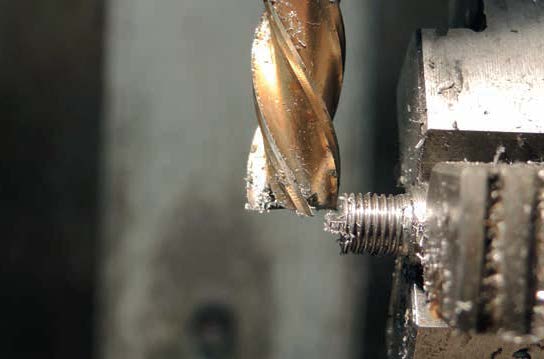
 

The hexagon being milled in the dividing head on the mill

The electrode being milled to the required width


The electrode being milled to the required width

The components partially assembled. The metal bodies were heated with a gas flame until blue and dunked in old oil producing a black lustre
 

The components partially assembled. The metal bodies were heated with a gas flame until blue and dunked in old oil producing a black lustre

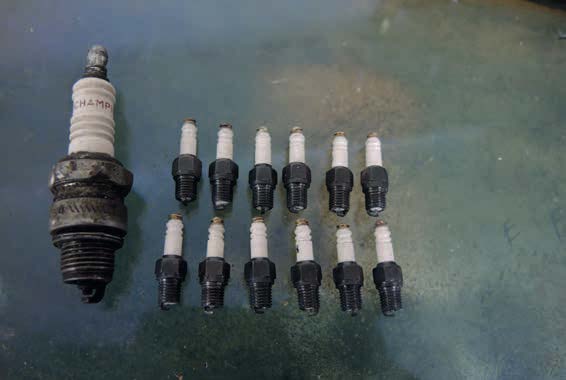
The completed plugs alongside a short-reach champion spark plug

 

The completed plugs alongside a short-reach champion spark plug

Share:

More Posts

Revving up Island-style

As you can imagine, on Great Barrier Island, the population is likely to have more than its share of characters, given the island’s remote location. Part of the charm is its lack of power supply and absence of a supermarket. If something breaks, there’s not likely to be a spare part sitting on a shelf anywhere on the Island, so if you don’t want to wait or to pay hefty freight charges on top of the cost of the part, you make one or use real no. 8 wire ingenuity. Even though it is New Zealand’s fourth largest island (after the North, South and Stewart Islands) and is only a half-hour flight from Auckland, it’s like a different world, and that’s why the locals love it.

The Shed magazine June/July 2026 issue 127 on sale now

Murray Belfield is a phenomenon
He has built a few planes over the years, but none gave Murray the performance and thrills he really wanted until he built his scaled-down German paratrooper’s plane, a Storch. Building this rarest of planes consumed nine years of this 86-year-old’s life. And the result? He couldn’t be happier.
For most of us, stalking a deer across the back country, shooting it cleanly and lugging it home to furnish the table would be accomplishment enough for any evening’s bragging rights.
But when that involves landing an aeroplane you built in your shed onto a handkerchief-sized patch of hilltop scrub, finding and shooting the quarry, manoeuvring the carcase into the spare seat and getting off the ground again, and doing all that at the age of 86, bragging just vanishes in the slipstream. Murray Belfield is, anyway, far too practical and busy a guy to waste his evenings boasting to his mates, but he is, nevertheless, a phenomenon. His plane, the second he has built by hand, is another. Highly specialised for short take-offs and landings (STOL), it is a three-quarters-scale replica of a WWII flying legend, the Fieseler Storch.
The replica, designed by famed aircraft engineer Ladislao Pazmany, is so challenging to build that, to Murray’s knowledge, only one other Pazmany model has been completed to the flying stage, by an enthusiast in Alaska. As if that wasn’t a hard enough ask, Murray has incorporated many improvements of his own based on his many years of bush flying experience (and his dislike of fibreglass).

In the dining room shed

Jane Allnatt’s father was a commercial artist, a painter, model-maker and did a bit of carving, so there’s something of the family tradition in what Jane Allnatt is doing in working with wood. But it’s unlikely her father imagined her designs and creations coming out of a shed in the dining room.
Working on a sheet on the floor of a room in her house is the Howick resident’s “workshop” and preferred way of creating work. Yet that work has regularly taken prizes in various categories at the annual National Woodskills Festival at Kawerau, a central gathering place of woodturners and sheddies.
It is also unlikely you would find many men praising the convenience of their working space because, as the sculptor puts it, “the room is centrally placed and I can disappear to cook dinner or if there is any washing, I can do that. The light is good, too.”