
Create your own parrot-beaked pliers

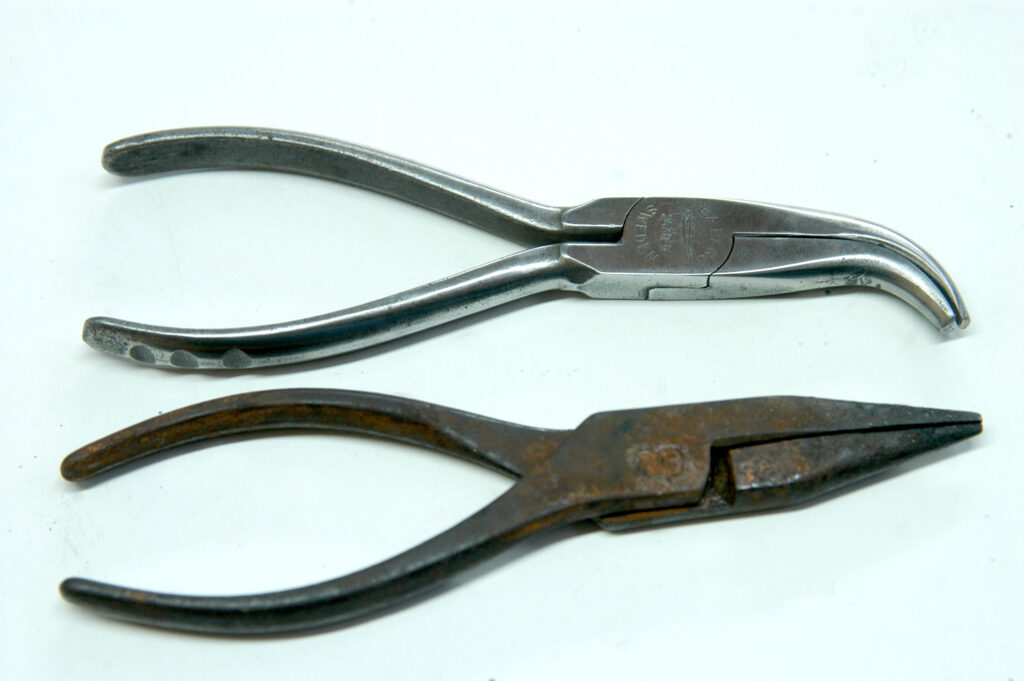
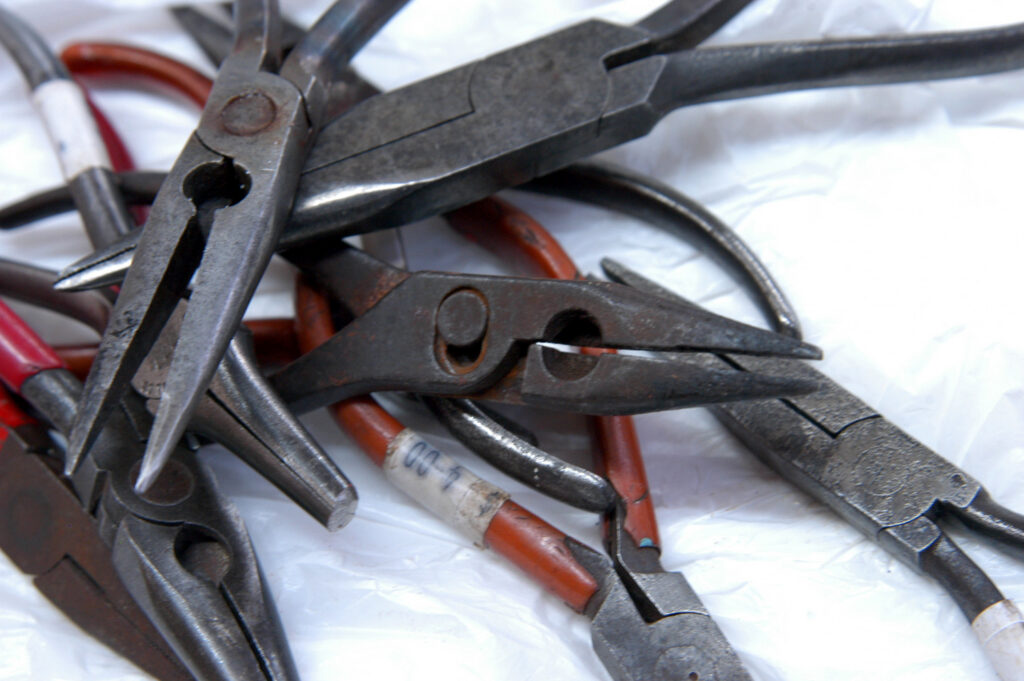
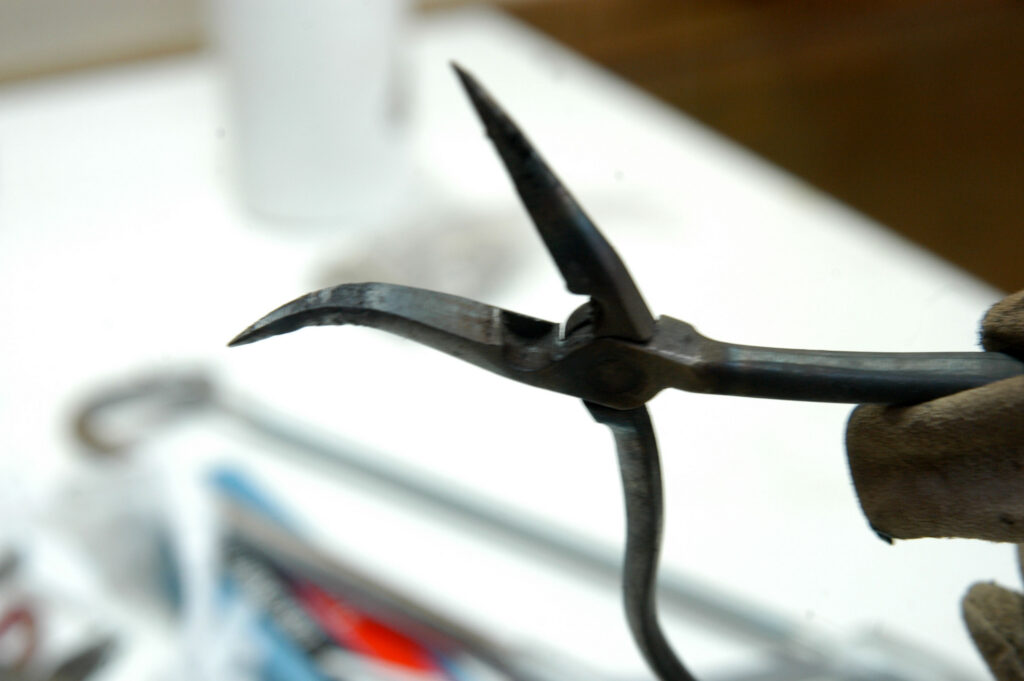
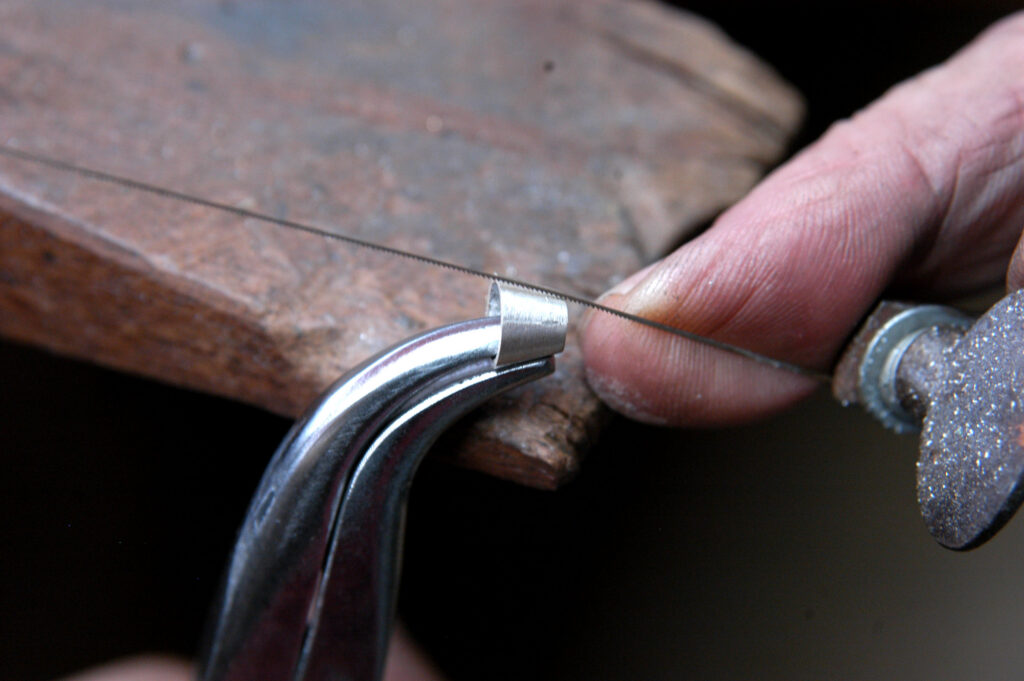
A specialist tool we made in that Hatton Garden workshop where I served my time was parrot-beaked pliers. These are used by the ring-maker for hand-made gem settings. They present the setting in a ring at just the right angle so the jeweller can pierce and file the design of the setting. The best pliers for this are a pair of heavy, flat-pointed pliers, known in the trade as snipe pliers. Good jeweller’s pliers can cost up to $50, so I save my students money by most often using second-hand electrician’s snipe pliers. You can pick these up at any market for used tools and they do just as well. I am still using the pair I made during my apprenticeship 50 years ago.

Curved jaws make this handy jeweller’s tool
By Peter Minturn
Photographs: Gerald Shacklock 

Polished parrot beak pliers

A specialist tool we made in that Hatton Garden workshop where I served my time was parrot-beaked pliers. These are used by the ring-maker for hand-made gem settings. They present the setting in a ring at just the right angle so the jeweller can pierce and file the design of the setting.
The best pliers for this are a pair of heavy, flat-pointed pliers, known in the trade as snipe pliers. Good jeweller’s pliers can cost up to $50, so I save my students money by most often using second-hand electrician’s snipe pliers. You can pick these up at any market for used tools and they do just as well. I am still using the pair I made during my apprenticeship 50 years ago.

Second-hand pliers are the source
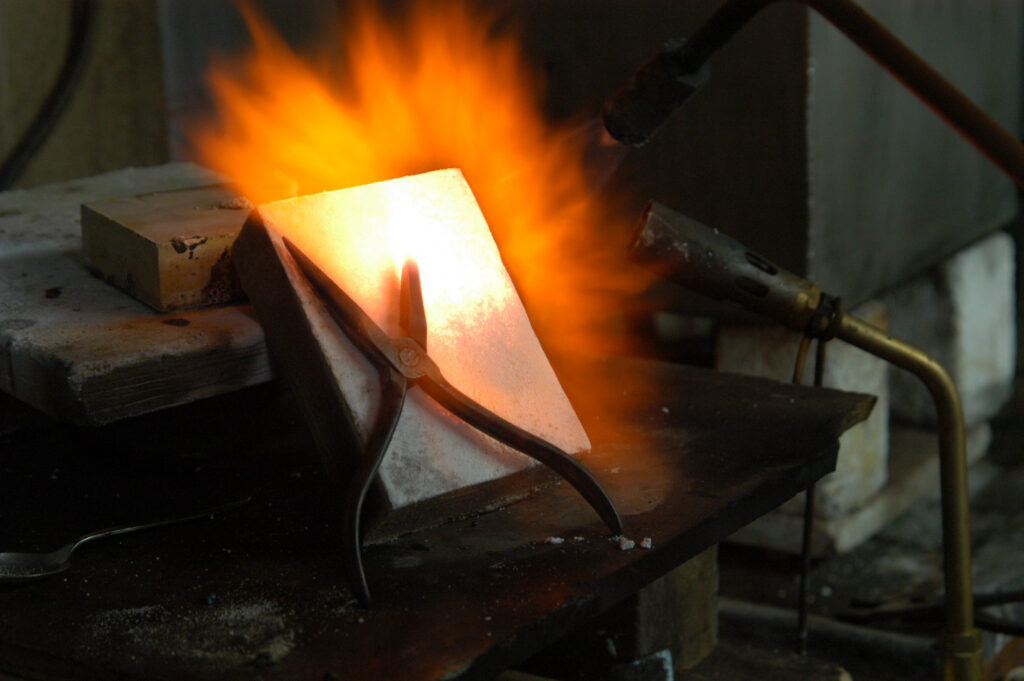
Heat one arm of the pliers

Bending the jaws
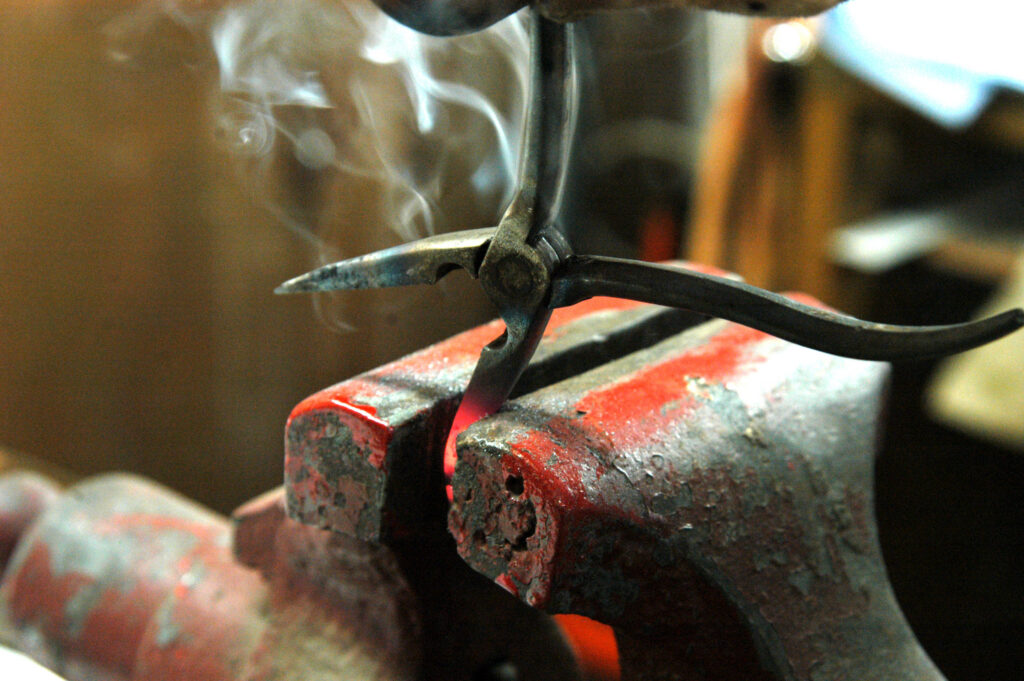
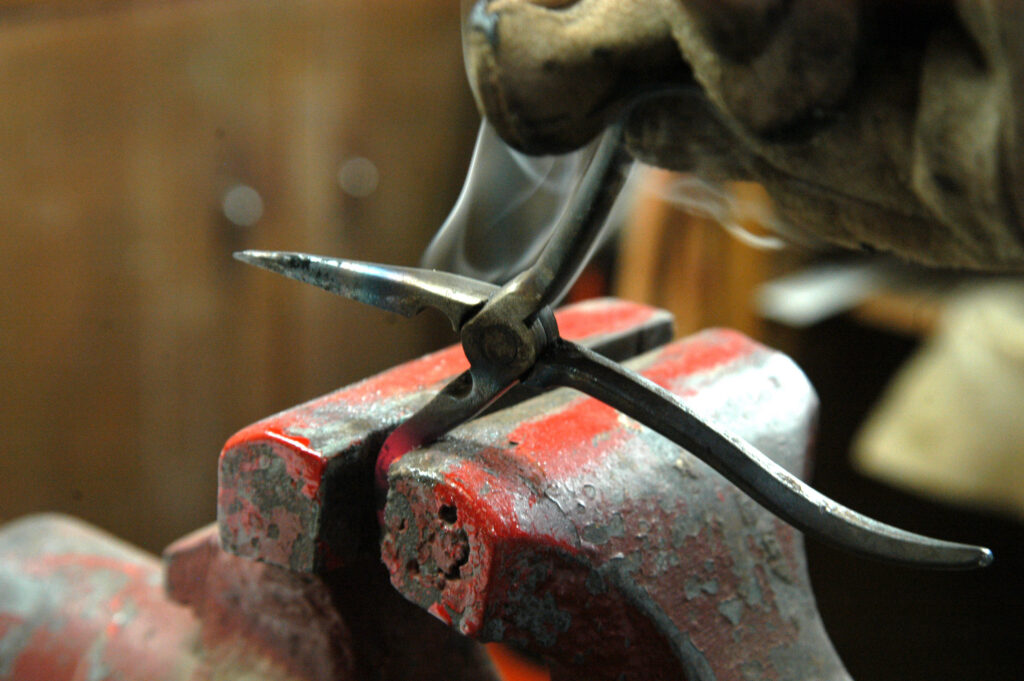
The first part of our conversion job is to bend the jaws of the pliers into the angle we require. Using my hydrogen and oxygen blow torch, I bring up one of the jaws of the pliers to red heat and then bend the jaw in my vice to about a 45° angle. Then I heat the other jaw and bend that to conform to the first one.
This might need a bit of persuasion with the vice and a hammer, as well as a bit of muscle power. Be sure to wear gloves, and you will probably have to use another set of pliers to grip with. The metal of the pliers you are working on gets hot throughout.

Bend jaw in vice
Grind half-groove in the jaw

Groove
When the pliers are cool, I then grind a half-round groove in the lower jaw and file the top jaw half-round so it will fit into the concave lower jaw. 
When this is done, I take the blowtorch to the pliers and heat the top jaw to red heat, and then hammer the two jaws together to produce a close fit. You may need a couple of goes at this to produce the right fit. It really only needs to sit snugly for the first 6-8mm or so of the jaws.

File round on jaw

Finishing
At this stage, the lower jaw will be much longer than the top. I usually take it to the bench grinder and remove the protruding metal, but it could just as easily be sawn off with a hacksaw. Then I smooth off the sharp edges on the jaws.
If I have used pliers with wire-cutter blades, I also grind away the sharp surface of the cutters. This done, I go back to the grindstone and shape the ends so they will fit into a smallish gem setting. Finally, I take the pliers to the sanding disk and make them look like a professional tool.

Holding ring setting at correct angle

Share:

More Posts

Making a die nut

A die nut is created with interrupted sections of thread around its internal diameter. Die nuts are simply screwed onto the threaded part. As they are wound down, they cut away any of the screw thread that is bruised (bent over) or out of line. A die nut cuts irregularities and scrapes off the dirt from the thread it is being used on so needs cutting edges, which are formed by the cut-away places.
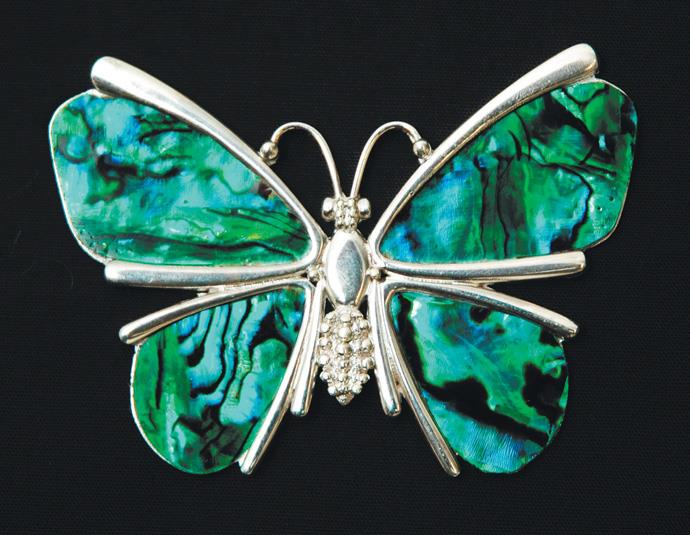
A silver butterfly takes wing

If this design was being made in an art school, it would be stuck to a sheet of silver and the basic shapes cut from there. If a design was made this way in, say, 18 carat gold and the wing outlines (as here) made from 2.5mm thick metal, the outlay and waste material would be considerable from a 2.5mm-thick sheet of 18 carat gold plate. But we will make it like a professional craftsman who has to live in the real world where costs matter.