Restoring a 1971 Johnson outboard motor

A couple of Shed readers start a rebuild project for the Shed Magazine

We got this email from a Shed reader who was sent a project from another Shed reader, the rebuild of a 1971 Johnson 25hp outboard motor.


The challenge, to rebuild this outboard from a box of bits

The idea being that this pile of bits would eventually become a backup motor for his fishing boat. So nice to see our readers are thinking of us. Here at The Shed we are already looking forward to the restored engine article.
Below is the note that came with the engine, the Sheddies names have been deleted. 
“As mentioned earlier, herewith the old Johnson outboard from dad’s shed. Make of it what you will or if you are not inclined or reckon it is not worth the effort or in the too hard basket or whatever, pass it onto someone who may be keen to give it a go, or, simply send it to the tip.
In any event, I reckon it could be a good article for The Shed magazine so if you or someone else wants to give it a go and give it a Lazarus type resurrection or rebirth, maybe take some photos for a Shed article as you go along.
Kind regards and cheers to all.”
Onya fellas.


Lets hope all the parts are here


Even the newspaper wrapping the parts is from the 1970s
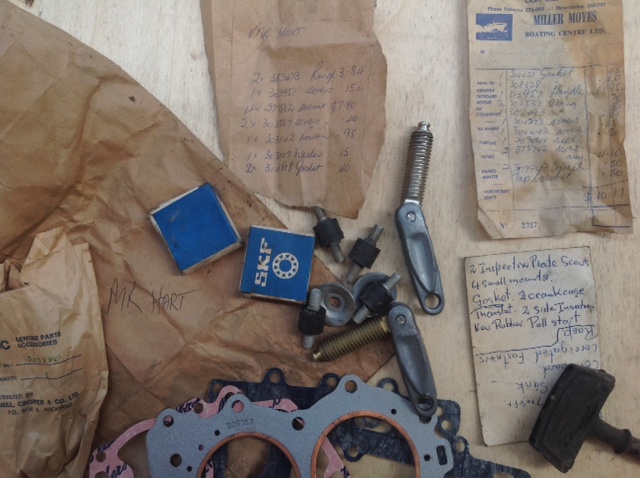


The jigsaw building begins

The jigsaw building begins

Share:

More Posts

All hands to the tanks

The call goes out. The volunteers pour into the military camp at Waiouru in the centre of the North Island. The only war, though, is going to be on rust, handbrake cables,
driveshafts, seized brake systems, the battered cylinders of tank engines and the ongoing tussle to turn out new truck engine parts.
Here is a group of willing sheddies who meet about once every six weeks under the keen oversight of George Pycraft. Their job: to continue repairing the heritage vehicles of the Army Museum at Waiouru.
Their “shed” is a group of four storage sheds housing 85 vehicles in various states of repair. They are as diverse as tanks, the 24-tonne M41 Walker Bulldog, the Centurion, and Valentine tanks (the latter still in World War II Pacific theatre camouflage), a 1941 Canadian Pattern Chevrolet gun tractor, an MB Jeep still wearing its 1942 Long Range Desert Group livery, an M113A1 Armoured Personnel Carrier (APC) painted in UN colours and of the type used in Bosnia, a 1943 Ford F30 truck, a 39-inch searchlight and an M816 recovery wrecker truck made by American Motor Corporation in 1969.
Pycraft, the museum’s Assistant Curator – Technology, says with the help and dedication of the museum’s volunteers they are slowly coming closer to having a complete running collection of heritage vehicles.

A weighty subject

One problem with working alone in the shed and having a liking for large pieces of Victorian cast iron is the difficulty of safely moving or lifting them.
They can be moved with load skates and pipes as rollers, but how do you lift the weight onto the rollers? Trying to push down on a crowbar while arranging pipe rollers under a machine is inviting trouble. A toe jack allows you to lift and hold the weight in the air as you arrange the rollers and put in safety blocks. It is not intended for great weights or high lifts due to stability, but it allows you to lift the weight.

From armour to fighter

An unassuming garage in the Hunua Ranges south of Auckland is the current shed of Gordon Turner and home to his latest project – a full-sized replica cockpit of a Messerschmitt Bf 109E fighter plane. Made from plywood, timber and aluminium and five years in the making so far, it will never take to the skies. But it is eventually intended to become a flight simulator, giving the ‘pilot’ a realistic experience of flying one of World War Two’s most famous aircraft.