
Simple bins

Many black plastic bins from the hardware shops don’t allow enough air through or are only big enough for postage stamp-sized sections or blocks of land. I make my own compost bins. Now that might seem fairly easy, but how many compost systems either take a huge amount of effort, or produce something reminiscent of milking-shed sludge? These bins require very little intervention besides putting stuff in.

Make your own simple compost bins
By David Todd
Photographs: David Todd
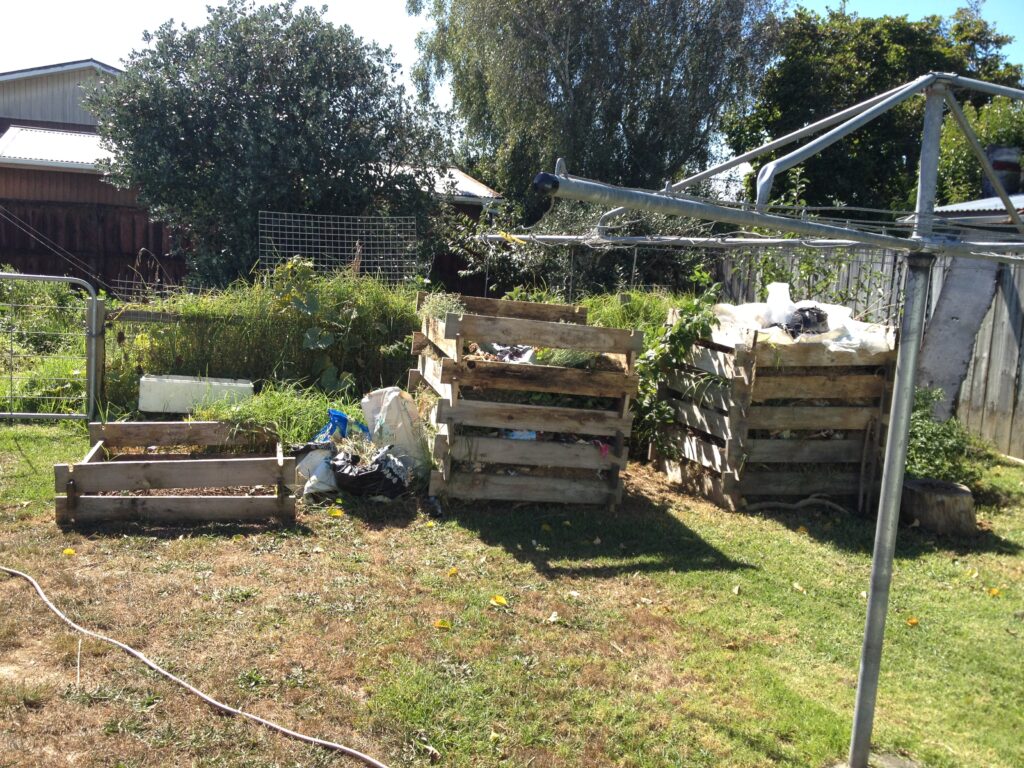
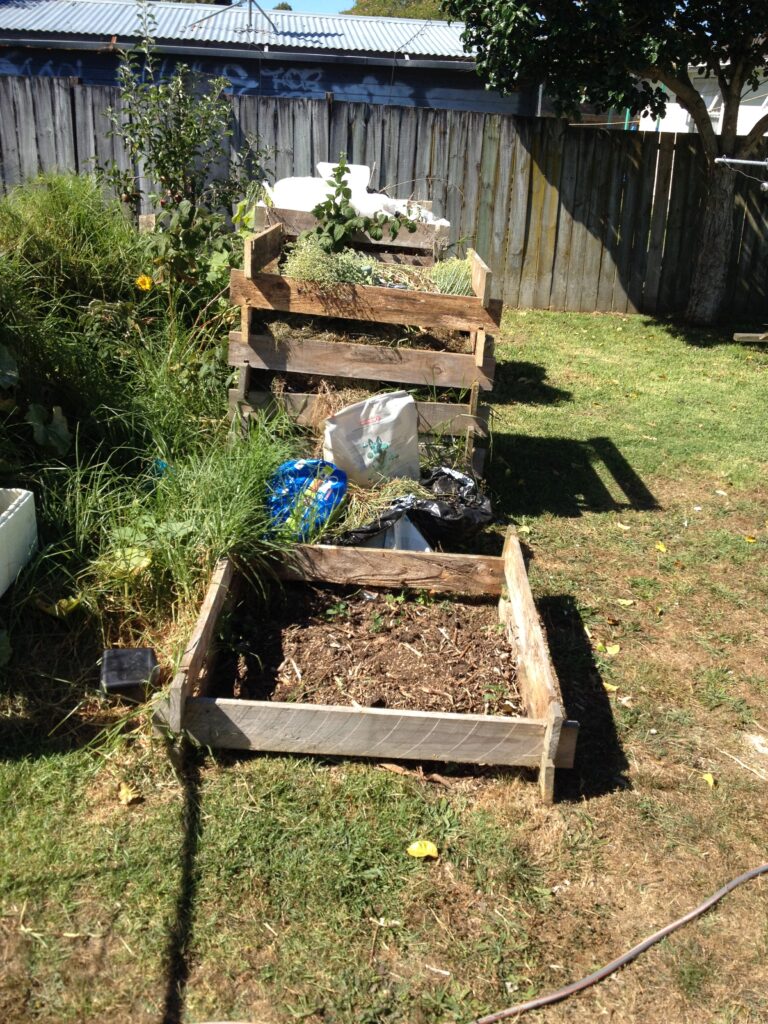
Some Shed magazine projects, while inspiring, are way out of the league of many of us. So, here is how I made my own simple  compost bins. 
I’ve spent summer holidays with technicians and riggers and electricians and fitters, but I’m just a home handyman. I’ve done a minor amount of renovations to previous houses and much of my own house maintenance. I like growing my own veggies. We were nearly self-sufficient in potatoes last year and are hoping to do better this year. Currently I’m self-employed in IT.
Good compost needs balanced grist for the mill:

  • green stuff (lawn clippings, kitchen food scraps and the like); and
  • brown stuff (untreated sawdust, leaves, shredded paper, cardboard packaging)

and air and water.

Many black plastic bins from the hardware shops don’t allow enough air through or are only big enough for postage-stamp-sized sections or blocks of land.
I make my own compost bins. Now that might seem fairly easy, but how many compost systems either take a huge amount of effort, or produce something reminiscent of milking-shed sludge? These bins require little intervention besides putting stuff in.
Materials
I used 4.8 metre lengths of 150 mm x 25 mm untreated pine (rough-sawn boxing). The reason for 4.8m lengths is that I cut them into four 1198mm lengths. That is, measure 1200 mm, and cut on the wrong side of the line. Do this three times, and on the fourth time,  measure for the actual length of 1200 mm with the saw kerf. It’s important to do this reasonably accurately.
For the notches, set the fence on your router with a 25 mm bit so there is about 65 mm from the end of the wood to the edge of the notch. Rout a notch that is around 37 mm deep.
I set the fence on the router as above. I set the combination saw for 37 mm, then clamp a length of wood to the sawhorse so that each end is clear of the end. Have the clamp so the handle is up (I prefer a G clamp to an F clamp as they clamp harder).
Cutting notches
On the left-hand end (matches the way I set the fence on the router), I mark a line indicating the depth of the notch on the far side of the wood. On the right-hand end, I do this on the near side.
I use the router by pulling it towards me. Then once one notch is cut, I can flip the sawhorse around and do one notch on the other end. Flip the wood over the sawhorse, mark for the other two notches and repeat.
Four lengths is the minimum, really. The actual notches don’t need to be done 100 per cent accurately, and the first ones I did (read: sloppy first attempts) worked best. The wood doesn’t have to nest together properly.
I’ve found the huge amount of air available, and the addition of brown stuff makes a nice light compost and not the usual sludge. It doesn’t require a huge amount of effort to turn (and aerate).

Share:

More Posts

The Shed magazine February/March 2026 issue 125 on sale now

Going solar
Solar power seems like a great idea; who doesn’t want free power, right? But, what to choose, and what are the pitfalls of solar?
Regular The Shed writer, Andrew Broxholme, has just completed a large solar installation on his property and shares all the good, the bad, and the ugly aspects of his solar power journey.
I’m environmentally aware, but am not an environmentalist, so I’ve gone solar for only one reason, because it makes good financial sense to do so, that said it isn’t necessarily going to be right for everyone and its impact on your power bills will depend on where you are in New Zealand and the orientation and design of your house relative to where the sun rises and sets.
I’ve been interested in renewables for many years. I first looked at it while living in the UK. The early systems had promise, but really didn’t make financial sense as the cost of installation and ongoing maintenance wasn’t offset by big enough reductions in power bills. They wouldn’t repay that investment during their service life, which at the time was 15–20 years (maximum).
That’s no longer true, with higher volume, the equipment has got a lot cheaper, it is more efficient, but we have also seen huge increases in energy costs; this, in particular, changes the economics dramatically. That doesn’t, however, mean that you can buy the first solar system presented or recommended to you. Read on to find out why.

The ultimate man cave

It’s tempting to think of Gregor Kregar’s work space as the ultimate humongous man cave. The 410-square-metre studio in a gritty industrial area of Auckland’s New Lynn certainly has all the “boy’s toys” to make the most avid sheddie happy.
Vises, grinders, table saw and cut-off saw? Check. MIG and TIG welders and drill press? Check. Two electric and a gas-fired kiln? Check. You get the picture. This is a serious space set up to work on all manner of materials.

Video of Geraldine Military Museum military revival

Two years ago, Don Pelvin set up the Military Museum in Geraldine as a retirement project.
He is pretty happy with how things are going, with an average of a thousand visitors a month, especially as his museum is one of six in the small South Canterbury town. He also organises the Rangitata Island Military Revival on the Saturday and Sunday of Labour weekend every year.
This is a combination of a display of military vehicles and gear, and reenactments of actions from WWI and WWII, and it all takes place at the Rangitata aerodrome, an airfield owned by a local farmer. About 50 reenactors turned up in their historically correct uniforms with their suitable weapons, after word had spread in the tight-knit military history world that the event was happening.