Keep on rolling
Growing up near a railway station sparked Greville Wills’ lifelong love for trains. Throughout his working career, he has experienced a diverse range of jobs. Today, he identifies as an old-school tinkerer, a model engineering enthusiast, and a “Mr. Fix-it.”
Space is definitely at a premium in Greville Wills’ garage workshop. On first look, the visual jumble of tools, projects, ornaments, neons, and former business equipment is confounding. Yet despite the wriggle room between the maze of workstations, there is an underlying order.
Greville is an old-school tinkerer, model engineering enthusiast, and a Mr. Fix-It to his neighbours. He always knew the space here was going to be tight, so before he moved in, he pre-measured and drew a plan for everything from machine placement to car park spaces, factoring in ergonomics and power supply locations to make certain everything would fit and work efficiently.
He is adamant that the layout suits his needs and says, “When I’m making things, everything is here. It is a single person’s workshop, where I can do most things. If assembling or constructing something of size, I just push the cars out to use that space temporarily.”
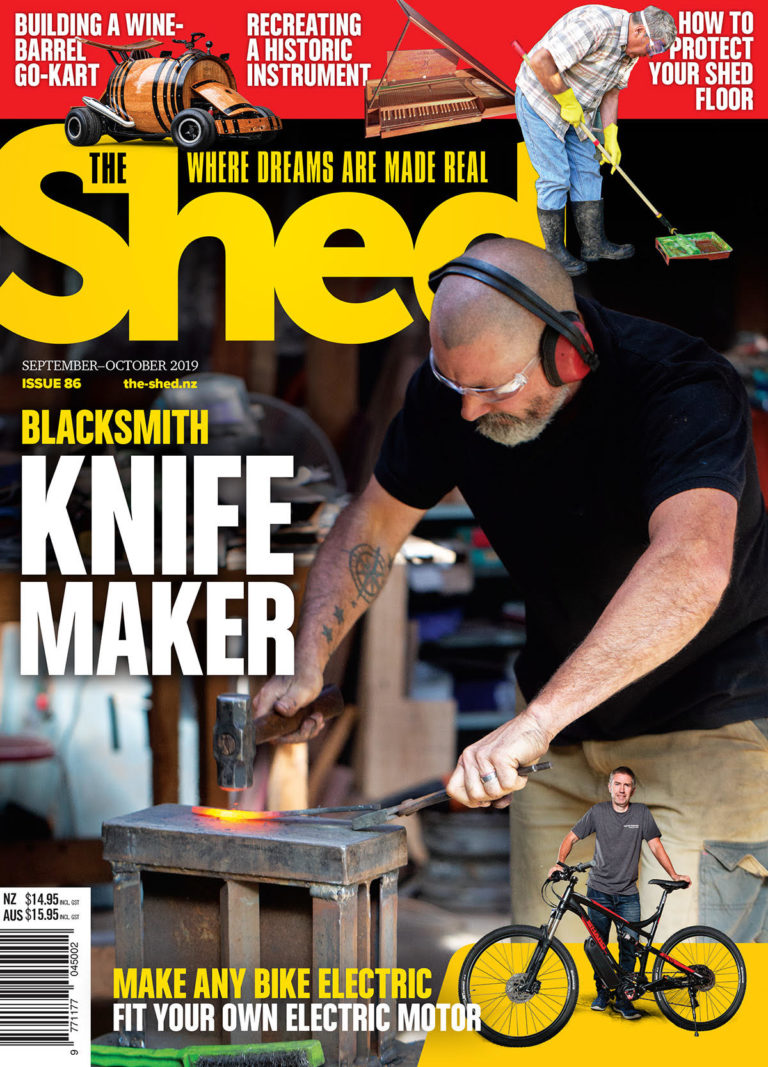
To purchase a copy of this magazine, head here to our online store.


Using sewage to heat Parakiore Sports Centre
Clever technology brings huge annual savings on power bills for this brand-new sports complex.
Swimming pools used in Olympic competition should have a temperature of around 27 °C. Achieving and maintaining this can require some sophisticated engineering.
The water which emerges from Christchurch taps comes from deep aquifers and is warmed by geothermal heat, so it has a temperature of about 10 °C year-round. A huge amount of heat is required to increase the water temperature in an Olympic-sized pool by 17 degrees. Possible sources of this heat are the traditional fossil fuels (natural gas, coal and petroleum) or electricity. These are costly and likely to get more so. Biogas or wood would be more environmentally acceptable, but again, expensive.

Turning black and blue – how to achieve a black oxide finish
Putting a durable finish on steel components is usually the last step in a project, but it is one which needs to be thought out at the beginning.
The thickness of the coating may have to be allowed for when machining, holes may have to be incorporated to hang the part from during a finishing process, etc. The particular process we are looking at in this article does not effectively alter the dimensions of the part as it etches into the surface rather than deposits on top.
Black oxide finish is sometimes called parkerizing, and it is common on components such as gun barrels because it does not involve high enough temperatures to cause distortion, and there is no dimensional change.
While strictly speaking not an anticorrosion coating on its own, it does perform well due to its microscopic porosity. The final step in the black oxide process is to wipe the part liberally with oil, which soaks into those pores and tends to stay there even after the excess is wiped off. Just don’t put it in the dishwasher!

Tool making: Wooden tool handles
A small local business supplies wooden handles and more for various tools and has done so for over 80 years. Expert knowledge and skills that the global move to shopping has not deterred this company from growing and being a real asset to Kiwi sheddies.
The company is called ‘Leech Timber Products’ and specialises in woodturning and can exactly reproduce historic features for older wooden villas.
The firm was started by Phillip Leech at its present site, about 50km south of Christchurch, in 1952. The building originally housed a joinery shop making windows, doors and kitchens for Phillip’s house building business, but when one of the regular, seemingly inevitable, downturns in the building industry occurred, Phillip branched out into making tool handles and bar stools on his hobby lathe.

Restoring a 1952 AJS Part 5 – the electricals, seat, and tank refurbishments
Peter realises that he needs to cultivate more patience and humility, as he is facing stubborn electrical issues that are difficult to resolve. Additionally, it seems he will need to extend his restoration timeframe, since most tasks are taking longer to complete than he initially anticipated.
In my last article, part four of the series, I described my efforts to rebuild the bike’s dynamo (generator) by reconstructing the disintegrated commutator, rewinding the armature, replacing the bearings and then testing. Sadly, with no success.
I have achieved a little bit of progress with fixing the fuel tank and the seat, but I have not really met any targets. When I started this series, I expected that by this article, part 5, I would be writing about fixing the famous ‘Jampot’ and ‘Teledraulic’ suspensions, and at the end of part 6, I would have re-laced the wheels, having nickel-plated the spokes, rims and hubs ready for a trial ride.

The Skate Banana
As a youngster, Chris Gordon pinched his sister’s roller skates to create a skateboard, igniting a lifelong passion for boards on wheels. Now in his 60s, nothing has changed for the ever-busy sheddie, Chris Gordon.
The year 2024 finished with mixed emotions. I had just completed one of my favourite builds: Big Finks 498cc V8-powered Sidewalk Surfer skateboard, a homage to Ed Roth’s 1960s Kustom Kulture.
However, issues at work cast a dampener on the festive season. Ongoing inclement weather during late December and January didn’t help. What better way to release me from my end-of-year malaise than a trip to the Christchurch City Council’s ECO Shop.

From idea to reality – part 2
Once Bob has completed the 3D digital model of a visor for a digital SLR camera using Alibre Atom 3D software, he now needs to create it using a 3D printer. Dilemma: Should he purchase a printer or use a local 3D printing service?
In the last issue, The Shed 121, we created a 3D digital model of a visor for a digital SLR camera using Alibre Atom 3D software.
The design was done with 3D Printing in mind as a cost-effective way of manufacturing for making just one visor. The process of turning this imagined part into reality is remarkably simple due to how easily 3D printing programs and 3D CAD programs talk with each other.

Arduino 102 – Libraries
It’s time to learn about libraries. A library is a collection of code that provides specific functions or a method for communicating with particular hardware. In this latest instalment in our series, our Arduino guru will explain why we use libraries and highlight some potential pitfalls to be aware of.
In the last few issues, we’ve covered a range of subjects, including ‘Errors’ in the previous issue. During these articles, we’ve used added code called ‘Libraries’, so it’s time to explain why we use them and some of the pitfalls.
Arduino has the big advantage of being Open Source, which is where a manufacturer or supplier doesn’t have control, and the public can freely use and contribute to the software. That’s not to say manufacturers don’t contribute, but they share their offerings for all to use without a license or restriction (apart from the credit). The size of the Arduino ecosystem proves that ‘Open Source’ works.

Off the grid: The pleasure of pressing parts
Here comes the Hurdy Gurdy man, and it’s not Donovan. Murray shares his new passion for making models by pressing parts together and commences with that mysterious instrument, the Hurdy Gurdy.
It all started when I went to a Donovan concert somewhere around 1972, and came away with his ‘Hurdy Gurdy’ song as an earworm. After a slight delay – 50 years, give or take – it occurred to me to find out what a Hurdy Gurdy was. That led to getting onto YouTube, eventually coming across ‘Hurdy Gurdy Reverse Dance’ (check it out for yourself!) and getting gobsmacked, haunted, stunned. And immediately wanted to build one, as you do.

Building the dream shed – part two
Our hero continues his odyssey, erecting a temple to craft his dream projects.
After a slow start due to the weather, I had the pad done and the portals erected. The frame was up, and the purlins were all screwed down. There was also a cross brace from a galvanised steel strip to put in place on two roof bays. I had to fix strips to every second purlin as fly-bracing on the roof. Fly-bracing was also called for on the walls attached to the girts, but I reasoned that since I was cladding the interior, it would be unnecessary.

The Shed Quiz No. 4
You’ve got a shed, and you know how to use it – but do you really understand how everything works? Test your sheddie knowledge here.

The Roger Mahan Heritage Centre
Roger Mahan was an earthmoving contractor who considered any job involving rock between Bluff and Cape Reinga as his domain. Concerned about historically significant tractors being sold overseas, he decided to gift his extensive collection of cars, tractors and earth-moving equipment.
In 2020, the Roger Mahan Heritage Centre on State Highway 79, on the northern side of the town, opened. It is owned by the New Zealand Cultural Heritage Charitable Trust and is run by a five-member management board chaired by Peter Lyttle.
The Trust was set up in 2003 by Roger Mahan after he became concerned about historically important tractors being sold overseas; its purpose is to preserve vehicles of historic significance in New Zealand. The Trust eventually purchased nine hectares of land to the north of Geraldine and had Thompson Construction and Engineering of Timaru build a 5600 m2 industrial building there. Roger gifted his very considerable collection of earthmoving machinery, antique automobiles and other items of interest – “He was interested in many things”, Peter Lyttle tells me – to the trust, where they make up a significant portion of the large number of items on display at the Roger Mahan Heritage Centre.


The Shed shrink: A creative soul with a master plan
Our Shed Shrink draws inspiration from a dedicated painter and decorator who spends his days in a nine-to-five routine, then transforms city walls into vibrant canvases as a street artist during his spare time.
Every bus trip into town now reveals generous tributes to our national heroes of the past, with a new contemporary vibrancy. Iconic renditions of Christchurch’s John Britten and Sir Ed, and many, many more. The sheer scale of these masterpieces is quite remarkable, especially how lifelike they are. Not knowing the community of artists involved in this rebirth of Christchurch, I was stoked when I was introduced to Sholto, who had some connections with this world.
I was intrigued and a little apprehensive, to be honest, these artists are a kind of cool bunch, sort of aloof and mysterious.
Our first introduction helped due to our mutual appreciation for Mooneyes, Vans shoes, old Ironhead Choppers and all things relating to lowbrow art. This rendered our difference in age no barrier. So, I got an opportunity to visit his shed and have a yarn about his craft.

Project: Build a useful trolley
A neat and tidy shed is just one of the reasons for this recycling project. The environment and local council fees were also a factor. Necessity… they say.
When we moved out to our lifestyle property, 12km out of town and a kilometre down an unsealed road, there were a couple of impediments to continuing our recycling efforts.
Firstly, the council would not travel down our road. If we wanted our bins emptied, they had to be taken to the highway end of the road each week. In addition, at the time, there was a monthly charge of around $70 for even that limited service. So we decided to see if we could simply collect up the recyclable material and take it into town and drop it off free at the waste transfer station. They charged at the time $4 for a bag of general waste (now increased to $5.50).

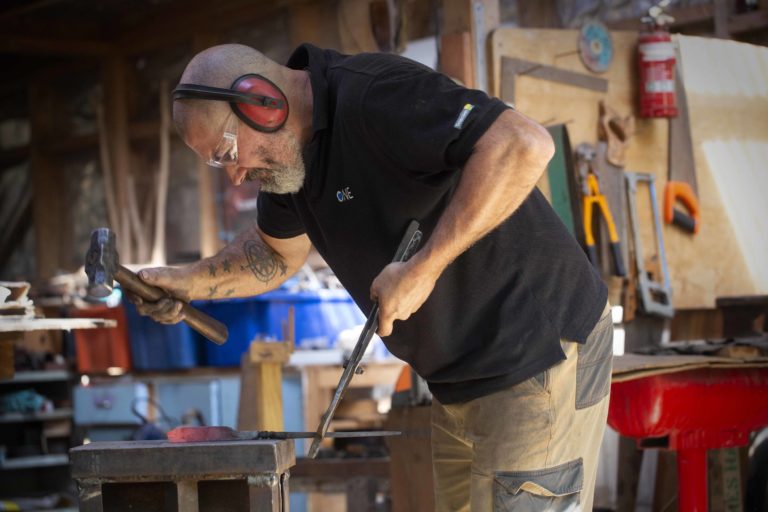
Blacksmithing: A blacksmith and his shining armour (part 1)
Leon Deverick’s journey from circus performer to blacksmith has been both eventful and adventurous. His enduring passion for armoury has ultimately guided him to his current profession as an armourer, a role he has embraced for the past ten years.
Inside a large red brick warehouse on Head’s Road, Whanganui, sparks fly and metal clangs as armourer Leon Deverick plies his trade. Metal coverings for body parts hang from the walls – there’s an arm and shoulder, thigh and calf armours, and a pair of gauntlets lie on the workbench.
Three large tree stumps are placed within easy reach of a small forge; the walls lined with a selection of rather esoteric-looking tools.
Leon, 35, makes armour for medieval re-enactors and Buhurt, full-contact medieval fighting sport fighters. He also makes a range of other items such as letter box numbers, trivets, leather water bottles, belts, creatively shaped wooden pipes and anything else he or his customers want him to make with his eclectic set of skills.
Leon’s smithy uses a tiny portion of the heritage-listed former woolshed, built 1918-1919, so he has plenty of room among the “dusty old warehouse vibes” in which to display his wares, see clients, give metal work and armoury lessons and lease space to craftspeople and other artists.

Back O The Shed: The power and the glory
The independent power retailer Flick has been gobbled up by one of the mega electricity gentailers. Jude wonders what now for our country, its consumers and our energy needs.
Our dysfunctional electricity industry has resurfaced to torment me again.
Flick Electric has been sold to Meridian. A monopolistic company swallowing its competitor, yet again.
I am a customer of Flick. This means my power bills will increase, and I will no longer get a reasonable price for the power I generate. It is probably not a coincidence that at the same time as Meridian swallowed Flick, Genesis reabsorbed its version of Flick, Frank. They felt they no longer had to compete.